Primary & Middle School Mathematics · Grades 1–9
59Midpoints and Parallels
Join the midpoints of two sides of a triangle: the segment you get is always parallel to the third side, and exactly half as long. This “midpoint theorem” and its converse are the first taste of a great idea — parallels cut lengths proportionally — which blossoms into Thales’ theorem in Chapter 68.
59.1 The midpoint theorem
Theorem 59.1 (Midpoint theorem)
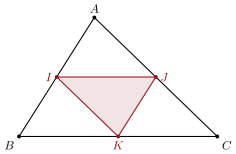
In a triangle , let be the midpoint of and the midpoint of . Then the line is parallel to , and
Idea of proof. Let be the symmetric of about (a half-turn, Chapter 52). The quadrilateral has diagonals and crossing at their common midpoint : it is a parallelogram, so is parallel to , i.e. to , and . Then has two opposite sides ( and ) parallel and equal: it is a parallelogram too (Theorem 52.9), so — that is — and . ∎
![The midpoint segment [IJ] (red) is parallel to the third side (BC) and half as long.](/images/onecourse/chapters/math-1/g8-midpoints/fig-c5593cfefe80.svg)
Example 59.2
In a triangle with cm, the midpoints of and of are joined. Without any measurement: and cm. The small triangle is a half-size copy of — its perimeter is half the perimeter of as well.
Theorem 59.3 (Converse)
In a triangle , the line through the midpoint of and parallel to crosses the side at its midpoint.
Proof. Admitted at this level. ∎
Example 59.4
A path crosses a triangular field, starting at the middle of one edge and running parallel to the opposite edge. The converse guarantees that the path exits exactly at the middle of the other edge — no measuring needed on the far side.
Method 59.5 (Choosing between theorem and converse)
- Two midpoints known use the direct theorem: conclude parallelism and half-length.
- One midpoint and a parallel known use the converse: conclude that the crossing point is a midpoint.
- Write which triangle, which midpoints and which theorem you use — one sentence each.
59.2 Half-size triangles
Proposition 59.6 (The midpoint triangle)
Joining the three midpoints of the sides of a triangle cuts it into four triangles of equal areas, each a half-size copy of the original.
Proof. Each side of the midpoint triangle is parallel to a side of and half as long (Theorem 59.1, applied three times). The four small triangles have sides of the same three lengths, so they are identical copies; together they tile , so each has a quarter of its area. ∎
Remark 59.7 (Towards Thales)
The midpoint theorem is the case “one half” of a more general fact: a line parallel to one side of a triangle cuts the two other sides in equal ratios — one third and one third, two fifths and two fifths … That general statement is Thales’ theorem (Chapter 68); the midpoint case is the only one needed this year.
59.3 Exercises
Exercise 59.1 ★
In a triangle , is the midpoint of and the midpoint of , with cm. What can be said of the line and the length ? Cite the theorem used.
Solution
Solution of Exercise 59.1.
and are the midpoints of two sides of the triangle : by the midpoint theorem (Theorem 59.1), and cm.
Exercise 59.2 ★
In a triangle , is the midpoint of and the line through parallel to cuts at , with cm. Compute , citing the theorem used.
Solution
Solution of Exercise 59.2.
is a midpoint and : by the converse (Theorem 59.3), is the midpoint of , so cm.
Exercise 59.3 ★
Draw a triangle with cm, cm, cm, place the midpoints of and of , and measure to check the theorem. Compute the perimeter of without measuring anything else.
Exercise 59.4 ★
is the midpoint triangle of , whose sides measure , and cm. Give the three sides of and its perimeter. How do the two perimeters compare?
Exercise 59.5 ★
The area of a triangle is cm. What is the area of its midpoint triangle? Of each of the four small triangles?
Solution
Solution of Exercise 59.5.
The midpoint triangle is one of the four equal triangles of Proposition 59.6: area cm — and each of the four small triangles has area cm.
Exercise 59.6 ★★
In a triangle , is the midpoint of , that of and that of . Show that is a parallelogram. (Compare and : parallel? equal?)
Solution
Solution of Exercise 59.6.
By the midpoint theorem in : , i.e. , and (as is the midpoint of ). Two opposite sides of are parallel and equal: it is a parallelogram (Theorem 52.9, criterion 3).
Exercise 59.7 ★★
A triangular sail has its lowest edge m long. A reinforcement seam joins the midpoints of the two other edges. What length of seam is needed? What if the seam instead joins the points located at one quarter of each edge, starting from the top vertex? (Conjecture with a drawing; the proof is Thales’, Chapter 68.)
Solution
Solution of Exercise 59.7.
The seam joins two midpoints: m. At one quarter from the top vertex, the drawing suggests a seam of m, parallel to the base — confirmed by Thales in Chapter 68.
Exercise 59.8 ★★
In triangle , right-angled at , is the midpoint of the hypotenuse , and the parallel to through meets at .
- Show that is the midpoint of .
- Explain why is perpendicular to .
Solution
Solution of Exercise 59.8.
1. is the midpoint of and : by the converse of the midpoint theorem (in the triangle , side ), is the midpoint of .
2. and (right angle at ): a line parallel to is also perpendicular to (Proposition 40.3). So — the segment is the perpendicular bisector piece showing again that (Theorem 60.1).
Exercise 59.9 ★★★
Let be any quadrilateral, and , , , the midpoints of , , , (the conjecture of Exercise 52.11).
- Apply the midpoint theorem in the triangle to the segment , and in the triangle to the segment : compare each to the diagonal .
- Conclude that is always a parallelogram.
Solution
Solution of Exercise 59.9.
1. In triangle , and are midpoints of and : and . In triangle , and are midpoints of and : and .
2. So and are parallel (both parallel to the diagonal ) and equal (both half of ): is a parallelogram (Theorem 52.9, criterion 3) — for every quadrilateral , as conjectured in Exercise 52.11.
59.4 Problem: The three medians and the center of gravity
Problem 59.1
Weekend problem — the medians of a triangle meet at a single point, two thirds of the way down each of them
Cut a triangle out of stiff cardboard and it will balance, perfectly flat, on a pencil tip placed at one special point: the center of gravity of the triangle. This problem finds that point. A median of a triangle is the segment joining a vertex to the midpoint of the opposite side. You will prove — with the midpoint theorem used twice, in an unexpected way — that the three medians all pass through one point, and locate it precisely.
Part I — Warm-up.
- Draw a large triangle (no special shape), construct the midpoints of , of and of , and draw the three medians , , . What do you observe?
- Prove that a median cuts the triangle into two triangles of equal areas. (Compare bases and heights, and use the area formula: base height .) For a triangle of area cm, what are the two pieces’ areas?
- In the triangle , what does Theorem 59.1 say about the segment ?
Part II — Two medians meet two thirds of the way. The medians and cross at a point; call it . Let be the midpoint of and the midpoint of .
- Apply the midpoint theorem in the triangle : what does it say about the segment ?
- Deduce that and , and conclude with Theorem 52.9 that is a parallelogram.
- Explain why and both lie on the median , and and both on the median — so the diagonals of the parallelogram are and , and they cross exactly at . What does the definition of a parallelogram then say about ?
Deduce that , and conclude:
— the point sits on the median at two thirds of the way from the vertex . State and justify the analogous result on the median .
- Now forget and run the very same argument on the pair of medians and : their crossing point also sits at two thirds of from . Explain why this forces it to be the same point — and conclude that all three medians pass through .
- In a triangle where the median measures cm, how far is from , and from ?
- Justify (one sentence) that as well.
Part III — Six equal slices, and coordinates. The three medians cut the triangle into six small triangles around .
- In the triangle , the segment is a median. Deduce that the two small triangles and have equal areas.
- Using question 2 in the triangles and (both cut by the median of ), show that the triangles and have equal areas. Repeating with another median, conclude that the three triangles , , all have area one third of .
- Each of these three triangles is cut in half by a piece of median (for instance is a median of the triangle — seen from which vertex?). Conclude: the six small slices around all have the same area, one sixth of the triangle.
On a coordinate grid, plot , and , with the midpoint of . Use the two-thirds theorem of Part II to compute the coordinates of on the median ; then check that the same point sits at two thirds of the median , where . Compare ’s coordinates with the averages
- The balance finale: using questions 2 and 8, explain why the cardboard triangle balances on a knife edge laid along any median — equal amounts of cardboard on each side — and why the pencil tip must therefore be placed at , the point the physicists call the center of gravity. (A fully rigorous balance proof needs the integral calculus of the university volumes; the equal areas make it believable today.)
Solution
Solution of Problem 59.1.
1. Whatever triangle is drawn, the three medians appear to pass through a single point, situated inside the triangle, visibly closer to each side’s midpoint than to the opposite vertex. The rest of the problem proves it.
2. Take the median of the triangle : the triangles and have bases and of the same length ( is the midpoint of ) carried by the same line , and the same height: the distance from to . By the area formula, each has area base height , with equal bases and equal heights: the areas are equal. For a triangle of area cm: two pieces of cm each.
3. and are the midpoints of the sides and of the triangle , so by Theorem 59.1: and .
4. and are the midpoints of the sides and of the triangle , so by the same theorem: and .
5. Both and are parallel to , hence parallel to each other; and . The quadrilateral thus has two opposite sides, and , parallel and of the same length: by criterion 3 of Theorem 52.9, is a parallelogram.
6. lies on the median , and is the midpoint of , a segment carried by that same median line: so , (and , ) all lie on . Likewise , and lie on the median line . In the parallelogram , the diagonals are and ; they are carried by the two median lines, which cross at — so the diagonals cross at . By the definition of a parallelogram (criterion 1 of Theorem 52.9: the diagonals have the same midpoint), is the midpoint of and of : and .
7. is the midpoint of , so ; and by question 6. Hence : the median piece is cut into three equal parts, of which takes two:
Symmetrically, is the midpoint of and , so and : on the median too, the crossing point sits two thirds of the way from the vertex.
8. The argument used nothing special about the pair , : run on the pair , , it shows their crossing point also lies on at two thirds of the way from . But there is only one point of the segment at distance from — so the crossing point of and is the very same . All three medians therefore pass through : they are concurrent.
9. cm and cm.
10. By question 8 the same two-thirds computation holds on the median (run the argument of questions 4–7 with the pair , ): .
11. In the triangle , the point is the midpoint of the side , so is a median of ; by question 2, the triangles and have equal areas.
12. The median cuts into and of equal areas (question 2). Removing from each its small triangle of question 11:
and the removed areas are equal, so . The same computation along the median — which halves into and , while , a median of the triangle , halves it into and — gives . So the three triangles , , have equal areas, and since together they tile , each has area one third of the whole.
13. In the triangle , the point is the midpoint of the side , so is a median of from the vertex : it cuts into two triangles of equal areas (question 2), namely and . The same happens in (median ) and in (median ). Each third of is cut in half: the six slices around each have area of the triangle.
14. On the median , from to : sits two thirds of the way, so its coordinates are . On the median , from to : two thirds of the way means adding two thirds of the displacement ( horizontally, vertically):
The same point — as question 8 promised. And , : the center of gravity’s coordinates are the averages of the three vertices’ coordinates.
15. By question 2, a knife edge laid along a median has the same amount of cardboard on each side (equal areas), so the triangle balances along each of the three median lines. A point of balance must lie on all three balance lines at once, and by question 8 the three medians share exactly one point: . That is where the pencil tip goes. (Equal areas on both sides is the believable version of the argument; the honest one, weighing where the cardboard sits and not just how much there is, needs the integral calculus of the university volumes — which confirms .)