Primary & Middle School Mathematics · Grades 1–9
66Algebra and Equations
Letters stand for numbers, and computing with letters proves facts about all numbers at once. This chapter practices expanding and factoring — including the three identities that will follow you through all of mathematics — and solves first-degree equations, product equations, and simple inequalities, always one justified step at a time.
66.1 Expanding
Definition 66.1 (Expanding)
Expanding means transforming a product into a sum, using distributivity:
Example 66.2
Every term of the first bracket multiplies every term of the second:
Signs travel with the terms:
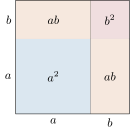
Theorem 66.3 (The three identities)
For all numbers and :
Proof. Expand each left-hand side. For the first: . For the second, replace by in the first. For the third: (the cross terms cancel). ∎
Example 66.4
Mental arithmetic: , and .
66.2 Factoring
Method 66.5 (Factoring)
To factor an expression, try in order:
- common factor: , where may itself be a bracket;
- difference of squares: ;
- perfect square: (and with , ).
Always check by expanding the result.
Example 66.6
Common factor: .
Common bracket:
Difference of squares: , and
Each factor still has a common factor: .
66.3 Equations
Method 66.7 (First-degree equations)
To solve an equation like :
- gather the -terms on one side, the numbers on the other, by adding the same quantity to both sides;
- reduce each side;
- divide both sides by the coefficient of ;
- check the solution in the original equation.
Example 66.8
Check: and . The solution is .
With brackets, expand first: becomes , so and .
Theorem 66.9 (Zero-product rule)
A product is zero if and only if at least one factor is zero:
Proof. If a factor is zero the product clearly is. Conversely if with , dividing both sides by gives . ∎
Example 66.10
Solve : either or , so the solutions are and .
Solve : factor first, , solutions and .
Solve : never divide by ! Move and factor: , solutions and .
66.4 Inequalities
Proposition 66.11 (Rules for inequalities)
An inequality is preserved when adding the same number to both sides, and when multiplying both sides by the same positive number. Multiplying both sides by a negative number reverses the inequality sign.
Proof. If then . Adding : , so . Multiplying by : , so . Multiplying by : , so : the order is reversed. ∎
Example 66.12
Solve :
The solutions are all numbers greater than : on a number line, a hollow dot at and shading to the right.

66.5 Exercises
Exercise 66.1 ★
Expand and reduce:
Solution
Solution of Exercise 66.1.
.
.
.
.
Exercise 66.2 ★
Expand using the identities:
Solution
Solution of Exercise 66.2.
.
.
.
.
Exercise 66.3 ★
Compute mentally, using an identity: ; (write ); .
Solution
Solution of Exercise 66.3.
.
.
.
Exercise 66.4 ★
Factor:
Solution
Solution of Exercise 66.4.
.
.
.
.
Exercise 66.5 ★
Solve, writing every step:
Solution
Solution of Exercise 66.5.
: , so .
: , so .
: , so and .
Exercise 66.6 ★★
Solve using the zero-product rule:
Solution
Solution of Exercise 66.6.
: or .
: or .
: the single solution .
: , so or .
Exercise 66.7 ★★
Factor , then solve .
Solution
Solution of Exercise 66.7.
Difference of squares with and :
Zero-product rule: gives , and gives .
Exercise 66.8 ★★
Solve the inequalities and represent the solutions on a number line:
Solution
Solution of Exercise 66.8.
: , so (filled dot at , shade right).
: , dividing by reverses the sign: (hollow dot at , shade left).
: , so , so (filled dot at , shade left).
Exercise 66.9 ★★
I think of a number, multiply it by , add , and get the same result as if I had multiplied it by and subtracted . What is my number? (Set up an equation and solve it.)
Solution
Solution of Exercise 66.9.
Let be the number: . Then , so . Check: and .
Exercise 66.10 ★★★
Let be a whole number.
66.6 Problem: The algebra of digits
Problem 66.1
Weekend problem — why the divisibility rules work, the 1089 trick unmasked, and mental arithmetic that looks like sorcery
Grade school taught you rules (a number is divisible by when its digit sum is); magicians perform tricks (everyone ends on ); markets know shortcuts (, instantly). All of it is the same secret: a number with digits , , is the expression , and this chapter’s algebra (Theorem 66.3, expanding, factoring) can take it apart. By the end of this problem you will have proved the rules, unmasked the trick, and learned the sorcery.
Part I — Digits under the microscope.
- A two-digit number with tens digit and units digit is . Expand and factor the difference between the number and its reversal, , and state the discovery. Check it on .
Prove the rule of nine for three-digit numbers: verify the identity
and explain why it shows that a number and its digit sum leave the same remainder in the division by — so one is divisible by exactly when the other is (Proposition 64.3, now proved).
- Deduce the rule of three from the same identity, in one sentence.
- “Casting out nines”, the accountants’ check: to test , replace each number by the digit sum of its digit sum: , , and ; then : consistent. Explain why a correct product must pass the test (write , and expand), and find a wrong result that the test fails to catch (why are swapped digits invisible to it?).
Prove the rule of eleven for four-digit numbers: verify
and use it to decide whether is divisible by .
Part II — The 1089 trick. The trick: think of a three-digit number whose first and last digits differ by at least ; reverse it; subtract the smaller from the larger; reverse the result; add the last two numbers. The magician announces: 1089.
- Perform the trick on and on one number of your choice.
- Let the number have digits , , with . Factor the first subtraction, , and list all the values it can take when runs from to .
Each of those multiples of has a striking digit pattern. Writing , verify the identity
and read off the three digits of .
- Add to its own reversal, using question 8’s digits, and prove that the total is — whatever is. The trick is dead; long live the algebra.
- Why did the magician require the first and last digits to differ by at least ? Examine the cases and (where the subtraction gives , which must be written for the reversal to work), and state the small print that keeps the trick honest.
Part III — Sorcery for daily use.
- The birthday trick: “multiply your birth month by , add , double, add your birth day, subtract .” Show that the result is always — month and day, readable at a glance. (Try it on someone.)
- You redesign the trick as: “multiply the month by , add , double, add the day.” What number must the spectator now subtract at the end for the same month–day readout?
- The missing-digit trick: the spectator picks any number, subtracts its digit sum (question 2 says the result is always a multiple of — explain why for a three-digit number), then crosses out one nonzero digit and reads you the remaining digits. Explain how you recover the crossed-out digit, and why had to be excluded.
- Market sorcery: prove the identity , state the rule for squaring any number ending in , and compute , and in your head.
- Finale, extending Exercise 66.10: prove that the sum of five consecutive integers is always a multiple of , but that the sum of four consecutive integers is never a multiple of . (Two short computations — and one moral about what algebra does to the words “always” and “never”.)
Solution
Solution of Problem 66.1.
1. : the difference between a two-digit number and its reversal is always a multiple of . Check: , and .
2. Expanding the right side: . So the number equals a multiple of plus its digit sum: dividing by , both leave the same remainder. In particular remainder for one means remainder for the other: the rule of nine, proved.
3. is also a multiple of , so the same identity shows number and digit sum leave the same remainder in the division by : the rule of three.
4. Write and . Then
the product leaves the same remainder as , namely . A correct result must therefore also leave remainder — which does. But the test only sees remainders: and (digits swapped) pass identically, so passing proves nothing — failing is what convicts.
5. Expanding: . So the number is divisible by exactly when its alternating sum is. For : , divisible by : yes, .
6. ; . Any valid example lands on too.
7. . For :
8. . So the three digits of are , then , then (check : gives , , ).
9. The reversal of has digits , , , so it equals . Adding:
independent of . Whatever the starting number, the magician is safe.
10. If , the subtraction gives and the trick dies at once. If , it gives , which must be treated as the three-digit string (reversal , : saved!). The small print: differences of work only if the spectator writes the subtraction result with three digits, leading zero included — requiring a gap of at least avoids the argument.
11. : the tens (and hundreds, for October–December) show the month, the units (and tens) the day.
12. : subtract .
13. By question 2, for a three-digit : always a multiple of (similar identities work for any length). A multiple of has digit sum a multiple of (question 2 again), so the digits the spectator reads out must be completed to the next multiple of : the missing digit is that complement. Ambiguity: if the read digits already sum to a multiple of , the crossed digit could be or — excluding removes the doubt.
14. : write , then glue behind it. : , so . : , so . : , so .
15. Five consecutive: : a multiple of , always. Four consecutive: : remainder in the division by , never a multiple. Algebra converts “it seems to work” into always, and “I found no example” into never — two words no amount of testing can reach (Method 48.8).