Primary & Middle School Mathematics · कक्षा 1–9
33Geometric Constructions
Ruler, set square, compass: with these three tools and a bit of method, any figure described in words can be built exactly. This chapter constructs perpendiculars, parallels, triangles and the special quadrilaterals — craft first, theory later (Chapters 40 and 41).
33.1 Perpendiculars and parallels through a point
Method 33.1 (The two basic constructions)
Perpendicular to through : slide the set square along until its other right-angle edge reaches ; draw; mark the right angle.
Parallel to through : press a ruler against the set square as a rail laid along ; slide the set square up to ; draw. (Check: the gap between the two lines is the same everywhere.)
Example 33.2 (Chaining constructions)
Many figures are chains of these two moves. A rectangle with cm and cm: draw ; perpendicular at ; perpendicular at ; mark and at cm on the same side; join. Every step is one basic construction.
33.2 Triangles with the compass
Method 33.3 (Triangle from three sides)
To build a triangle with sides cm, cm, cm:
- draw the longest side, with cm;
- arc of center and radius cm;
- arc of center and radius cm;
- their crossing is the third vertex ; join.
The compass guarantees the lengths: every point of the first arc is at exactly cm from .
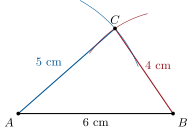
Example 33.4 (Isosceles and equilateral for free)
Same compass opening for both arcs isosceles triangle. Opening equal to the base equilateral. The compass does not measure: it copies lengths, which is even better.
33.3 The special quadrilaterals, by construction
Method 33.5 (Building the family)
- Rectangle: two pairs of parallels crossing at right angles — or the chain of Example 33.2;
- square: a rectangle whose four sides use the same length — carry it with the compass;
- rhombus: four equal sides — draw one side, then two compass arcs from its ends with the same opening fix the other two vertices (a rhombus is two isosceles triangles glued along a diagonal).
After building, always check with the tools: set square on the corners, compass on the sides.
Example 33.6 (Recognizing from a description)
“A quadrilateral with four cm sides and one right angle” — build it: the four equal sides force a rhombus shape, and pressing one corner to a right angle straightens all the others: the result is a square. Some descriptions secretly describe a more special shape than they announce. (Why the right angle spreads to all four corners is explained in Chapter 52.)
33.4 Circles in constructions
Example 33.7 (The circle as a tool)
“Find all points at cm from ”: the circle of center , radius cm. “Find all points at cm from and cm from ”: draw both circles; their crossings (two, one or zero points) are the answers. Treasure maps and triangle constructions use exactly this idea.
33.5 Exercises
Exercise 33.1 ★
Draw a line and a point at about cm from it. Construct the perpendicular to through , then the parallel to through . Mark the right angles.
Solution
Solution of Exercise 33.1.
Both constructions follow Method 33.1; the perpendicular and the parallel through are themselves perpendicular to each other.
Exercise 33.2 ★
Construct a rectangle with cm and cm, following Example 33.2. Check the fourth angle with the set square: if the construction is exact, it is right automatically.
Solution
Solution of Exercise 33.2.
Chain of perpendiculars as in Example 33.2. If the three built angles are exactly right and the lengths exact, the fourth angle has no choice but to be right too — a well-built rectangle checks itself.
Exercise 33.3 ★
Construct a triangle with sides cm, cm and cm (Method 33.3).
Solution
Solution of Exercise 33.3.
Base of cm; arcs of radii cm (from ) and cm (from ); the crossing is .
Exercise 33.4 ★
Construct an isosceles triangle with base cm and equal sides of cm; then an equilateral triangle of side cm.
Solution
Solution of Exercise 33.4.
Isosceles: base cm, both arcs with the same cm opening. Equilateral: base cm, both arcs with the cm opening.
Exercise 33.5 ★
Construct a square of side cm. Which tools guarantee the right angles? Which guarantee the equal sides?
Solution
Solution of Exercise 33.5.
The set square guarantees the right angles; the compass (or the ruler) carries the cm side to all four sides.
Exercise 33.6 ★
Construct a rhombus of side cm that is not a square (choose your own opening for the first corner). Check the four sides with the compass.
Solution
Solution of Exercise 33.6.
Draw a side of cm, choose a direction for (not perpendicular, to avoid the square), cm; then arcs of cm from and from cross at . The compass confirms the four equal sides.
Exercise 33.7 ★
Draw two points and with cm. Construct all points that are at cm from and at cm from . How many are there?
Exercise 33.8 ★
Write a construction program (numbered steps, named points) for a rectangle cm cm topped by an isosceles triangle with equal sides cm (a pencil shape). Have a classmate execute it.
Solution
Solution of Exercise 33.8.
One correct program: “1. Draw a rectangle with cm (bottom) and cm. 2. Draw two arcs of radius cm centered at and at (the top corners); name their crossing above the rectangle. 3. Draw and .” (The point of the pencil is the isosceles triangle .)
Exercise 33.9 ★★
Try to construct a triangle with sides cm, cm and cm. What happens with the arcs? Explain in one sentence why this triangle cannot exist.
Solution
Solution of Exercise 33.9.
The arcs of radii cm and cm, drawn from the two ends of the cm base, never meet: even end to end, cm cannot stretch across cm. Two sides together must always be longer than the third — otherwise the triangle cannot close.
Exercise 33.10 ★★
Construct a rhombus whose diagonals measure cm and cm, knowing that the diagonals of a rhombus cross at their middles at a right angle: draw the diagonals first, then join their four ends.
Solution
Solution of Exercise 33.10.
Draw a segment of cm and its midpoint ; draw the perpendicular at ; mark on it two points at cm from (one on each side); join the four endpoints in order. The compass confirms the four equal sides.
Exercise 33.11 ★★
A goat is tied to a stake by a m rope, in a flat field with a straight fence passing m from . Draw a plan (1 cm per meter): which region can the goat reach? Where does the fence limit it?
Solution
Solution of Exercise 33.11.
On the plan, the goat reaches the disk of center and radius cm, cut off by the fence line at cm from : her region is the disk minus the sliver beyond the fence. Along the fence she can graze on a segment (where the circle crosses the fence line); beyond it, nothing.