Primary & Middle School Mathematics · Grades 1–9
57Literal Calculation and Equations
Grade 7 introduced letters and reduced simple expressions (Chapter 48). This chapter adds the two skills that make algebra powerful: expanding products of brackets, and solving equations — finding the number hidden behind the letter.
57.1 Expanding
Theorem 57.1 (Simple and double distributivity)
For all numbers:
Proof. The first rule is Theorem 45.6 (signs included: and the terms may be negative, Chapter 54). For the second, apply the first rule twice, treating as a single number:
∎
Example 57.2
Mind the signs at every term:
Method 57.3 (Expand and reduce)
- Expand every product, writing each term with its sign;
- collect like terms ( with , with , numbers with numbers);
- check with a value: substitute e.g. in the original and in the result — equal outcomes catch most mistakes.
57.2 Solving equations
Definition 57.4 (Equation)
An equation is an equality with an unknown number, written (or any letter). Solving it means finding all the values of making the equality true — the solutions.
Theorem 57.5 (Balance rules)
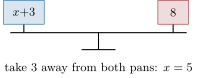
An equation keeps exactly the same solutions when:
- the same number is added to (or subtracted from) both sides;
- both sides are multiplied (or divided) by the same nonzero number.
Proof. Admitted at this level. ∎
Method 57.6 (Solving a first-degree equation)
- Expand and reduce each side if needed;
- add or subtract on both sides to gather the -terms on one side, the plain numbers on the other;
- reduce, then divide both sides by the coefficient of ;
- check by substituting the value found into the original equation.
Example 57.7
Solve :
Check: left side ; right side . The solution is .
Example 57.8 (With brackets and negatives)
Solve :
Check: and . Solution: .
Method 57.9 (Solving a problem with an equation)
- Choose the unknown: “let be …” (the quantity asked for, or a simpler related one);
- translate the story into an equation;
- solve it;
- interpret: answer the original question in a sentence, with units, and check the answer against the story.
Example 57.10
Lucas is years older than his sister; together their ages sum to . Let be the sister’s age; then Lucas is , and
The sister is , Lucas is . Check: and .
57.3 Order and inequalities
Proposition 57.11 (Operations and order)
Adding the same number to both sides of an inequality preserves it; multiplying both sides by a positive number preserves it; multiplying by a negative number reverses it:
Proof. Admitted at this level. ∎
Example 57.12
Solve : subtract on both sides, ; divide by and reverse: . All the numbers greater than or equal to are solutions — an equation usually has one solution, an inequality has a whole half-line of them.
57.4 Exercises
Exercise 57.1 ★
Expand and reduce:
Solution
Solution of Exercise 57.1.
.
.
.
Exercise 57.2 ★
Expand and reduce:
Solution
Solution of Exercise 57.2.
.
.
.
Exercise 57.3 ★
Is a solution of ? Of ? Of ? (Substitute and compare both sides.)
Solution
Solution of Exercise 57.3.
: yes. and : yes. and : yes — solves all three.
Exercise 57.4 ★
Solve, with a check:
Solution
Solution of Exercise 57.4.
: (check: ).
: .
: .
: , (check: ).
Exercise 57.5 ★
Solve:
Solution
Solution of Exercise 57.5.
: , so .
: , so .
: , so .
Exercise 57.6 ★
Solve , expanding first, and check your solution.
Solution
Solution of Exercise 57.6.
, so and . Check: and .
Exercise 57.7 ★
Translate and solve: “three times a number, decreased by , equals ”; “the double of a number increased by equals the number increased by ”.
Solution
Solution of Exercise 57.7.
“”: , .
“”: .
Exercise 57.8 ★★
A rectangle’s length is cm more than its width, and its perimeter is cm. Let be the width: write an equation, solve it and give the two dimensions.
Solution
Solution of Exercise 57.8.
Width , length ; perimeter , so and : width cm, length cm (check: ).
Exercise 57.9 ★★
Three consecutive whole numbers have sum . Call the middle one and find all three.
Exercise 57.10 ★★
Solve the inequalities and describe the solutions:
Solution
Solution of Exercise 57.10.
: , so .
: , dividing by reverses: .
: , so and .
Exercise 57.11 ★★
Mia has euros in savings and adds euros each month; Tom has euros and adds euros each month. After how many months will Mia have strictly more than Tom? (Set up an inequality.)
Solution
Solution of Exercise 57.11.
After months, Mia has and Tom . Mia leads when
from the th month on.
Exercise 57.12 ★★★
Solve the equation . (Multiply both sides by , the common denominator, then proceed as usual; check your solution in the original equation.)
Solution
Solution of Exercise 57.12.
Multiply both sides by :
Check: , and . Equal: the solution is .
57.5 Problem: Remarkable identities and the staircase of odd numbers
Problem 57.1
Weekend problem — , , , and the sum
Three expansions come up so often that algebra knows them by heart: they are called the remarkable identities. This problem derives them from double distributivity (Theorem 57.1), turns them into a mental-arithmetic superpower, uses them to prove a beautiful fact about odd numbers, and ends by solving equations of a brand-new kind: equations with a square in them.
Part I — The three identities.
Expand and reduce, to prove
Prove likewise the two companions:
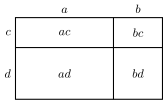
- Draw a square of side , split each side into and , and cut the square into four pieces. Which piece of the first identity does each part of the picture represent?
Mental arithmetic: use the identities to compute, without posing any multiplication,
- A classic trap: Zoe writes “”. Test her formula with , , and explain on the picture of question 3 exactly which pieces her formula forgets.
Part II — The staircase of odd numbers.
- Compute , then , then , then , then . What do you notice about the results?
- Explain why the -th odd number is (check: give ).
- Use an identity of Part I to expand and reduce . What does the result have to do with question 7?
Question 8 says: to pass from a square of side to a square of side , one adds exactly the next odd number of unit cells — an L-shaped border along two sides and the corner. Starting from and growing the square one layer at a time, explain why
the sum of the first odd numbers is the -th square.
- Deduce, without adding them up one by one: the value of ; and how many odd numbers, starting from , add up to exactly .
Part III — Equations with a square.
- Recognize a remarkable identity in , and solve the equation .
- Explain, using the sign-and-distance rule of Theorem 54.1, why a product of two numbers can be zero only if one of the two factors is zero. Use this to solve .
- Solve by moving everything to one side and factoring with the third identity. How many solutions does this equation have — and how does that differ from every equation solved in this chapter so far?
- In Exercise 57.3 you checked that is a solution of . Show that it is the only one: bring everything to one side, recognize an identity, and conclude.
- Finale: compute in your head, and explain with an identity why the difference of two consecutive squares is always the sum of the two numbers — which is question 8 all over again.
Solution
Solution of Problem 57.1.
1. Double distributivity (Theorem 57.1) with , :
since and are the same product.
2. Same expansion, minding the signs:
this time the cross-terms and cancel instead of doubling.
3. The square of side cuts into four pieces: a square (the ), a square (the ), and two rectangles (together, the ). The identity is the statement that the four areas fill the big square — it is the picture of double distributivity with both sides split the same way.
4. With the identities:
5. For , : but . Zoe’s formula forgets the two rectangles of the picture — the missing , and indeed .
6. ; ; ; ; . The results are the perfect squares .
7. The odd numbers start at and go up in steps of : the -th one is reached after steps of from , so it equals . Check: give .
8. By the first identity,
the difference between two consecutive squares is exactly the -th odd number (question 7 with in place of : ).
9. Build the squares one after the other. Start with a single cell: . To pass from the square of side to the square of side , add cells (question 8): . To pass to side , add cells: . Each new odd number is exactly the L-shaped layer completing the next square, so after adding the first odd numbers the square of side is complete: .
10. The odd numbers from to are the first of them ( gives ), so
And requires : the first twenty odd numbers ( up to ) add up to .
11. : the first identity with , . So the equation reads . A square is zero only when the number itself is zero (Theorem 54.1: a nonzero number has nonzero distance, so its square has nonzero distance too). Hence : the only solution is .
12. By Theorem 54.1, the distance of a product is the product of the distances. If both factors are nonzero, both distances are nonzero, so the product’s distance is nonzero: the product cannot be . A zero product therefore forces at least one zero factor. For : either or , giving the two solutions and .
13. becomes , and the third identity factors it:
By question 12, or : two solutions. Every equation solved so far in this chapter was of first degree and had exactly one solution; a square in the equation can produce two.
14. Bring everything to the left side: , and recognize the second identity: . So the equation is , which forces (as in question 11): is the one and only solution — the check of Exercise 57.3 found it, and the factoring proves there are no others.
15. By the third identity,
In general : the difference of two consecutive squares is the sum of the two numbers — the same as in question 8, now obtained from the third identity instead of the first.