Primary & Middle School Mathematics · Grades 1–9
28Measures and Perimeter
Grade 3 measured with rulers, scales and clocks (Chapter 19); this chapter adds the units table — the machine that converts everything — and two ways of measuring a flat shape: the length of its border (perimeter) and the room inside it (area, counted in squares for now).
28.1 The units table
Method 28.1 (Converting with the table)
For lengths, each column is worth ten of the next:
| km | hm | dam | m | dm | cm | mm |
|---|---|---|---|---|---|---|
- Write the number with one digit per column, the units digit of the measure in its unit’s column (here m: the under m);
- read the number in the new unit: m cm (fill empty columns with zeros);
- masses (kg … g) and capacities (L … cL) work the same way.
Example 28.2
km m; cm m (the lands under m); kg g g; L cL.
28.2 Perimeter
Definition 28.3 (Perimeter)
The perimeter of a polygon is the total length of its border: add the lengths of all its sides (in the same unit!). Shortcuts for the classics:
Example 28.4
A rectangular garden m by m:
of fence. A square photo frame of side cm: cm.
28.3 Area: counting squares
Definition 28.5 (Area by counting)
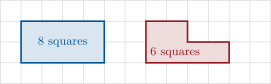
The area of a figure drawn on a grid is the number of grid squares it covers. Two half-squares count as one. Area answers “how much surface”, perimeter answers “how long is the border” — two different questions!
Example 28.6 (Half-squares)
A right triangle drawn on the grid with legs and covers full squares and half-squares … count carefully: its area is half of the rectangle, i.e. squares. Cutting a rectangle along its diagonal always gives two triangles of equal area.
Example 28.7 (Same area, different perimeters)
A square and an rectangle both cover squares — same area. Borders: units for the square, for the rectangle. Neither measure determines the other: a long thin shape has lots of border for little surface.
28.4 Durations
Method 28.8 (Adding times across the hour)
To add or subtract durations, work in hops through the full hours (recall h min):
Never add minutes past without converting: min h min.
Example 28.9
The train leaves at and arrives at . Duration: is min; is h; is min. Total: h min.
28.5 Exercises
Exercise 28.1 ★
Convert with the units table: m in cm; km in m; mm in cm; m in km.
Solution
Solution of Exercise 28.1.
m cm; km m; mm cm; m km.
Exercise 28.2 ★
Convert: kg in g; g in kg and g; L in cL; cL in L.
Solution
Solution of Exercise 28.2.
kg g; g kg g; L cL; cL L.
Exercise 28.3 ★
Compute the perimeter: a rectangle cm cm; a square of side cm; a triangle with sides cm, cm and cm.
Solution
Solution of Exercise 28.3.
Rectangle: cm. Square: cm. Triangle: cm.
Exercise 28.4 ★
A rectangle has perimeter cm and length cm. Find its width (first find length width).
Solution
Solution of Exercise 28.4.
Length width cm, so the width is cm.
Exercise 28.5 ★
On grid paper, draw an L-shaped figure covering exactly squares, and count the units of its perimeter.
Solution
Solution of Exercise 28.5.
Many L-shapes work; for a -square L made of a rectangle plus a foot, walking the border gives units. (Any correct figure and careful count is right; the perimeter depends on the L chosen.)
Exercise 28.6 ★
Draw two different rectangles of area squares. Compute the perimeter of each. Which is “rounder”, which is “thinner”?
Exercise 28.7 ★
A right triangle is drawn on the grid with legs and . What is its area in squares? (Use Example 28.6.)
Exercise 28.8 ★
Compute the durations: from to ; from to . A film lasts h and starts at : when does it end?
Solution
Solution of Exercise 28.8.
: h min. : h min. Film: h .
Exercise 28.9 ★
Kim runs laps of a rectangular field m by m. How many meters does she run?
Solution
Solution of Exercise 28.9.
One lap: m. Three laps: m.
Exercise 28.10 ★★
A farmer wants to fence a square field of side m, leaving a gate of m without fence. How many meters of fence must he buy?
Exercise 28.11 ★★
True or false, with grid examples: “if two figures have the same perimeter, they have the same area”; “if two figures have the same area, they have the same perimeter”. (Example 28.7 and the chapter’s figure will help.)
Solution
Solution of Exercise 28.11.
Both claims are false. Same perimeter, different areas: the rectangle and the L-shape of the chapter’s figure (both perimeter ; areas and ). Same area, different perimeters: the square and the rectangle (both area ; perimeters and ).