Primary & Middle School Mathematics · Grades 1–9
9Subtraction
When the units on top are too few to take from, we break open a ten — the borrow, the mirror of the carry. This chapter explains it with sticks, then trains the written subtraction, with counting up as a friendly shortcut.
9.1 Why we borrow
Example 9.1 (Unbundling a ten)
: we want to take units from units — too few! So untie one of the tens into ten loose units: now the top has tens and units. Take away: units, and tens. So .

9.2 The written method
Method 9.2 (Column subtraction)
- Write the bigger number on top, aligned on the right;
- subtract the units; if the top digit is too small, borrow a ten (it becomes ten units in the current column);
- subtract the tens, then the hundreds;
- check: the answer plus the number taken away must give back the top number.
Example 9.3
Compute :
Units: too small; borrow through the tens (there are none, so borrow from the hundreds first): the top becomes hundreds, tens, units. Then ; ; . Check: . ✓
9.3 Counting up
Method 9.4 (Subtracting by counting up)
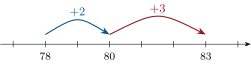
For numbers that are close, climb from the small one to the big one and add the hops:
Counting up is quicker than borrowing when the two numbers are near each other — and it is exactly how a shopkeeper gives change.
Example 9.5 (Giving change)
A toy costs ; you pay with a . Change: count up, is , is , so the change is . The subtraction , done the shopkeeper’s way.
9.4 Exercises
Exercise 9.1 ★
Compute (no borrow needed): ; ; .
Solution
Solution of Exercise 9.1.
; ; .
Exercise 9.2 ★
Compute with a borrow: ; ; .
Solution
Solution of Exercise 9.2.
; ; .
Exercise 9.3 ★
Compute in columns and check each one: ; ; .
Solution
Solution of Exercise 9.3.
(check ); (check ); (check ).
Exercise 9.4 ★
Compute by counting up: ; ; .
Solution
Solution of Exercise 9.4.
; ; .
Exercise 9.5 ★
Compute the change (count up): pay for a book; pay for a toy; pay for a bag.
Solution
Solution of Exercise 9.5.
; ; .
Exercise 9.6 ★
“A tree is cm tall. It grew cm this year. How tall was it last year?” Write the subtraction and answer.
Solution
Solution of Exercise 9.6.
Last year: cm.
Exercise 9.7 ★
Complete with the twin addition to check: ; is it right? ; is it right?
Solution
Solution of Exercise 9.7.
: check — right. : check — wrong (the correct answer is ).
Exercise 9.8 ★
For each story, choose or : “ birds, fly away”; “ apples, more picked”; “Sam has , Lea has : how many more has Sam?”.
Solution
Solution of Exercise 9.8.
“fly away”: . “more picked”: . “how many more”: .
Exercise 9.9 ★
Fill the hole: . (Count up from to .)
Solution
Solution of Exercise 9.9.
From up to is , so : the hole is .
Exercise 9.10 ★★
A game: think of a number, add , then take away . The result is . What was the number? (Work backward!)
Solution
Solution of Exercise 9.10.
Work backward from : before taking away , the number was ; before adding , it was . The starting number was (check: ).