Primary & Middle School Mathematics · कक्षा 1–9
13Solving Problems
A story with numbers hides a question: add? take away? multiply? This chapter gives a way to decide, uses simple bar pictures to see the operation, and reads information from tables and pictograms.
13.1 Choosing the operation
Method 13.1 (Which operation?)
- putting together, in all: add ();
- taking away, how many left, how many more: subtract ();
- so many equal groups: multiply ();
- draw a quick picture when unsure, and always answer with a sentence.
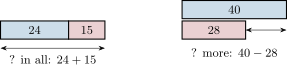
Example 13.2 (A two-step problem)
“Sam buys packs of stickers, then gives away. How many does he keep?”
- Groups: stickers;
- give away: .
Sam keeps stickers. Reread the question: is the story really finished? Here yes.
Example 13.3 (A hidden extra number)
“A -page book …” — careful, not every number in a story is needed. “Ben has red and blue marbles and is years old. How many marbles?” The age is a decoy: marbles. Sort the numbers before computing.
13.2 Tables and pictograms
Example 13.4 (A table)
Cakes sold at a stall:
| Saturday | Sunday | total | |
|---|---|---|---|
| muffins | |||
| tarts |
Reading: Sunday tarts, . Computing: muffins over the two days, ; more tarts on Sunday than Saturday by .
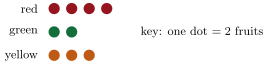
Example 13.5 (A pictogram)
Read the key first: here one apple stands for pieces of fruit.
13.3 Exercises
Exercise 13.1 ★
Name the operation (do not compute): “ and marbles put together”; “ sweets, eaten”; “ boxes of apples”; “Ana has , Leo has : how many more has Ana?”.
Solution
Solution of Exercise 13.1.
Put together: addition. sweets, eaten: subtraction. boxes of : multiplication. How many more: subtraction.
Exercise 13.2 ★
Solve: “A car park has cars; leave. How many stay?”
Solution
Solution of Exercise 13.2.
. There stay cars.
Exercise 13.3 ★
Solve: “ children each pick flowers. How many flowers in all?”
Solution
Solution of Exercise 13.3.
flowers.
Exercise 13.4 ★
Draw a bar picture, then solve: “Tom has cards, Mia has fewer. How many has Mia?”
Solution
Solution of Exercise 13.4.
Comparison bar: Tom , Mia shorter by : cards.
Exercise 13.5 ★
Two steps: “A crate holds bottles. A shop gets crates and sells bottles. How many bottles remain?”
Solution
Solution of Exercise 13.5.
Bottles received: ; remaining: bottles.
Exercise 13.6 ★
Find and cross out the useless number, then solve: “Ben is years old and has marbles. He wins more. How many marbles now?”
Solution
Solution of Exercise 13.6.
The useless number is the age (). Marbles: .
Exercise 13.7 ★
Using the table of Example 13.4: how many tarts sold over the two days? How many cakes of all kinds on Saturday?
Solution
Solution of Exercise 13.7.
Tarts: . Saturday, all cakes: .
Exercise 13.8 ★
Using the pictogram of Example 13.5: how many fruits in all? Which colour has the most?
Solution
Solution of Exercise 13.8.
Red , green , yellow : in all fruits. Red has the most.
Exercise 13.9 ★
Solve: “A ribbon is cm long. Lea cuts off cm. How long is the piece that remains?”
Solution
Solution of Exercise 13.9.
cm remain.
Exercise 13.10 ★★
“A baker makes trays of cakes in the morning and trays of cakes in the afternoon. How many cakes that day?” (Two multiplications, then a sum — or count the trays first!)
Solution
Solution of Exercise 13.10.
Morning: ; afternoon: ; total cakes. (Or: trays of , and .)