Primary & Middle School Mathematics · Grades 1–9
48Literal Expressions
A letter in a computation stands for a number we do not know yet, or for all numbers at once: writing gives the perimeter of every square in one formula. This chapter teaches the writing conventions, how to substitute values, and how to simplify simple expressions — the start of algebra, continued in Chapter 57.
48.1 Writing with letters
Definition 48.1 (Literal expression)
A literal expression is a computation containing one or more letters, each standing for a number. Writing conventions:
- the sign is dropped before a letter or a bracket: , , ;
- but it stays between two numbers: cannot be written !
- is written (“ squared”), ;
- is written , and is .
Example 48.2
Simplify the writing:
Example 48.3 (Formulas are literal expressions)
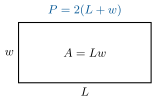
For a rectangle of length and width : perimeter , area . One formula summarizes the infinitely many rectangles at once — that is the whole point of letters.
48.2 Substituting
Method 48.4 (Evaluating an expression)
To evaluate an expression for given values of its letters:
- rewrite the expression putting the hidden signs back: is ;
- replace each letter by its value, keeping brackets around it if needed;
- compute, respecting the priorities of Chapter 45.
Example 48.5
Evaluate for :
Evaluate for and :
48.3 Reducing expressions
Proposition 48.6 (Collecting like terms)
Terms containing the same letter part can be collected by adding their number parts (this is distributivity, Theorem 45.6, read backwards):
Terms with different letter parts (like and , or and ) cannot be collected.
Example 48.7
Reduce , sorting the terms:
Careful: is not ! Test with : and agree, but would also be — test with : the original gives , and , while . The reduction is right, is wrong.
Method 48.8 (Testing an equality)
To check whether two expressions might be equal for every value:
- substitute the same value in both, at least twice (e.g. and ; avoid and , they hide too many differences);
- if the results differ even once, the expressions are not equal — one counterexample kills a general claim;
- if the results agree, the equality is only plausible: a proof needs algebra (expanding, reducing).
Example 48.9
Is equal to for every ? Expanding proves it: . Is equal to ? Test : but . No — and one counterexample is a complete proof of “no”.
48.4 Producing expressions
Example 48.10 (From situation to expression)
A taxi charges euros plus euros per kilometer. For a trip of kilometers the price is
For : euros. The expression is the general answer; substituting produces every particular one.
Example 48.11 (Number tricks)
“Think of a number, double it, add , divide by , subtract your number.” Call the number and follow the steps:
Everyone gets , whatever was — the letters explain the magic.
48.5 Exercises
Exercise 48.1 ★
Simplify the writing:
Solution
Solution of Exercise 48.1.
; ; ; ; .
Exercise 48.2 ★
Put the signs back:
Solution
Solution of Exercise 48.2.
; ; ; .
Exercise 48.3 ★
Evaluate for : ; ; ; .
Solution
Solution of Exercise 48.3.
For : ; ; ; .
Exercise 48.4 ★
Evaluate and for , .
Solution
Solution of Exercise 48.4.
; .
Exercise 48.5 ★
Reduce:
Solution
Solution of Exercise 48.5.
; ; ; .
Exercise 48.6 ★
Give a formula for: the perimeter of a square of side ; the perimeter of an isosceles triangle with base and equal sides ; the price of breads at euros each.
Exercise 48.7 ★
Match each expression to a description: ; ; ; . Descriptions: “the half of ”; “the double of ”; “the square of ”; “two more than ”.
Exercise 48.8 ★★
Using Method 48.8, decide (with proof or counterexample) whether these equalities hold for every :
Solution
Solution of Exercise 48.8.
: true for every (distributivity — this is a proof, no test needed).
: test : left , right — false in general (it holds only for ).
: test : left , right — false in general ().
Exercise 48.9 ★★
A rectangle has width and its length is cm more than its width.
- Express the length, then the perimeter, in terms of , and reduce.
- Compute the perimeter for cm, directly and with your reduced formula. Same answer?
Solution
Solution of Exercise 48.9.
1. Length: . Perimeter:
2. For : directly, the sides are and , so cm; with the formula, cm. They agree.
Exercise 48.10 ★★
Follow the trick of Example 48.11 with letters: “think of a number, add , multiply by , subtract , divide by your starting number” (assume it is not zero). What does everyone get?
Solution
Solution of Exercise 48.10.
Following the steps with the letter :
Everyone gets .
Exercise 48.11 ★★★
The figure below is a square of side with a square corner of side removed ( smaller than ). Write two different expressions for its area (one as a difference, one by cutting the L-shape into two rectangles), and check they agree for , .
Solution
Solution of Exercise 48.11.
As a difference: . By cutting the L into two rectangles: a full-width strip of height and, on top of it, a narrower rectangle:
(bottom rectangle wide and tall, top rectangle wide and tall gives the variant — the same). For , : , and . Both expressions agree — they always do: this is the identity of Chapter 66 in disguise.
48.6 Problem: The matchstick oracle
Problem 48.1
Weekend problem — growing patterns and their -th term: three formulas for one pattern, and the famous pattern that breaks at the sixth step
Lay matchsticks in a row of squares: one square, then two, then three … How many matches will the hundredth figure need? Counting them one by one would take all weekend; a formula in answers instantly for every figure at once — that is exactly what letters are for (Example 48.3). But beware: this problem ends with a celebrated pattern that plays fair for five steps and then betrays everyone who trusted it.
Part I — A row of squares. Figure is one matchstick square ( matches); each following figure adds one more square sharing a side with the previous one.
- Draw figures to and count their matches.
- Explain why each new square costs exactly extra matches, and use this to predict the count for figure without any formula.
- Justify the formula: figure needs matches. (Where does the lonely “” come from?) Check it against question 1.
- Amir reasons differently: “ matches for the first square, then for each of the others”, giving . Expand and reduce his expression (Proposition 48.6): does he agree with question 3?
- Lena counts a third way: “ horizontal matches, and vertical ones.” Write her formula, reduce it, and conclude. Then answer the opening question: how many matches for figure ?
Part II — Triangles, tables and going backwards.
- A row of matchstick triangles (each new triangle leans on the previous one): count the matches for , , triangles, then justify the formula for triangles.
- Going backwards: with exactly matches, how many triangles can the row have? (Undo the formula step by step.)
- Square banquet tables seat one guest per free side. When tables are pushed into one long row, explain why the seating formula is , and check it for , , tables.
- A party expects guests. How many tables does one row need? The caterer instead splits the same tables into two rows of seven: how many guests fit now? Explain the gain with the formula.
- Dot pattern: figure is an L of dots, dots tall and dots wide (the corner counted once). Count the dots of figures , , , find the formula, and name the numbers it produces. (Stacked together, these Ls tile a square — a story continued in Problem 57.1.)
Part III — Trust, test, prove.
- A classmate claims figure of Part I needs matches. Settle the claim by expanding and reducing — no testing needed.
- “Squaring makes numbers bigger, so for every number .” Test the claim for , , ; then find a number for which it fails. What did the three successful tests prove, and what does the single failure prove (Method 48.8)?
- Mark points on a circle and draw every segment between them, then count the regions inside the circle. Do it for , , and points (place the points unevenly, so that no three segments cross at one interior point). Record the counts. What formula does the pattern whisper?
- Now points, drawn large and unevenly, counting with great care (there are many small regions). How many regions do you find — and what happened to the conjecture?
- The moral, in two sentences: what would have been needed to prove the doubling conjecture, and why were the matchstick formulas of Parts I and II never in such danger? Celebrate with a proved prediction: how many matches for the row of squares?
Solution
Solution of Problem 48.1.
1. Figures to need , , , matches.
2. A new square shares one side with the previous figure, so only of its sides are new matches. From figure ( matches), six more squares cost : figure needs matches.
3. Reading the row from the left: it starts with one vertical match, and each of the squares then contributes a top, a bottom and a right side — matches each. Total: ; the “” is the very first vertical stick. Check: give .
4. : Amir’s formula expands to exactly the same reduced expression. Full agreement.
5. Lena: — the same again. Three ways of seeing, one reduced form. Figure : matches.
6. Counts: , , matches. Each new triangle leans on an existing side and adds only matches, starting from : figure needs matches.
7. Undo : removing the first match leaves , and each triangle then accounts for : triangles.
8. In a row of tables, each table offers its top and bottom side ( seats), and the two end tables offer one extra side each (): seats. Check: , , for .
9. One row: needs , so tables. Splitting the same tables into two rows of : each row seats , together — two more than the single row, because every new row brings two new ends. (Each split gains seats; caterers know.)
10. The L of size has dots going up and going across, the corner dot shared: dots. Figures , , : , , dots — the odd numbers. Nested one around the next, the Ls fill an square of dots: the story of Problem 57.1.
11. : the claim reduces to the proved formula, so it is right for every — established by algebra, not by examples.
12. Tests: , , : all pass. But gives : the claim fails. The three tests proved nothing about all numbers (they only failed to find trouble); the single counterexample proves the general claim false (Method 48.8). A letter stands for every number — decimals included.
13. Regions: points ; points ; points ; points . The pattern whispers “each point doubles the count”: regions expected for points.
14. A careful count gives regions — not . The doubling conjecture is dead: it survived four checks and failed the fifth. (This counterexample is famous enough to have a name, “the circle-regions trap”; no evenly-spaced shortcuts — three chords meeting at one point would merge regions and spoil the count.)
15. A proof would have needed a structural reason why adding a point doubles the regions — and there is none: the doubling was a coincidence of small cases. The matchstick formulas were safe because each was read off the construction itself (each square visibly costs matches, each table visibly offers seats): structure, not testing. Proved prediction: matches.