Primary & Middle School Mathematics · Grades 1–9
60The Right Triangle and the Cosine
Two beautiful facts tie the right triangle to the circle: a right triangle fits exactly in a half-circle, its hypotenuse being a diameter. And one number, the cosine of an angle, encodes the shape of every right triangle with that angle — the first trigonometric ratio, ahead of its siblings sine and tangent (Chapter 69).
60.1 The right triangle and its circle
Theorem 60.1 (Circle theorem)
- If a triangle is right-angled at , then lies on the circle whose diameter is the hypotenuse .
- Conversely, if lies on a circle of diameter (with ), then the triangle is right-angled at .
Equivalently: in a right triangle, the midpoint of the hypotenuse is at equal distance from the three vertices — the median from the right angle measures half the hypotenuse.
Proof of 1. Let be the midpoint of and the symmetric of about . The diagonals of cut at their common midpoint , so is a parallelogram (Definition 52.7) — with a right angle at : it is a rectangle. The diagonals of a rectangle are equal, so : the point is at distance from , i.e. on the circle of diameter . (Point 2 is proved by running the argument backwards.) ∎
![Wherever A sits on the circle, the angle BAC is right — the conjecture of , now a theorem. The red median [OA] is a radius: half the hypotenuse.](/images/onecourse/chapters/math-1/g8-cosine/fig-104da44b3199.svg)
Example 60.2
A triangle has a hypotenuse of cm. Without knowing anything else, the median from the right angle measures cm, and the circumscribed circle of the triangle has radius cm, centered at the midpoint of the hypotenuse.
60.2 The cosine of an acute angle
Definition 60.3 (Cosine)
In a right triangle, for an acute angle :
— the leg touching , divided by the hypotenuse. This ratio depends only on the angle, not on the size of the triangle: all right triangles with the same acute angle are enlargements of one another, and enlargements preserve ratios of lengths (Chapter 59 began this story; Chapter 68 finishes it).
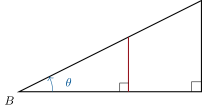
Proposition 60.4 (First values and bounds)
For every acute angle : , and the cosine decreases as the angle opens: a wider angle has a smaller cosine. Landmarks: , , (the extreme values corresponding to flattened triangles).
Proof. Admitted at this level. ∎
Method 60.5 (Using the cosine)
In a right triangle, when the known and wanted quantities are an acute angle, its adjacent side, and the hypotenuse:
- write the definition: with the known values in place;
- solve the small equation for the unknown (multiply or divide);
- for an unknown angle, apply the calculator’s to the computed ratio;
- sanity checks: a length must come out shorter than the hypotenuse; an angle strictly between and .
Example 60.6 (Finding a side)
A m ramp makes an angle of with the horizontal ground. Horizontal distance covered (adjacent to , hypotenuse m):
Example 60.7 (Finding an angle)
In a right triangle, the side adjacent to the angle measures and the hypotenuse :
60.3 Exercises
Exercise 60.1 ★
A right triangle has a hypotenuse of cm. What is the length of the median from the right-angle vertex? What is the radius of the circle through the three vertices?
Solution
Solution of Exercise 60.1.
Median from the right angle: half the hypotenuse, cm (Theorem 60.1). The circumscribed circle is centered at the midpoint of the hypotenuse with radius cm.
Exercise 60.2 ★
Draw a circle of diameter cm with a diameter , choose any point on the circle and draw . Which angle is right? Cite the theorem. Measure and and check Pythagoras.
Solution
Solution of Exercise 60.2.
The angle at is right ( is a diameter: point 2 of Theorem 60.1). The measures satisfy , up to measuring precision.
Exercise 60.3 ★
In a triangle right-angled at , name the side adjacent to the angle , the side opposite it, and the hypotenuse. Write as a ratio.
Solution
Solution of Exercise 60.3.
Hypotenuse: (opposite the right angle ). Adjacent to : . Opposite: . So .
Exercise 60.4 ★
Compute the missing quantity (, ):
- hypotenuse , angle : adjacent side?
- adjacent side , angle : hypotenuse?
Solution
Solution of Exercise 60.4.
1. adjacent .
2. hypotenuse .
Exercise 60.5 ★
In a right triangle, the adjacent side to measures and the hypotenuse . Compute , then ().
Solution
Solution of Exercise 60.5.
, so .
Exercise 60.6 ★
Explain why can never equal for an acute angle of a right triangle.
Solution
Solution of Exercise 60.6.
is a leg divided by the hypotenuse, and the hypotenuse is the longest side of a right triangle: the quotient is always smaller than . A value of would mean a leg longer than the hypotenuse — impossible.
Exercise 60.7 ★★
A m zip line descends from a platform to the ground, making an angle of with the horizontal (). What horizontal distance does it span?
Solution
Solution of Exercise 60.7.
Horizontal span m.
Exercise 60.8 ★★
Order without a calculator: , , (use Proposition 60.4). Then check with a calculator.
Solution
Solution of Exercise 60.8.
The cosine decreases as the angle grows (Proposition 60.4):
(Calculator: .)
Exercise 60.9 ★★
A ladder of length leans against a wall with an angle between ladder and ground. Its foot is m from the wall and (). Compute , then the height reached (Pythagoras).
Solution
Solution of Exercise 60.9.
The ground distance is adjacent to : , so m. Height (Pythagoras): m.
Exercise 60.10 ★★
is a diameter of a circle of center and radius cm, and is a point of the circle with cm.
- Why is right-angled at ?
- Compute , then .
Solution
Solution of Exercise 60.10.
1. is on a circle of diameter : right angle at (Theorem 60.1).
2. cm (twice the radius). Pythagoras: cm. And .
Exercise 60.11 ★★★
Using half an equilateral triangle of side (cut along a height), justify the landmark of Proposition 60.4. (Where does the foot of the height fall on the base? The full trigonometric version is Example 69.9.)
Solution
Solution of Exercise 60.11.
In the equilateral triangle of side , the height from one vertex lands on the midpoint of the opposite side (axis of symmetry). Half the triangle is right-angled with hypotenuse (a full side), an angle of at the base vertex, and adjacent side (half the base). Hence
60.4 Problem: Euclid’s relations, and Pythagoras all over again
Problem 60.1
Weekend problem — the altitude of a right triangle: , , a second proof of Pythagoras, and a machine for constructing square roots
Drop, from the right angle of a right triangle, the perpendicular to the hypotenuse: this short segment — the altitude — satisfies relations so useful that Euclid put them at the heart of his Elements. In this problem the cosine’s defining property, “the ratio depends only on the angle” (Definition 60.3), proves all of them; on the way you will re-prove Pythagoras’ theorem by a completely different route, and end with a ruler-and-compass machine that constructs , , for every whole number .
Throughout, is a triangle right-angled at , and is the foot of the perpendicular from to the hypotenuse , so that lies between and and .
Part I — One angle, two triangles.
- Using the angle sum of a triangle (Theorem 51.3) in and in , show that : the altitude cuts the right triangle into two smaller triangles carrying the same angles as the original.
The triangles (right-angled at ) and (right-angled at ) share the angle . Write in each of them, and deduce from Definition 60.3 that
(To pass from equal ratios to equal products, multiply both sides by both denominators, Theorem 57.5.)
State and prove the twin relation at the vertex :
- Take the –– triangle: , , . Compute and from questions 2 and 3, and check that .
- In general, express and as fractions involving only the three sides. In what sense does the foot split the hypotenuse “proportionally to the squares of the legs”?
Part II — Pythagoras again, and the altitude.
Add the relations of questions 2 and 3 and use to obtain
Pythagoras’ theorem (Theorem 58.1), re-proved — with no area puzzle in sight (compare Exercise 58.11).
Apply Pythagoras in the small triangle to write , replace by , and factor out to prove Euclid’s altitude relation:
Compute the area of in two ways — legs as base and height, then hypotenuse as base (Theorem 53.3) — and deduce the third relation:
- Back to the –– triangle: compute with question 8, then verify the altitude relation of question 7 numerically, using the values of and found in question 4.
- The altitude’s foot splits the hypotenuse of some right triangle into segments cm and cm. Compute the altitude .
Part III — A machine for square roots. Draw a segment made of two pieces laid end to end: and . Draw the half-circle of diameter , and let be the point where the perpendicular to at meets it.
Using Theorem 60.1, explain why the triangle is right-angled at — so question 7 applies and
(The length is called the geometric mean of and .)
- Take and . What is ? Which famous length of Example 58.9 has your ruler-and-compass figure just constructed?
- Describe the recipe that constructs a segment of length for any whole number , and say which choice of and constructs .
- Let be the center of the half-circle. Explain why can never exceed the radius , and for which position of the two are equal.
Deduce the inequality: for all positive numbers and ,
with equality exactly when . Then reprove it with no geometry at all: expand and recognize a remarkable identity (Problem 57.1).
Solution
Solution of Problem 60.1.
1. In the triangle , right-angled at , the angle sum (Theorem 51.3) gives , so . In the triangle , right-angled at : , so . Hence : both small triangles repeat the angles , , of the original.
2. In (right-angled at ), the side adjacent to is and the hypotenuse is : . In (right-angled at ), the side adjacent to is and the hypotenuse is : . The ratio depends only on the angle (Definition 60.3), so
multiplying both sides by (Theorem 57.5): .
3. The triangles (right-angled at ) and (right-angled at ) share the angle . Adjacent side over hypotenuse in each:
4. reads , so ; and gives . Check: — as it must, since lies on the hypotenuse between and .
5. Dividing each relation by :
So and are proportional to and : the foot of the altitude splits the hypotenuse in the ratio of the squares of the legs ( in question 4).
6. Adding the two relations and factoring out (distributivity):
This is Theorem 58.1, obtained from the cosine alone — a genuinely different proof from the four-triangle area puzzle of Exercise 58.11.
7. Pythagoras in (right-angled at , hypotenuse ): . Replacing by (question 2) and factoring out :
8. With the legs as base and height, the area of is ; with the hypotenuse as base, the height is exactly , so the area is also (Theorem 53.3). Equating and doubling: .
9. . Verification of question 7: and . Equal.
10. , so cm.
11. The point lies on the circle of diameter (and differs from and ), so by point 2 of Theorem 60.1 the triangle is right-angled at . By construction with between and : the segment is precisely the altitude of question 7, and .
12. : the figure constructs, with ruler and compass alone, a segment whose square is — the diagonal of the unit square, , of Example 58.9.
13. Recipe: lay end to end two segments of lengths and ; draw the half-circle whose diameter is the whole segment (length ); raise the perpendicular at the junction point; it meets the half-circle at a point whose distance to the junction is . For : take and (a half-circle of diameter ).
14. is on the circle of center , so , the radius. If , the triangle is right-angled at with hypotenuse , and a leg is shorter than the hypotenuse: . If , then exactly. In all cases , with equality precisely when is the center — that is, when .
15. Squaring (both sides positive) and using :
with equality exactly for . Algebraic re-proof, with the remarkable identities (Problem 57.1):
a square, hence never negative — and zero exactly when . The geometric mean of two numbers never exceeds their half-sum.