Primary & Middle School Mathematics · कक्षा 1–9
16Multiplication
Three bags of seven marbles: you could add , but there is a faster way — multiplication, the operation of repeated addition. This chapter builds the multiplication tables from pictures, then teaches the column method.
16.1 What multiplying means
Definition 16.1 (Multiplication)
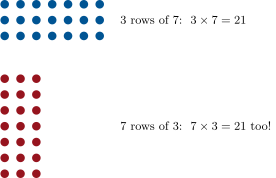
The product means “three times seven”:
On a picture, is a rectangle of dots: rows of dots.
Proposition 16.2 (Rules that help)
Proof. Admitted at this level. ∎
Example 16.3 (The table square)
All the tables fit in one square. To read : row , column .
| 1 | 2 | 3 | 4 | 5 | 6 | 7 | 8 | 9 | |
| 2 | 4 | 6 | 8 | 10 | 12 | 14 | 16 | 18 | |
| 3 | 6 | 9 | 12 | 15 | 18 | 21 | 24 | 27 | |
| 4 | 8 | 12 | 16 | 20 | 24 | 28 | 32 | 36 | |
| 5 | 10 | 15 | 20 | 25 | 30 | 35 | 40 | 45 | |
| 6 | 12 | 18 | 24 | 30 | 36 | 42 | 48 | 54 | |
| 7 | 14 | 21 | 28 | 35 | 42 | 49 | 56 | 63 | |
| 8 | 16 | 24 | 32 | 40 | 48 | 56 | 64 | 72 | |
| 9 | 18 | 27 | 36 | 45 | 54 | 63 | 72 | 81 |
The square is symmetric across its diagonal — that is rule 1 made visible.
16.2 Column multiplication
Method 16.4 (Multiplying by a one-digit number)
To compute :
- multiply the units: : write , carry ;
- multiply the tens and add the carry: : write , carry ;
- multiply the hundreds and add the carry: : write .
Estimate to check: is close to , and : the answer is plausible.
Example 16.5 (Splitting to multiply mentally)
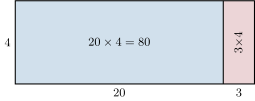
The column method secretly splits the number by places. Mentally, do the same:
And with a friendly neighbor: .
16.3 Multiplication in problems
Example 16.6
A minibus carries passengers. How many passengers can minibuses carry?
- It is a multiplication: groups of .
- (columns, or ).
- Sentence: the minibuses can carry passengers.
16.4 Exercises
Exercise 16.1 ★
Write as a multiplication, then compute: ; ; .
Solution
Solution of Exercise 16.1.
; ; .
Exercise 16.2 ★
Recite and complete: ; ; ; ; .
Solution
Solution of Exercise 16.2.
; ; ; ; .
Exercise 16.3 ★
Draw a dot rectangle for , then one for . What do you notice about the two counts?
Solution
Solution of Exercise 16.3.
Both rectangles contain the same dots — one is the other turned on its side: .
Exercise 16.4 ★
Compute using the rules of Proposition 16.2: ; ; ; ; .
Solution
Solution of Exercise 16.4.
; ; ; ; .
Exercise 16.5 ★
Compute in columns: ; ; .
Solution
Solution of Exercise 16.5.
; ; .
Exercise 16.6 ★
Compute mentally by splitting (as in Example 16.5): ; ; .
Solution
Solution of Exercise 16.6.
; ; .
Exercise 16.7 ★
Compute with a friendly neighbor: ; ; .
Solution
Solution of Exercise 16.7.
; ; .
Exercise 16.8 ★
Estimate first, then compute: (estimate with ); (estimate with ).
Solution
Solution of Exercise 16.8.
: estimate ; exactly .
: estimate ; exactly .
Exercise 16.9 ★
An egg box holds eggs. How many eggs are in boxes? Write the operation, compute, answer with a sentence.
Solution
Solution of Exercise 16.9.
. There are eggs in the boxes.
Exercise 16.10 ★★
A classroom has rows of desks; each desk seats students. How many students can the room seat? (Two multiplications.)
Solution
Solution of Exercise 16.10.
Desks: . Students: . The room can seat students.
Exercise 16.11 ★★
Find all the ways of arranging chairs into equal rows (rows of , of , …). Which arrangements are possible? (Use the table square: look for inside it.)
Solution
Solution of Exercise 16.11.
appears in the table square as , , , — and the same pairs reversed. Possible arrangements: row of , rows of , rows of , rows of , rows of , rows of , rows of , rows of .
Exercise 16.12 ★★
Zoe computes like this: , , and then . Léa computes . Explain each method. Which do you prefer for ? Compute it both ways.
Solution
Solution of Exercise 16.12.
Zoe splits into (the column method in her head); Léa replaces by the friendly and corrects by taking away the counted too much. For : Zoe’s way, ; Léa’s way, . Both work — Léa’s is quicker here because is close to .