Primary & Middle School Mathematics · Grades 1–9
15Addition and Subtraction
Adding means putting together; subtracting means taking away, or finding what is missing. This chapter trains the two column methods — with their famous carries and borrows — and the mental tricks that often make columns unnecessary.
15.1 Column addition
Method 15.1 (Adding in columns)
- Write the numbers one under the other, units under units, tens under tens (line up on the right);
- add the units; if the sum passes , write its units digit and carry the ten to the next column (a small );
- continue with the tens, the hundreds, …, adding the carry each time.
Example 15.2
Compute :
Units: : write , carry . Tens: : write , carry . Hundreds: . Result: .
Example 15.3 (Mental addition)
Look for friendly numbers before reaching for columns:
- make a ten: ;
- jump by parts: ;
- reorder: .

15.2 Column subtraction
Method 15.4 (Subtracting in columns)
- Write the bigger number on top, aligned on the right;
- subtract column by column, starting from the units;
- if the top digit is too small, borrow: take one from the next place on the top row (it is worth ten in the current column);
- check: the result plus the subtracted number must give back the top number.
Example 15.5
Compute :
Units: impossible; borrow through: becomes hundreds, tens, units. Then ; tens ; hundreds . Result: . Check: .
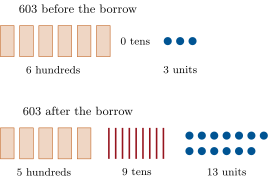
Example 15.6 (Subtraction as a missing part)
“Lila has marbles, Tom has : how many more has Tom?” is the subtraction . Mentally, count up from : is , then is ; in total . Counting up is often easier than borrowing.

15.3 Orders of magnitude
Method 15.7 (Estimating before computing)
Before any column computation, round the numbers to friendly ones and compute an estimate. After computing, compare: a result far from the estimate signals a mistake.
Example 15.8
For : the estimate is . The column result, , is close: plausible. If you had found (a missed alignment), the estimate would have warned you.
15.4 Exercises
Exercise 15.1 ★
Compute in columns: ; ; .
Solution
Solution of Exercise 15.1.
; ; .
Exercise 15.2 ★
Compute in columns, then check by an addition: ; ; .
Solution
Solution of Exercise 15.2.
(check: ).
(check: ).
(check: ).
Exercise 15.3 ★
Compute mentally by making tens: ; ; (add , take away ).
Solution
Solution of Exercise 15.3.
; ; .
Exercise 15.4 ★
Compute mentally by jumps: ; ; ; .
Solution
Solution of Exercise 15.4.
; ; ; .
Exercise 15.5 ★
Compute by counting up (as in Example 15.6), then check in columns.
Solution
Solution of Exercise 15.5.
From to : ; from to : ; total . Columns confirm: .
Exercise 15.6 ★
Estimate first (round to hundreds), then compute exactly: ; .
Solution
Solution of Exercise 15.6.
: estimate ; exactly .
: estimate ; exactly .
Exercise 15.7 ★
A school has girls and boys. How many students in all? Write the operation, compute, and answer with a sentence.
Solution
Solution of Exercise 15.7.
. The school has students.
Exercise 15.8 ★
A book has pages; Nora has read . How many pages are left to read?
Solution
Solution of Exercise 15.8.
. Nora still has pages to read.
Exercise 15.9 ★
Complete the holes (work column by column):
Is there only one way to fill the three holes? Explain.
Solution
Solution of Exercise 15.9.
Units: is impossible, so : the units hole is , carry . Tens: : the tens hole is (no carry). Hundreds: : the hundreds hole is . So , and each hole had exactly one possible digit — there is only one way.
Exercise 15.10 ★★
A bakery sold croissants in the morning and in the afternoon; croissants were left unsold at closing time. How many croissants were baked that day? (Two steps.)
Solution
Solution of Exercise 15.10.
Sold: croissants. Baked: sold plus unsold, croissants.
Exercise 15.11 ★★
Theo says: “to compute , I compute and then add .” Is he right? Compute both ways, and explain his trick.
Solution
Solution of Exercise 15.11.
He is right: , plus gives ; in columns, too. Taking away removes one too many, so one must be given back — subtracting a friendly neighbor and correcting is often faster than borrowing.