Primary & Middle School Mathematics · कक्षा 1–9
20Solving Problems
Knowing the four operations is one thing; knowing which one a story needs is another. This chapter gives a method for word problems — the same four steps every time — and teaches how to read information from tables and pictograms.
20.1 The four steps
Method 20.1 (Solving a word problem)
- Read the problem twice; say in your own words what is asked, and what is known.
- Choose the operation: draw a quick sketch or a bar picture if the choice is not obvious.
- Compute, in columns or mentally, with an estimate as a safety net.
- Answer with a full sentence, including the unit — and check the answer makes sense (a child does not weigh kg).
Example 20.2 (Which operation?)
The words hint at the operation, the sketch decides:
- putting together / in all: addition;
- taking away / how many more / what is missing: subtraction;
- so many groups of so many / so many times: multiplication;
- sharing fairly / how many groups: division.

Example 20.3 (A two-step problem)
“Maya buys packs of bottles and drinks bottles. How many bottles are left?”
- What is asked: the number of bottles remaining. Known: packs of ; drunk.
- Sketch: groups of , then take away. Two operations!
- Compute: , then .
- Sentence: bottles are left.
Never stop after the first operation: reread the question to see whether the story is finished.
Example 20.4 (A useless number)
“A baker, who is years old, bakes rolls and sells . How many rolls are left?” The age is there to distract you: the answer only needs rolls. Before computing, always sort the numbers: which ones does the question really use?
20.2 Reading tables and pictograms
Example 20.5 (A table)
Books borrowed at the library:
| comics | novels | science | total | |
|---|---|---|---|---|
| week 1 | ||||
| week 2 |
Reading: week 2, novels: . Computing from the table: in the two weeks together, comics were borrowed; the busiest week was week 2 ().
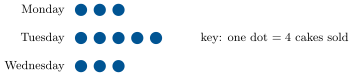
Example 20.6 (A pictogram)
In a pictogram, one symbol stands for a fixed amount — read the key first!
20.3 Exercises
Exercise 20.1 ★
For each story, just name the operation (do not compute): a flock of sheep joins a flock of ; cherries shared among children; boxes of pencils; Ali had cards and gave away .
Solution
Solution of Exercise 20.1.
Flocks joining: addition. Sharing cherries: division. Boxes of pencils: multiplication. Cards given away: subtraction.
Exercise 20.2 ★
Solve with the four steps: “A parking lot has cars in the morning; more arrive at noon. How many cars are there now?”
Solution
Solution of Exercise 20.2.
Asked: the number of cars now. Known: , then more. Operation: addition. Compute: . Sentence: there are now cars in the parking lot.
Exercise 20.3 ★
Solve: “A rope of m is cut into pieces of m. How many pieces?”
Solution
Solution of Exercise 20.3.
Grouping division: . The rope gives pieces.
Exercise 20.4 ★
Solve: “Tickets cost each. What do tickets cost?”
Solution
Solution of Exercise 20.4.
Multiplication: . The tickets cost .
Exercise 20.5 ★
Draw a bar picture, then solve: “Emma has stickers, Hugo has fewer. How many has Hugo?”
Solution
Solution of Exercise 20.5.
Comparison bar: Emma’s bar , Hugo’s bar shorter by . Subtraction: . Hugo has stickers.
Exercise 20.6 ★
Two steps: “A crate holds apples. A grocer receives crates and sells apples. How many apples remain?”
Solution
Solution of Exercise 20.6.
Received: apples. Remaining: apples.
Exercise 20.7 ★
Using the table of Example 20.5: how many science books were borrowed in the two weeks together? How many more novels in week 2 than in week 1?
Solution
Solution of Exercise 20.7.
Science books: . Novels: more in week 2.
Exercise 20.8 ★
Using the pictogram of Example 20.6: how many cakes were sold in the three days together? On which day were the most cakes sold?
Solution
Solution of Exercise 20.8.
Monday , Tuesday , Wednesday : total cakes. The best day was Tuesday.
Exercise 20.9 ★
This problem has a useless number — find it, then solve: “A -page book costs . Leo reads pages a day. How many days does he need to finish the book?”
Solution
Solution of Exercise 20.9.
The useless number is the price (). Division: (since ). Leo needs days.
Exercise 20.10 ★★
“A family of adults and children visits the museum. Adult tickets cost , children tickets . They pay with a bill. How much change do they get?” (Three steps: adults, children, then the change.)
Solution
Solution of Exercise 20.10.
Adults: . Children: . Total price: . Change: . They get back.
Exercise 20.11 ★★
Make up your own two-step problem whose answer is , write its solution with the four steps, and test it on a classmate.
Solution
Solution of Exercise 20.11.
Many correct answers — for instance: “A florist makes bunches of flowers, then removes wilted flowers. How many flowers remain?” Solution: , then .