Mathematics · Book 1 · Grades 1–9

Primary & Middle School Mathematics

Primary & Middle School Mathematics · Grades 1–9

30Computing with Decimals

Decimal numbers add, subtract and multiply almost like whole numbers — the whole art is knowing where the point goes. This chapter covers the column methods and the magic of multiplying or dividing by 1010, 100100, 10001000. (Multiplying two decimals together waits for Chapter 38.)

30.1 Adding and subtracting

Method 30.1 (Columns with a point)

  1. Write the numbers with the decimal points aligned (then units are under units, tenths under tenths);
  2. pad the shorter decimal part with zeros;
  3. add or subtract as with whole numbers;
  4. drop the point of the result straight down.

Example 30.2

27.5+3.8627.5 + 3.86 (pad 27.5=27.5027.5 = 27.50):

27.50+   3.8631.3612.40   5.65  6.75\begin{array}{r} 2\,7.5\,0 \\ +\ \ \ 3.8\,6 \\ \hline 3\,1.3\,6 \end{array} \qquad\qquad \begin{array}{r} 1\,2.4\,0 \\ -\ \ \ 5.6\,5 \\ \hline \ \ \,6.7\,5 \end{array}

For the subtraction (12.45.6512.4 - 5.65): pad, borrow as usual, and check by adding back: 6.75+5.65=12.46.75 + 5.65 = 12.4.

Example 30.3 (Mental complements)

What must be added to 7.67.6 to reach 1010? Climb: 7.687.6 \to 8 is 0.40.4, then 8108 \to 10 is 22: the complement is 2.42.4. Handy for change: pay 1010 for a 7.607.60 item, get 2.402.40 back.

30.2 Ten times bigger, ten times smaller

Proposition 30.4 (Times and divided by 10, 100, 1000)

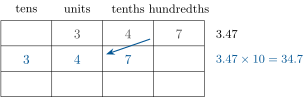
Multiplying by 1010 makes each digit worth ten times more: the digits slide one place left — which looks like the point moving one place right. Dividing does the opposite:

3.47×10=34.7,3.47×100=347,52.1÷10=5.21,6÷100=0.06.3.47 \times 10 = 34.7, \qquad 3.47 \times 100 = 347, \qquad 52.1 \div 10 = 5.21, \qquad 6 \div 100 = 0.06 .

Proof. Admitted at this level.

Multiplying by 10: every digit climbs one place to the left. The point does not really move — the digits do.
Multiplying by 1010: every digit climbs one place to the left. The point does not really move — the digits do.

Example 30.5 (Conversions again)

Units of measure are powers of ten apart, so conversions are just these shifts: 2.352.35 m =235= 235 cm (×100\times 100); 470470 g =0.47= 0.47 kg (÷1000\div 1000); 1.51.5 L =150= 150 cL.

30.3 Multiplying a decimal by a whole number

Method 30.6 (Decimal times whole)

Compute as if there were no point, then give the result as many decimal digits as the decimal factor:

4.35×6:435×6=2610  4.35×6=26.10=26.1.4.35 \times 6: \quad 435 \times 6 = 2\,610 \ \to\ 4.35 \times 6 = 26.10 = 26.1 .

Estimate to place the point with confidence: 4.354.35 is close to 44, and 4×6=244 \times 6 = 24 — so 26.126.1, not 2.612.61 nor 261261.

Example 30.7 (Repeated addition still works)

0.75×4=0.75+0.75+0.75+0.75=30.75 \times 4 = 0.75 + 0.75 + 0.75 + 0.75 = 3: four quarters make a whole, in decimal clothing. Multiplying by a whole number is still “so many times”.

Example 30.8 (Shopping)

Three notebooks at 2.452.45 each and a pen at 1.201.20:

  1. notebooks: 2.45×3=7.352.45 \times 3 = 7.35;
  2. total: 7.35+1.20=8.557.35 + 1.20 = 8.55;
  3. change from 1010: 108.55=1.4510 - 8.55 = 1.45.

30.4 Exercises

Exercise 30.1

Compute in columns: 45.7+8.9345.7 + 8.93; 16.25+3.7516.25 + 3.75; 0.86+12.40.86 + 12.4.

Solution

Solution of Exercise 30.1.

45.7+8.93=54.6345.7 + 8.93 = 54.63; 16.25+3.75=2016.25 + 3.75 = 20; 0.86+12.4=13.260.86 + 12.4 = 13.26.

Exercise 30.2

Compute in columns and check: 9.42.729.4 - 2.72; 2013.4520 - 13.45; 6.035.96.03 - 5.9.

Solution

Solution of Exercise 30.2.

9.42.72=6.689.4 - 2.72 = 6.68 (check: 6.68+2.72=9.46.68 + 2.72 = 9.4).

2013.45=6.5520 - 13.45 = 6.55 (check: 6.55+13.45=206.55 + 13.45 = 20).

6.035.9=0.136.03 - 5.9 = 0.13.

Exercise 30.3

Mental complements to 1010 (as in Example 30.3): 6.26.2; 3.753.75; 9.999.99.

Solution

Solution of Exercise 30.3.

6.2106.2 \to 10: 3.83.8. 3.75103.75 \to 10: 6.256.25. 9.99109.99 \to 10: 0.010.01.

Exercise 30.4

Compute without columns:

7.24×10,0.58×100,34.5÷10,7÷100,0.3×1000.7.24 \times 10, \qquad 0.58 \times 100, \qquad 34.5 \div 10, \qquad 7 \div 100, \qquad 0.3 \times 1000 .
Solution

Solution of Exercise 30.4.

72.472.4; 5858; 3.453.45; 0.070.07; 300300.

Exercise 30.5

Convert: 4.054.05 m in cm; 325325 cm in m; 0.60.6 kg in g; 8585 cL in L.

Solution

Solution of Exercise 30.5.

4.054.05 m =405= 405 cm; 325325 cm =3.25= 3.25 m; 0.60.6 kg =600= 600 g; 8585 cL =0.85= 0.85 L.

Exercise 30.6

Estimate first, then compute: 6.2×46.2 \times 4; 3.45×83.45 \times 8; 12.5×612.5 \times 6.

Solution

Solution of Exercise 30.6.

6.2×46.2 \times 4: estimate 2424; exactly 24.824.8.

3.45×83.45 \times 8: estimate 2828 (3.5×83.5 \times 8); exactly 27.627.6.

12.5×612.5 \times 6: estimate 7575; exactly 7575.

Exercise 30.7

One lap of a track measures 0.40.4 km. How long are 77 laps? And 2525 laps?

Solution

Solution of Exercise 30.7.

77 laps: 0.4×7=2.80.4 \times 7 = 2.8 km. 2525 laps: 0.4×25=100.4 \times 25 = 10 km.

Exercise 30.8

Lea buys 22 baguettes at 1.151.15 each and a cake at 12.6012.60. She pays with a 2020 bill. Compute her total and her change.

Solution

Solution of Exercise 30.8.

Baguettes: 1.15×2=2.301.15 \times 2 = 2.30. Total: 2.30+12.60=14.902.30 + 12.60 = 14.90. Change: 2014.90=5.1020 - 14.90 = 5.10.

Exercise 30.9

A bottle holds 1.51.5 L. How many liters in a pack of 66 bottles? A family drinks 0.750.75 L per day: for how many days does one pack last? (How many times does 0.750.75 fit in 99?)

Solution

Solution of Exercise 30.9.

Pack: 1.5×6=91.5 \times 6 = 9 L. Days: 0.75+0.75=1.50.75 + 0.75 = 1.5 L every two days, so 99 L last 1212 days (twelve servings of 0.750.75: 12×0.75=912 \times 0.75 = 9).

Exercise 30.10 ★★

Milo computes 5.6×3=15.185.6 \times 3 = 15.18, reasoning “5×3=155 \times 3 = 15 and 6×3=186 \times 3 = 18”. Use an estimate to show the answer must be wrong, then compute correctly.

Solution

Solution of Exercise 30.10.

Estimate: 5.65.6 is more than 5.55.5, and 5.5×3=16.55.5 \times 3 = 16.5 — so the product must be more than 16.516.5, and 15.1815.18 is too small. Correctly: 56×3=16856 \times 3 = 168, one decimal digit, so 5.6×3=16.85.6 \times 3 = 16.8. Milo glued his two partial products (1515 and 1818) side by side instead of adding them with their places: 15+1.8=16.815 + 1.8 = 16.8.

Exercise 30.11 ★★

A runner’s four laps took 65.465.4 s, 64.964.9 s, 65.065.0 s and 66.166.1 s.

  1. Compute the total time of the four laps.
  2. The record for four laps is 260260 s. Did she beat it? By how much?
Solution

Solution of Exercise 30.11.

1. 65.4+64.9+65.0+66.1=261.465.4 + 64.9 + 65.0 + 66.1 = 261.4 s.

2. 261.4>260261.4 > 260: she did not beat the record; she was 1.41.4 s over it.