Primary & Middle School Mathematics · Grades 1–9
68Thales’ Theorem
How do you measure the height of a pyramid without climbing it? Thales of Miletus compared its shadow with the shadow of a stick. His theorem — parallel lines cut segments in proportional pieces — is the mathematical heart of scale models, maps, and enlargements, and one of the oldest theorems with a name.
68.1 The theorem
Theorem 68.1 (Thales)
Let two lines meet at a point . Take on the first line and on the second, with further along the first and further along the second. If the lines and are parallel, then the triangles and have proportional sides:
Proof. Admitted at this level. ∎
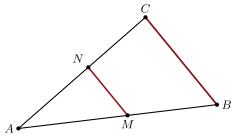
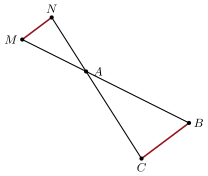
Method 68.2 (Computing a length with Thales)
- Identify the point where the two lines cross and the two parallel lines; name the two triangles;
- write the three equal ratios, always “small triangle over large triangle”;
- keep the equality of the two ratios involving the three known lengths and the unknown one;
- solve the resulting proportion by cross-multiplication.
Example 68.3
In the left configuration above, suppose , , and , and let us compute and . Thales gives
From , cross-multiplying: , so . From : , so .
Example 68.4 (Thales in real life)
A vertical stick of height m casts a shadow of m, while a tree casts a shadow of m at the same moment. Sun rays are parallel, so the stick-and-shadow and tree-and-shadow triangles are in Thales configuration:
68.2 The converse
Theorem 68.5 (Converse of Thales)
With the points placed as in Theorem 68.1 ( on , on , in the same order on both lines): if
then the lines and are parallel.
Proof. Admitted at this level. ∎
Method 68.6 (Proving or disproving parallelism)
- Compute separately the two ratios and (as fractions, not roundings);
- if they are equal and the points are in the same order on the two lines, the lines are parallel (converse of Thales);
- if they differ, the lines are not parallel — because if they were, Thales’ theorem would force the ratios to be equal.
Example 68.7
On line 1, and ; on line 2, and . Then
equal ratios, same order: .
With instead: , so the lines are not parallel.
68.3 Enlargement and reduction
Definition 68.8 (Scaling a figure)
Enlarging or reducing a figure by the scale factor means multiplying all its lengths by : an enlargement when , a reduction when . In Thales’ configuration, the triangle is the reduction of by the factor .
Proposition 68.9 (Effect on angles and areas)
Scaling by the factor preserves angles and the shape of figures, multiplies every length by , and multiplies every area by .
Proof. Admitted at this level. ∎
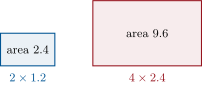
Example 68.10
A photo of cm is enlarged with scale factor : the print measures cm. Its area goes from cm to cm — times larger, not .
68.4 Exercises
Exercise 68.1 ★
The lines and are parallel, with on and on ; , , , . Compute and .
Solution
Solution of Exercise 68.1.
Thales: , i.e. . So gives , and gives .
Exercise 68.2 ★
Same configuration: , (careful: , not !), . Compute .
Solution
Solution of Exercise 68.2.
First find . Then gives , so and .
Exercise 68.3 ★
In a butterfly configuration, is between and and between and , with ; , , , . Compute and .
Solution
Solution of Exercise 68.3.
The butterfly works exactly like the nested configuration: , i.e. . So gives , and gives .
Exercise 68.4 ★
is on with , ; is on with , . Are the lines and parallel?
Solution
Solution of Exercise 68.4.
and : equal ratios, points in the same order, so by the converse of Thales.
Exercise 68.5 ★★
Same as above with , , , . Are and parallel? Justify carefully.
Exercise 68.6 ★★
A m tall person stands m away from a street lamp’s base; their shadow measures m. Draw the Thales configuration formed by the lamp, the person, and the tip of the shadow, and compute the height of the lamp.
Exercise 68.7 ★★
A map has scale (lengths on the map are the real lengths multiplied by ).
- Two villages are cm apart on the map. What is the real distance, in km?
- A forest has an area of cm on the map. What is its real area, in km?
Solution
Solution of Exercise 68.7.
1. Real distance: cm km.
2. Areas scale by : real area cm cm cm. Since km cm, that is km.
Exercise 68.8 ★★
Triangle has , , . The point on satisfies , and the line through parallel to cuts at .
- Compute and .
- What is the scale factor from to ? Compare the perimeters of the two triangles.
Solution
Solution of Exercise 68.8.
1. The ratio is . Thales: and .
2. The scale factor is . Perimeters: has , and has : the perimeter scales by too, like every length.
Exercise 68.9 ★★★
Let be a trapezoid with , and , whose diagonals and meet at . Using Thales in the butterfly configuration around , compute the ratio , and show that cuts both diagonals in the same ratio.
Solution
Solution of Exercise 68.9.
Around , the lines and cross, and : butterfly configuration with the triangles and . Thales gives
So , and the equality says precisely that cuts the two diagonals in the same ratio.
68.5 Problem: The unmarked ruler, the pinhole camera, and the three means of a trapezoid
Problem 68.1
Weekend problem — Thales at work: dividing any segment into equal parts, measuring the Sun with a shoebox, and a trapezoid where all three famous means meet
Thales’ theorem is the mathematics of rays: sun rays, light rays through a pinhole, pencil rays from a vertex. This problem uses it three ways — as a construction tool (dividing a segment of any length, even , into perfectly equal parts), as a measuring instrument (the diameter of the Sun, with a shoebox and a coin), and as a magnifying glass on the trapezoid of Exercise 68.9, where the arithmetic, geometric and harmonic means of this series all turn up in one figure.
Part I — Dividing with an unmarked ruler.
- Draw a segment of cm. To cut it into three equal parts with compass and unmarked ruler: draw any ray from (not through ); step off three equal compass lengths on it, giving points , , ; join to ; draw the parallels to through and . Perform the construction and mark where the parallels cut .
- Justify with Theorem 68.1 that the two marked points cut exactly at its third points.
- Adapt the method to divide a segment into equal parts, then to construct of a given segment.
- Construct the point of with (that is, at of the way from ). How many equal steps on the ray, and which point joins ?
- Why is this construction better than measuring with a graduated ruler? Consider a segment of length (a unit square’s diagonal, irrational by Problem 65.1): what would measuring give, and what does Thales give?
Part II — The pinhole camera. Poke a pin through one face of a closed box: on the opposite face, an upside-down image of the world appears. A point of an object, the pinhole, and the image point are aligned — light travels straight — so the object (height , at distance in front of the hole) and its image (height , on the back wall at depth behind the hole) sit in the butterfly configuration of Thales.
- Derive the pinhole formula from Thales in the butterfly around the hole.
- A m tree stands m from a shoebox of depth cm. How tall is its image, and which way up?
- Point the box at the Sun: at m behind the pinhole, the Sun’s image is a disk of diameter about mm. Given the Sun’s distance m, compute its diameter in scientific notation (Problem 63.1’s notation at work). Compare with the true value, m.
- The Moon: diameter m, distance m. Compute the ratio for the Moon and for the Sun. What lucky coincidence do the two numbers reveal — and what spectacular event does it make possible?
- In one or two sentences: why is the pinhole image upside down, and why does enlarging the pinhole make the image brighter but blurrier?
Part III — The trapezoid of the three means. is the trapezoid of Exercise 68.9: , , , diagonals crossing at with .
- Butterfly practice: two lines cross at with in butterfly position; , , and . Compute and .
- Explain how Thales, applied with ratio , contains the midpoint theorem of Theorem 59.1 as its special case.
- Draw the parallel to the bases through ; it meets at . Working in the triangle (note ), compute .
By the mirror computation in the triangle , the piece (with on ) has the same length. Conclude that
the parallel through the diagonal crossing measures the harmonic mean of the bases — the round-trip mean of Problem 61.1, reappearing in pure geometry.
- The grand finale: compute the three classical means of the bases and — arithmetic , geometric , harmonic — and order them. Each lives in the trapezoid: the arithmetic mean is the midline joining the legs’ midpoints (Problem 53.1), the harmonic mean is your segment , and the geometric mean is the parallel that cuts the trapezoid into two similar trapezoids (check its value with a calculator; the proof is a lovely extra challenge). Where has the inequality between the three been proved in this book (Problem 60.1, Problem 61.1)?
Solution
Solution of Problem 68.1.
1. The construction produces two points on ; call them (from ) and (from ).
2. In the triangle , the parallels to through and cut the sides proportionally (Theorem 68.1):
The compass made , , equal, so the ratios are exactly thirds — whatever the angle of the ray and the compass opening chosen.
3. For fifths: step off five equal lengths, join the fifth point to , and draw four parallels. For of a segment: same figure, and take the point cut by the parallel through : it sits at of from .
4. means : five equal steps on the ray, join to , and the parallel through marks .
5. Measuring cm only ever uses finitely many decimals: any measured “third” is an approximation. The Thales construction never reads a number: it delivers the exact point at — equal parts of a segment no ruler can even express (Problem 65.1).
6. The object’s top, the hole and the image’s bottom are aligned, and likewise for the object’s bottom and the image’s top: two lines crossing at the hole, with the object and the image wall parallel. Thales in the butterfly:
7. m cm — upside down (the rays cross at the hole).
8. m. True value m: a shoebox measures the Sun to within a few percent.
9. Moon: . Sun: . The two ratios — the apparent sizes in the sky — are almost identical: the Moon can cover the Sun exactly, rim to rim. That cosmic fluke is the total solar eclipse.
10. Every ray must pass through the one hole, so rays from the top of the object continue down and rays from the bottom continue up: the image is inverted. Enlarging the hole lets through a whole bundle of slightly shifted copies of the image, which overlap: brighter, but smeared.
11. , so ; and , so .
12. If the parallel passes through the midpoint of one side, the Thales ratio is , so it cuts the second side at its midpoint, and the parallel segment measures half the base: precisely Theorem 59.1. Thales is the midpoint theorem freed from the ratio .
13. In the triangle , the line is parallel to the base , with . Thales: , so .
14. In the triangle , likewise and . Hence
the harmonic mean of the bases — the mean of round trips (Problem 61.1), drawn in a trapezoid.
15. Arithmetic: ; geometric: ; harmonic: . Order: , i.e. harmonic geometric arithmetic — with equality only for equal bases. In the figure: the midline measures , the parallel through the diagonal crossing , and the similarity cut , all stacked between the bases in that order. The inequalities were proved in Problem 60.1 (geometric arithmetic, by circle and by identity) and Problem 61.1 (harmonic arithmetic); harmonic geometric follows by combining them (, proved there too).