Grade 3 multiplied by one digit (Chapter 16); this chapter multiplies by two-digit numbers — and explains the mysterious “shifted line” of the column method, which is nothing but a splitting into tens and units.
22.1 Multiplying by tens
Proposition 22.1(Times 10, 20, 300 …)
Multiplying by 10 appends one zero, by 100 two zeros. To multiply by 20, multiply by 2, then by 10:
36×20=36×2×10=72×10=720.
Likewise 14×300=14×3×100=4200.
Proof.Admitted at this level.∎
22.2 The column method with two digits
Example 22.2(Why the shifted line?)
To compute 23×12, split 12 into 10+2:
23×12=23×2+23×10=46+230=276.
The column method writes exactly these two products, one under the other — the second shifted left because it is a number of tens:
23×124623⋅276
(the dot marks the units place of the shifted line, often left blank).
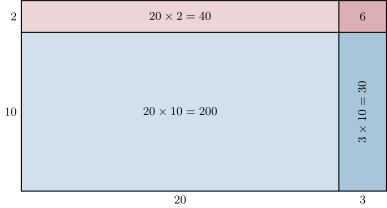
The rectangle picture of 23×12: four easy products, 200+40+30+6=276. The column method groups them into two lines: 46 (the “×2” row) and 230 (the “×10” row).
Method 22.3(Column multiplication by a two-digit number)
To compute 457×36:
first line: 457×6=2742;
second line: 457×3tens=1371 tens — write 1371 shifted one place left;
add the two lines: 2742+13710=16452;
estimate to check: 457×36≈500×36=18000? Better: 450×36 is about 16000 — plausible.
457×3627421371⋅16452
Example 22.4(Mental tricks)
Split the friendly way: 18×11=18×10+18=198.
Use a near-hundred: 25×99=25×100−25=2475.
Double and halve: 16×35=8×70=560 (halving one factor and doubling the other keeps the product).
22.3 Multiplication in problems
Example 22.5
A school orders 28 boxes of 145 sheets of paper.
Operation: 145×28.
Estimate: 150×30=4500, a bit too much on both counts.
Columns: 145×8=1160; 145×2 tens =2900; total 4060.
Every day, a bakery uses 67 kg of flour. About how much flour is that in a 30-day month — estimate with rounded numbers, then compute exactly.
Solution
Solution of Exercise 22.10.
Estimate: 70×30=2100 kg. Exactly: 67×30=2010 kg.
Exercise 22.11★★
Explain, with a rectangle picture like the one of this chapter, why 15×12 can be computed as 15×10+15×2. Then invent another splitting of 15×12 that also works.
Solution
Solution of Exercise 22.11.
A 15×12 rectangle of unit squares can be cut by a vertical line into a 15×10 part and a 15×2 part: counting each part gives 150+30=180. Another cut works just as well, for instance 15=10+5: 10×12+5×12=120+60=180. Any way of cutting the rectangle leaves the total number of squares unchanged.