Primary & Middle School Mathematics · Grades 1–9
19Measuring
How long, how heavy, how much does it hold, how late is it? Measuring turns the world into numbers — provided everyone uses the same units. This chapter presents the units of length, mass and capacity, and teaches how to read a clock.
19.1 Lengths
Definition 19.1 (Units of length)
The basic unit of length is the meter (m). For small lengths: the centimeter (cm) and the millimeter (mm); for long distances: the kilometer (km).

Example 19.2 (Choosing the right unit)
An ant: about mm. A pencil: about cm. A door: about m. A walk to the next village: about km. Giving “the length of a pencil is ” means nothing — the unit is part of the answer.
Method 19.3 (Converting units)
To convert, multiply or divide by , or :
- from a big unit to a small one, multiply: m cm;
- from a small unit to a big one, divide: cm m and cm;
- to add lengths, convert them to the same unit first: m cm cm.
19.2 Masses and capacities
Definition 19.4 (Units of mass and capacity)
Masses are measured in grams (g) and kilograms (kg), capacities (how much a container holds) in liters (L) and centiliters (cL):
Example 19.5
A letter: about g. A bag of flour: kg. A bathtub: about L. A glass: about cL. To balance a scale holding a kg bag against g of apples, add g on the apples’ side.
19.3 Reading the clock
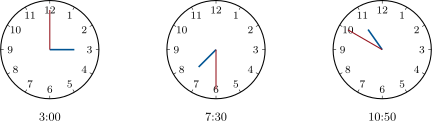
Method 19.6 (Reading the time)
On a clock with hands:
- the short hand gives the hour: read the number it has passed last;
- the long hand gives the minutes: each big mark is minutes, so a long hand on the means minutes;
- after half past, one can also read “to the next hour”: is “ten to eleven”.
Example 19.7 (Durations)
The film starts at and ends at . How long is it? Count in two hops:
- from to : minutes;
- from to : hour minutes.
Total: h min. Careful: an hour has minutes, so minus cannot be computed like !
19.4 Exercises
Exercise 19.1 ★
Which unit would you use (mm, cm, m or km) for: the width of a nail; the height of a classmate; the length of the schoolyard; the distance between two towns?
Solution
Solution of Exercise 19.1.
Nail width: mm. Classmate’s height: cm (or m). Schoolyard: m. Distance between towns: km.
Exercise 19.2 ★
Convert: m into cm; mm into cm; km into m; cm into m.
Solution
Solution of Exercise 19.2.
m cm; mm cm; km m; cm m.
Exercise 19.3 ★
Measure with your ruler (to the nearest millimeter) the sides of a triangle drawn by a classmate, and compute the total length of its border.
Solution
Solution of Exercise 19.3.
Answers depend on the triangle; the total length of the border is the sum of the three measured sides (this total is called the perimeter, studied in Chapter 28).
Exercise 19.4 ★
Compute, converting first: m cm (in cm); km m (in m); cm mm (in mm).
Solution
Solution of Exercise 19.4.
m cm cm.
km m m.
cm mm mm.
Exercise 19.5 ★
Convert: kg into g; g into kg and g; L into cL; cL into L and cL.
Solution
Solution of Exercise 19.5.
kg g; g kg and g; L cL; cL L and cL.
Exercise 19.6 ★
A recipe needs g of flour. Mona has a kg bag. Does she have enough? How much will be left?
Solution
Solution of Exercise 19.6.
kg g g: yes, she has enough, and g will be left.
Exercise 19.7 ★
Read the times: the short hand is between and , the long hand on the ; the short hand on the , the long hand on the ; the short hand almost on the , the long hand on the .
Solution
Solution of Exercise 19.7.
Short hand between and , long hand on the : . Short hand on , long hand on : . Short hand almost on , long hand on : (“ten to five” — the hour hand has not reached the yet).
Exercise 19.8 ★
School starts at and the morning ends at . How long is the morning? (Count in hops, as in Example 19.7.)
Solution
Solution of Exercise 19.8.
From to : min; from to : h min. Total: h min.
Exercise 19.9 ★
The train leaves at and the ride lasts minutes. At what time does it arrive? (Hop to first.)
Solution
Solution of Exercise 19.9.
From to : min; there remain min after . Arrival: .
Exercise 19.10 ★★
A bottle holds L. Paul fills glasses of cL. How many full glasses can he pour? (Convert first.)
Solution
Solution of Exercise 19.10.
L cL, and : Paul can pour full glasses.
Exercise 19.11 ★★
Lena walks m to school, and back, every day. How many meters does she walk in a -day school week? Give the answer in meters, then in kilometers.
Solution
Solution of Exercise 19.11.
Each day: m. In five days: m km.