Primary & Middle School Mathematics · Grades 1–9
12Money and Measures
Measuring rulers, kitchen scales, jugs, coins, clocks and calendars: this chapter is about the numbers of everyday life — how long, how heavy, how much it holds, how much it costs, and what time it is.
12.1 Lengths, masses, capacities
Definition 12.1 (Everyday units)
- Length: centimeter (cm) for small things, meter (m) for big ones, with m cm;
- mass: gram (g) for light things, kilogram (kg) for heavy ones, with kg g;
- capacity (how much a container holds): liter (L).
Smaller units and their exact rules come in Chapter 19.
Example 12.2 (Which unit?)
A crayon: about cm. A door: about m. An apple: about g. A big bag of flour: kg. A milk bottle: L. Guess the unit before measuring — it stops silly answers like “the door is cm”.
12.2 Money
Method 12.3 (Making an amount)
With coins and bills of , , , , :
- start with the biggest that fits, then fill the rest;
- to make : a , a , and a ;
- there are often several ways — is also .

Example 12.4 (Change)
A book costs ; you pay with a . The change is , found by counting up: is (Method 9.4).
12.3 Time
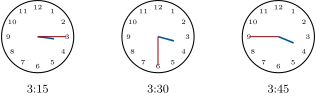
Method 12.5 (Half and quarter hours)
The long hand tells the minutes past the hour:
- straight up (): on the hour — ;
- quarter turn to the right (): quarter past — ;
- straight down (): half past — ;
- three-quarter turn (): quarter to the next hour — , “quarter to four”.
Example 12.6 (The calendar)
A year has months, in order: January, February, March, April, May, June, July, August, September, October, November, December. Most months have or days; February has (or ). A date names the day and the month: “the th of March”.
12.4 Exercises
Exercise 12.1 ★
Choose the unit (cm, m, g, kg or L): a pencil; the classroom length; a feather; a schoolbag; a water bottle.
Solution
Solution of Exercise 12.1.
Pencil: cm. Classroom length: m. Feather: g. Schoolbag: kg. Water bottle: L.
Exercise 12.2 ★
Convert: m into cm; cm into m; kg into g.
Solution
Solution of Exercise 12.2.
m cm; cm m; kg g.
Exercise 12.3 ★
Make these amounts with coins and bills: ; ; . Give one way for each.
Solution
Solution of Exercise 12.3.
For example: ; ; . (Other ways are possible.)
Exercise 12.4 ★
Compute the change: pay for a toy; pay for a book; pay for a game.
Solution
Solution of Exercise 12.4.
; ; .
Exercise 12.5 ★
Read the time: long hand on , short hand between and ; long hand on , short hand just after .
Solution
Solution of Exercise 12.5.
Long hand on , short between and : half past four (). Long hand on , short just after : quarter past eight ().
Exercise 12.6 ★
Draw a clock showing half past two. Where does each hand point?
Solution
Solution of Exercise 12.6.
Half past two: the long hand points down to the , the short hand sits between the and the .
Exercise 12.7 ★
Name the month: after May; before January; the month of your birthday.
Solution
Solution of Exercise 12.7.
After May: June. Before January: December. (Birthday month varies.)
Exercise 12.8 ★
Lea buys a drink for and a cake for . She pays with a bill. How much change?
Solution
Solution of Exercise 12.8.
Spent: . Change: .
Exercise 12.9 ★
Which is heavier: a kg bag of sugar or g of apples? By how many grams?
Solution
Solution of Exercise 12.9.
kg g, which is more than g: the sugar is heavier, by g.
Exercise 12.10 ★★
Make with exactly four coins or bills (chosen from , , , , ). Find two different ways.
Solution
Solution of Exercise 12.10.
For example and (two ways with exactly four coins or bills).