Primary & Middle School Mathematics · Grades 1–9
34Perimeter and Area
Grade 4 counted grid squares (Chapter 28); this chapter earns the first area formula — length times width for the rectangle — and learns the units cm and m. The formulas for triangles and other shapes ripen in Chapter 43 and Chapter 53.
34.1 Two different measures
Example 34.1 (Border vs surface)
A gardener needs perimeter to buy the fence and area to buy the grass seed. The two do not follow each other: stretching a rectangle thinner and longer can keep its area while its perimeter grows — compare a and a rectangle (same area , perimeters and ).
34.2 The rectangle formula
Proposition 34.2 (Area of a rectangle)
A rectangle of length and width (in the same unit) has area
in square units: cm (squares of side cm), m (squares of side m), …
Why, by counting. Cover the rectangle with unit squares: rows of squares each, so squares in total — exactly the multiplication rectangle of Chapter 16. ∎
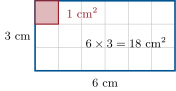
Example 34.3
A rug measures m by m: area m. A stamp measures cm by cm: area cm. Same formula, any unit — as long as both sides use the same one.
Example 34.4 (Square units convert by 100)
m cm, but m cm: a square meter is a -by- grid of square centimeters. Area units jump by hundreds, not tens.
34.3 Composite figures
Method 34.5 (Cut, add, subtract)
For a figure made of rectangles (an L, a T, a frame):
- cut it into rectangles, or complete it into a big rectangle;
- compute each rectangular area with the formula;
- add the pieces — or subtract the hole from the big rectangle;
- check against a rough count of grid squares.
Example 34.6
An L-shaped room: a m m rectangle with a m m corner missing.
Or cut the L into a strip and a strip: m — two roads, one answer.
Example 34.7 (Half a rectangle)
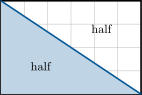
Cutting a rectangle along a diagonal gives two triangles of the same area: each is half the rectangle. A right triangle with legs cm and cm therefore has area cm — a picture worth remembering for Chapter 43, where it becomes a formula.
34.4 Exercises
Exercise 34.1 ★
Compute the area and the perimeter of a rectangle cm cm. Which answer is in cm, which in cm?
Exercise 34.2 ★
Compute the areas: a square of side cm; a rectangle m m; a rectangle cm cm.
Solution
Solution of Exercise 34.2.
cm; m; cm.
Exercise 34.3 ★
A rectangle has area cm and length cm. Find its width, then its perimeter.
Exercise 34.4 ★
Draw two different rectangles with area squares on grid paper, and compute both perimeters. Same area — same perimeter?
Solution
Solution of Exercise 34.4.
For instance (perimeter ) and (perimeter ): same area , different perimeters.
Exercise 34.5 ★
Convert: m in cm; cm in m. (Remember Example 34.4: by hundreds!)
Solution
Solution of Exercise 34.5.
m cm; cm m.
Exercise 34.6 ★
A T-shaped figure is made of a horizontal bar on top of a vertical bar (in cm). Compute its area by adding two rectangles.
Solution
Solution of Exercise 34.6.
Bar: cm; stem: cm; total cm.
Exercise 34.7 ★
A picture frame: a cm cm rectangle with a cm cm rectangular window cut out. What area of wood does the frame use?
Solution
Solution of Exercise 34.7.
cm of wood.
Exercise 34.8 ★
Compute the area of a right triangle with legs cm and cm (half a rectangle, Example 34.7).
Exercise 34.9 ★
A rectangular vegetable patch measures m by m. Seed costs per square meter, and fencing per meter. Compute the cost of the seed, then the cost of the fence.
Exercise 34.10 ★★
A corridor floor is m long and m wide, and must be covered with square tiles of side cm. How many tiles are needed? (Convert first, or count tiles along each direction.)
Solution
Solution of Exercise 34.10.
Two tiles of cm make a meter: along the m length, tiles; along the m width, tiles. Total: tiles.
Exercise 34.11 ★★
Double the sides of a cm cm rectangle. What happens to its perimeter? To its area? (Compute both before and after — the two answers differ!)