Primary & Middle School Mathematics · Grades 1–9
56Powers
Fold a sheet of paper in half times (if you can!): its thickness doubles each time, and doublings multiply it by . Powers are the shorthand of repeated multiplication; this chapter sets up the notation and its rules, with a special role for the powers of .
56.1 Definition
Definition 56.1 (Power)
For a number and a whole number :
read “ to the (power) ”; is the base, the exponent. Special names: is “ squared”, “ cubed”. By convention:
Example 56.2
; ; ; and (Example 54.5). Watch out: is not : , not .
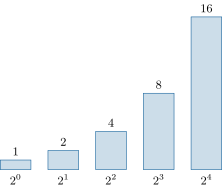
56.2 The rules of exponents
Theorem 56.3 (Rules of exponents)
For a nonzero base and whole-number exponents , :
Proof by counting factors. lines up factors followed by more: in total. repeats a block of factors times: factors. contains letters and letters , which can be regrouped. The quotient rule comes from canceling of the factors; with the conventions and , it remains true even when . ∎
Example 56.4
A trap: the rules apply to a common base (or a common exponent, for the last one). No rule simplifies — just compute: .
56.3 Powers of ten
Proposition 56.5 (Powers of ten)
For : , and . The rules of exponents read: multiplying powers of ten adds the exponents.
Example 56.6
; . Large and small quantities become readable:
Combined with decimals: and (shift the decimal point, Proposition 38.7). The systematic use of this writing — scientific notation — is developed in Chapter 63.
Example 56.7 (Orders of magnitude)
Light travels about m/s; a year has about seconds. A light-year is therefore about
— ten million billion meters. Powers of ten make astronomical computations fit on one line.
Method 56.8 (Simplifying an expression with powers)
- Group the factors base by base;
- apply the exponent rules within each base;
- compute the remaining small powers, or leave the answer as a power if it is large.
Example 56.9
56.4 Exercises
Exercise 56.1 ★
Compute:
Solution
Solution of Exercise 56.1.
; ; ; ; ; .
Exercise 56.2 ★
Compute:
Solution
Solution of Exercise 56.2.
; ; ; ; .
Exercise 56.3 ★
Write as a single power:
Exercise 56.4 ★
Write as a decimal number: ; ; ; .
Solution
Solution of Exercise 56.4.
; ; ; .
Exercise 56.5 ★
Write with a power of ten: one hundred thousand; one tenth; ten billion; .
Solution
Solution of Exercise 56.5.
; ; ; .
Exercise 56.6 ★
Simplify, then compute:
Solution
Solution of Exercise 56.6.
.
.
.
Exercise 56.7 ★
True or false? Correct the false ones.
Exercise 56.8 ★★
A rumor spreads: on day 1, three people know it; each day, every person who knows tells three new people. Write with a power the number of new people informed on day , and compute how many people know the rumor at the end of day 4 (including the original three).
Solution
Solution of Exercise 56.8.
New people on day : each of the people informed on day 3 tells three others: . Knowing at the end of day 4: people.
Exercise 56.9 ★★
A sheet of paper is mm thick, i.e. m. Folding it doubles its thickness each time.
- Express the thickness after folds as a product, and compute it in centimeters ().
- After folds the thickness would be m, with . Show that this exceeds the Earth–Moon distance, about m.
Solution
Solution of Exercise 56.9.
1. Thickness: m m m cm.
2. m, larger than m: after (theoretical!) folds, the wad of paper would pass the Moon.
Exercise 56.10 ★★
Order from smallest to largest, without a calculator:
(Compute each one; and are famous neighbors.)
Solution
Solution of Exercise 56.10.
; ; ; . Order:
Exercise 56.11 ★★★
Which is larger, or ? Use to compare with .
Solution
Solution of Exercise 56.11.
and . Since , multiplying ten copies of each keeps the inequality: .
56.5 Problem: The chessboard and the powers of two
Problem 56.1
Weekend problem — the geometric sum , from a famous legend to binary numbers
The legend: as a reward for inventing chess, the sage Sissa asked his king for one grain of wheat on the first square of the board, two on the second, four on the third — doubling from square to square, up to the sixty-fourth. The king laughed at such modesty. This problem computes what the king promised, using the exponent rules of Theorem 56.3, and ends where the story secretly leads: the binary numbers inside every computer.
Part I — The doubling trick. For , let be the total number of grains on the first squares.
- Express the number of grains on square as a power of . Which power sits on square ?
- Compute , , , and , and compare each with a nearby power of . Conjecture a formula for .
The doubling trick: write the sums and one under the other, subtract, and prove your conjecture:
- How many grains did the king promise in total? Express the answer with a power of , and complete the classic remark: “the whole board holds one grain fewer than a single sixty-fifth square would.”
- Show that the second half of the board (squares to ) holds exactly times as many grains as the first half.
Part II — How big is ? The comparison of Exercise 56.11 is the key to all the estimates below.
- Show that .
- A grain of wheat weighs about g, i.e. g. Show that the promised wheat weighs more than g, and convert this into tonnes ( tonne g).
- The whole world currently harvests about tonnes of wheat per year. At least how many years of world harvest did the king promise?
- Find the smallest whole number such that — that is, how many doublings it takes to pass one million. (Compute and exactly, using .)
- A trickster offers you a month’s salary: cent on day , then double the previous day’s pay each day. On which day does the daily pay alone first exceed one million euros ( cents)? (Compute and exactly.)
Part III — Binary weights. A merchant owns five weights: , , , and grams, one of each. She places some of them on one pan of a balance to weigh goods on the other pan.
- Which weights does she place to weigh g? To weigh g?
- Explain why any target of g or more must use the g weight, and why any target of g or less must not use it. (Question 3 tells you what the weights can reach at most.) Explain why the same reasoning repeats with the next-largest weight, at every stage.
- Deduce that every whole target from to g can be weighed, and in exactly one way: each number between and is a sum of distinct powers of in a single manner.
- The merchant buys a sixth weight, of g. Up to what target can she now weigh? Write g as a sum of distinct powers of .
- In a computer, a “64-bit” number is stored on squares, each holding a or a — square contributing when it holds a , like the grains of the legend. Using Part I, explain why the whole numbers such a machine can store run exactly from to .
Solution
Solution of Problem 56.1.
1. The grains double from square to square starting at : square holds grains (Definition 56.1). Square holds .
2. , , , , : always one less than the next power of (, , , , ). Conjecture: .
3. Doubling every term of shifts each power up by one ():
Subtracting the first line from the second, every term from to appears in both and cancels:
4. The total is grains. A sixty-fifth square would hold grains: the whole board carries exactly one grain fewer than that single square would.
5. The first half holds grains. The whole board holds , so the second half holds
(factor out , using , Theorem 56.3): exactly times the first half.
6. By the exponent rules, . Since ,
7. More than grains at g each:
Dividing by g per tonne: more than tonnes — eight hundred billion tonnes.
8. : the king promised at least a thousand years of today’s entire world harvest. (The legend says his advisers told him as much.)
9. , while . So the smallest exponent is : twenty doublings pass the million.
10. The pay on day is cents (day 1: ). Now
So the daily pay first exceeds cents when : on day .
11. : weights , and g. : weights , , and g.
12. By question 3, the weights together weigh g. So without the g weight the merchant cannot pass g: any target of g or more must use it. And a target of g or less must not use it, since the g weight alone already exceeds the target. The choice of the largest weight is therefore forced. What remains is a target of at most g to be formed with — and the same argument repeats: is forced (used if the remaining target is , unused otherwise, because ), then (because ), then , then .
13. Following the forced choices, the remaining target after each stage is at most the total of the remaining weights, so the process ends with remainder : every target from to is reached. And since every choice along the way was forced, no other selection of weights can reach the same target: the writing of each number from to as a sum of distinct powers of exists and is unique.
14. The six weights total g, and the same forced-choice argument covers every target from to g. For : the target is , so use ; remains , so skip ; use (remains ), use (remains ), skip , use :
15. Choosing a or a on each of the squares amounts to choosing which powers to include in a sum — exactly the merchant’s weighing with weights. The smallest storable number is (all squares at ); the largest is the sum of all the powers, which is the king’s total: (Part I). By the forced-choice argument, every whole number in between is reached exactly once: a -bit machine stores precisely the whole numbers from to .