Primary & Middle School Mathematics · Grades 1–9
47Fractions: Comparing and Adding
Grade 6 introduced fractions as shares and as exact quotients (Chapter 39). This chapter learns to compute with them: recognizing equal fractions, comparing, adding and subtracting — for now with friendly denominators; the general case comes in Chapter 63.
47.1 Equal fractions
Theorem 47.1 (Equal fractions)
A fraction is unchanged when its numerator and denominator are multiplied, or divided, by the same nonzero number:
Proof. Admitted at this level. ∎
Example 47.2
, and in the other direction (simplified by ).
To test whether and are equal, simplify both: and — yes, equal.
47.2 Comparing fractions
Method 47.3 (Comparing two fractions)
- Same denominator: compare the numerators: .
- One denominator is a multiple of the other: rewrite the coarser fraction, then compare: vs : .
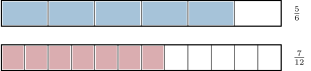
- Compare with or when possible: settles vs instantly.
47.3 Adding and subtracting
Theorem 47.4 (Same denominator)
Fractions with the same denominator are added (or subtracted) by adding (or subtracting) the numerators:
Why. parts of size plus parts of the same size make parts of that size. ∎
Method 47.5 (Different denominators)
When one denominator is a multiple of the other:
- rewrite the fraction with the smaller denominator so both have the larger one (Theorem 47.1);
- add or subtract the numerators;
- simplify the result if possible.
Example 47.6
Compute , step by step:
- is a multiple of : rewrite ;
- add: ;
- nothing to simplify: the result is , i.e. .
Another: (write the whole number over the denominator first).
Example 47.7 (A classic trap)
is not ! Adding numerators and denominators separately is wrong — the answer would be smaller than , absurd when adding something positive to . (The correct sum, , needs a common denominator ; the general method is in Chapter 63.)
47.4 Multiplying a fraction by a number
Proposition 47.8 (Fraction times a number)
For a number :
Taking of a quantity means multiplying by .
Proof. Admitted at this level. ∎
Example 47.9
: six times two thirds is four wholes. And “ of euros” is euros — the same answer as dividing by then multiplying by (Method 39.8).
47.5 Exercises
Exercise 47.1 ★
Complete: ; ; ; .
Solution
Solution of Exercise 47.1.
; ; ; .
Exercise 47.2 ★
Simplify as much as possible: ; ; ; .
Solution
Solution of Exercise 47.2.
; ; ; .
Exercise 47.3 ★
Are and equal? And and ? Justify by simplifying.
Solution
Solution of Exercise 47.3.
and : equal.
and : to compare, and — not equal.
Exercise 47.4 ★
Compare (write the reasoning, not just the answer):
Exercise 47.5 ★
Compute and simplify if possible:
Solution
Solution of Exercise 47.5.
; ; .
Exercise 47.6 ★
Compute using Method 47.5:
Solution
Solution of Exercise 47.6.
.
.
.
Exercise 47.7 ★
Compute:
Solution
Solution of Exercise 47.7.
; ; .
Exercise 47.8 ★
Compute:
Solution
Solution of Exercise 47.8.
; ; of is .
Exercise 47.9 ★★
Marc ate of a pizza and Julie of the same pizza. What fraction of the pizza did they eat together? What fraction is left?
Solution
Solution of Exercise 47.9.
Together: of the pizza. Left: .
Exercise 47.10 ★★
A bottle contains L of juice. Lea pours out L twice. How much juice remains? (Common denominator: .)
Solution
Solution of Exercise 47.10.
Poured out: L. Remaining:
Exercise 47.11 ★★
Explain, with the argument of Example 47.7, why cannot be , without computing the correct sum.
Solution
Solution of Exercise 47.11.
Adding the positive quantity to must give a result larger than . But (indeed and ): the claimed sum is smaller than one of its terms — impossible.
Exercise 47.12 ★★★
Compute the sum
step by step (left to right). Observe the pattern of the partial sums: what number do they approach as more and more terms are added?
47.6 Problem: The fractions hidden in a bar of music
Problem 47.1
Weekend problem — note values are fractions that must add up exactly, rhythm counting hides a famous sequence, and parity rules the Balkan beat
Music is written in fractions. A whole note lasts measure (in the common “four-four” time); a half note lasts ; then come the quarter note , the eighth note and the sixteenth note . One inviolable law: the durations inside a measure must add up to exactly the measure’s total — in four-four time. Every question below is this chapter’s arithmetic (Theorem 47.4, Method 47.5) set to music; on the way you will meet a counting sequence discovered by Indian scholars a thousand years ago.
Part I — Notes that must add up.
- Check that each of these measures is legal in four-four time: (a) half quarter quarter; (b) quarter eighth eighth half.
- A copyist wrote: half quarter eighth. What fraction of the measure is written, and which single note completes it?
- How many sixteenth notes fill one whole measure? How many sixteenths make one eighth note?
- A dot after a note adds half the note’s value: a dotted half is , a dotted quarter is . Compute both values.
- A waltz is written in three-four time: each measure must total . Check that a single dotted half fills a waltz measure, and write down two other legal waltz measures using only quarters and eighths.
Part II — The copyist’s workshop.
- A four-four measure contains: dotted quarter eighth quarter. What is missing?
- Which lasts longer, a dotted eighth or a quarter note? Compare via sixteenths.
- A tie glues durations together into one long sound: a half note tied to an eighth lasts how long? How many sixteenths is that?
- The notes of a measure add up to ; the remainder is silence (a rest). How long is the rest?
- A drummer fills one quarter note ( of the measure) using only eighths () and sixteenths (), order mattering: for instance eighth–sixteenth–sixteenth, or sixteenth–eighth–sixteenth. Check that both examples are legal, then list all the possible rhythms. How many are there?
Part III — A thousand-year-old sequence, and an odd measure.
- Let us count the drummer’s rhythms for longer notes. Every rhythm ends either with a sixteenth or with an eighth; explain why this gives the rule: (rhythms filling sixteenths) (rhythms filling ) (rhythms filling ). Starting from rhythm for one sixteenth and for two, build the table up to : how many rhythms fill a half note?
- The numbers you found — — were published by the Indian scholar Hemachandra around the year 1150, counting exactly such rhythms, two generations before Fibonacci wrote them down in Italy. State their defining pattern in one sentence, and check it on the last three entries of your table.
- “Swing” style replaces two equal eighths by a long–short pair: then . Verify that the swap is legal (same total duration), using the common denominator .
- A triplet squeezes three equal notes into one quarter note. How long is each note (check your answer by multiplying it by , Proposition 47.8)? Same question for three equal notes filling a half note.
- Balkan dance music uses seven-eight time: each measure totals . Verify that dotted quarter quarter quarter fills it. Then explain why no combination of half notes and quarter notes alone, however many, can ever fill a seven-eight measure. (Count in eighths and think about even and odd.)
Solution
Solution of Problem 47.1.
1. (a) : legal. (b) : legal.
2. : one eighth note is missing.
3. A measure is : sixteen sixteenth notes. An eighth is : two sixteenths.
4. Dotted half: . Dotted quarter: .
5. The dotted half is worth (question 4): exactly one waltz measure. Other fillings, for instance: quarter quarter quarter (), or quarter eighth eighth quarter ().
6. : one quarter note () is missing.
7. Dotted eighth: . Quarter: . The quarter is longer.
8. , that is : ten sixteenths.
9. of the measure is silence.
10. Both examples total : legal. All rhythms filling four sixteenths with pieces of and :
five rhythms.
11. A rhythm filling sixteenths ends either with a sixteenth — and what precedes fills — or with an eighth — and what precedes fills . Every rhythm is counted exactly once this way, so . Table:
| ways |
A half note ( sixteenths) can be drummed in ways. ( recovers the five rhythms of question 10.)
12. Each number is the sum of the two before it: , , , — the rule question 11 proved, a thousand years old and now known as the Fibonacci rule.
13. : the same duration as two straight eighths (). The swing swap is legal.
14. Each triplet note lasts : check, (Proposition 47.8). For a half note: each lasts , since .
15. Dotted quarter quarter quarter: in eighths, eighths : legal. Halves and quarters are worth and eighths — both even numbers. Any sum of even numbers is even, but a seven-eight measure needs eighths, an odd number: impossible. To fill an odd measure, something odd — an eighth or a dotted note — must appear.