Primary & Middle School Mathematics · Grades 1–9
3Subtraction: First Steps
Seven balloons, two fly away: how many are left? Taking away is subtracting, written with the sign . And subtraction has a second face: it also answers “how many more?”.
3.1 Taking away
Definition 3.1 (Subtraction)
Subtracting means taking away and counting what is left. We write
and read: “seven minus two equals five”.

Example 3.2 (Counting back)
For a small take-away, count backward on the line: : say “eleven”, then three steps back — “ten, nine, eight”. So .
3.2 How many more?
Example 3.3 (The difference)
“Nina has marbles and Tom has . How many more has Nina?” Nothing is taken away, yet it is a subtraction: pair up the marbles, and count Nina’s marbles without a partner:
Nina has more. The answer of a subtraction is called the difference.
Method 3.4 (Counting up)
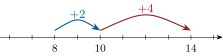
To find a difference, counting up is often easiest: for , start at and climb to : “ten, eleven, twelve” — three steps. So . (Climb through for bigger gaps: : from to is , from to is : difference .)
3.3 Addition and subtraction are twins
Example 3.5 (Fact families)
The numbers , and form a little family:
Knowing one fact of the family gives the three others for free. Subtraction undoes addition: after , doing brings you back.
Example 3.6 (Checking)
Computed ? Check with the twin addition: . ✓ A subtraction is right exactly when adding back works.
Example 3.7 (Which operation?)
“ birds on the wire, fly away”: take away, . “ birds, then more arrive”: put together, . “ sparrows and robins: how many more sparrows?”: difference, . Draw the story when unsure!
3.4 Exercises
Exercise 3.1 ★
Draw, cross out, and compute: ; ; .
Solution
Solution of Exercise 3.1.
; ; .
Exercise 3.2 ★
Count backward to compute: ; ; .
Solution
Solution of Exercise 3.2.
; ; .
Exercise 3.3 ★
Count up to find the difference: ; ; .
Solution
Solution of Exercise 3.3.
(from up to ); ; .
Exercise 3.4 ★
Write the four facts of the family of , and .
Solution
Solution of Exercise 3.4.
, , , .
Exercise 3.5 ★
Compute, then check with the twin addition: ; .
Solution
Solution of Exercise 3.5.
(check: ); (check: ).
Exercise 3.6 ★
Complete the holes:
Solution
Solution of Exercise 3.6.
; ; .
Exercise 3.7 ★
“There are cherries in the bowl. The children eat . How many are left?” Write the subtraction and the answer sentence.
Solution
Solution of Exercise 3.7.
. There are cherries left.
Exercise 3.8 ★
For each story, choose or , then compute: “ ducks on the pond, swim away”; “ ducks, geese arrive”; “Ali is , his sister is : how many years older is Ali?”.
Solution
Solution of Exercise 3.8.
“ swim away”: ducks. “ geese arrive”: birds. “How many years older”: years.
Exercise 3.9 ★★
Mother duck had eggs. Some hatched; now eggs remain and she counts unhatched eggs. How many eggs hatched? (Which fact family is this?)
Solution
Solution of Exercise 3.9.
Family of , and : eggs hatched (and checks it).