Primary & Middle School Mathematics · Grades 1–9
29Decimal Numbers
Tenths and hundredths appeared in Chapter 25; adding one more level, thousandths, completes the decimal system. This chapter consolidates reading, decomposing and — above all — comparing decimal numbers without falling into their famous traps.
29.1 Down to thousandths
Definition 29.1 (Decimal places)
After the decimal point come the tenths, the hundredths, the thousandths — each worth ten times less than the one before:

Example 29.2 (Many readings, one number)
can be read “four point three six two”, or “four and thousandths”, or decomposed as . And padding with final zeros changes nothing: . But : a zero inside pushes every digit to a smaller place.
Example 29.3 (Where is it on the line?)
To place : between and ; zooming, between and ; zooming again, between and , closer to . Each decimal digit is one more level of zoom.
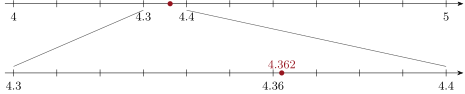
29.2 Comparing decimals
Method 29.4 (Comparing two decimals)
- Compare the whole parts: .
- Equal whole parts: compare the decimal parts digit by digit from the point — tenths, then hundredths, then thousandths;
- padding with final zeros makes the comparison fair: vs becomes vs , and hundredths.
The trap, one last time: a longer decimal part does not mean a bigger number — has more digits than and is smaller.
Example 29.5
Order ; ; ; . Pad to three decimals: ; ; ; . Then
Note even though looks big: thousandths against thousandths.
Example 29.6 (Squeezing between two decimals)
Is there a number between and ? Yes, plenty: , , … Between and ? Again plenty: , for one. Between two different decimals, one can always squeeze another — there is no “next” decimal number.
29.3 Rounding decimals
Definition 29.7 (Rounding)
To round to the unit (or tenth, or hundredth), look at the next digit: or more rounds up, otherwise round down. So rounds to (unit), to (tenth), to (hundredth).
Example 29.8 (Money rounds to cents)
A price computed as is displayed as : real-life amounts are rounded to the hundredth. Note the cascade: , where the became — rounding can ripple through several digits.
29.4 Exercises
Exercise 29.1 ★
Write as a decimal number: ; ; ; “twelve and nine thousandths”.
Solution
Solution of Exercise 29.1.
; ; ; .
Exercise 29.2 ★
In : what does the count? The ? Decompose the number as in Definition 29.1.
Solution
Solution of Exercise 29.2.
The counts the tenths, the the thousandths:
Exercise 29.3 ★
True or false? Explain with places. ; ; ; .
Solution
Solution of Exercise 29.3.
: true (a final zero adds nothing).
: false — tenths against hundredths.
: true.
: false — tenths against hundredths.
Exercise 29.4 ★
Copy and complete with , or :
Solution
Solution of Exercise 29.4.
; (tenths equal, hundredths ); ; .
Exercise 29.5 ★
Order from smallest to biggest: ; ; ; ; .
Solution
Solution of Exercise 29.5.
.
Exercise 29.6 ★
Between which two whole numbers does each number lie? Between which two numbers with one decimal? ; ; .
Solution
Solution of Exercise 29.6.
: between and ; between and .
: between and ; between and .
: between and ; between and .
Exercise 29.7 ★
Round : to the unit; to the tenth; to the hundredth. Round to the tenth.
Solution
Solution of Exercise 29.7.
: to the unit ; to the tenth ; to the hundredth . And to the tenth: the hundredths digit is , round up: .
Exercise 29.8 ★
Give a number strictly between: and ; and ; and .
Solution
Solution of Exercise 29.8.
For instance ; ; . (Infinitely many answers each time.)
Exercise 29.9 ★
The heights of four plants are m, m, m and m. Order them from shortest to tallest.
Solution
Solution of Exercise 29.9.
(in meters).
Exercise 29.10 ★★
Lucie says: “ because ”. Correct her mistake, comparing tenths first.
Solution
Solution of Exercise 29.10.
Compare the tenths first: has tenth, has tenths, so . Lucie compared the decimal parts as whole numbers ( vs ), forgetting that hundredths is far less than hundredths.
Exercise 29.11 ★★
Find all the numbers with exactly two decimal digits that round to when rounded to the tenth. What are the smallest and the biggest?