Primary & Middle School Mathematics · Grades 1–9
36Problems and Charts
The last chapter of the year puts everything to work: multi-step problems with money, quantities and durations, and the charts that present information at a glance. The star idea is “per one” — finding the price of a single item — which will grow into proportionality in Chapter 44.
36.1 Multi-step problems
Method 36.1 (Taming a long problem)
- Read to the end; say what the final question is;
- plan backwards: to answer it, what do I need first?
- solve the steps in order, writing one operation and one short sentence per step;
- check the final answer against common sense and against an estimate.
Example 36.2
“A school orders boxes of books at each, and pays for delivery on top. What is the total cost?”
- Books: books.
- Book cost: .
- Total: .
Estimate check: about a hundred books at is about , plus about : about — the answer is plausible.
Example 36.3 (Per one)
“ identical mugs cost ; what do mugs cost?” Find the price of one mug first:
Through one, everything becomes reachable — this two-step pattern solves a whole family of problems (recipes, speeds, prices), and is the seed of Chapter 44.
Example 36.4 (Change and budget)
Zoe has . She buys a book at and two pens at each. Can she also afford a board game?
- Pens: .
- Spent so far: .
- Remaining: — exactly enough for the game, with nothing left.
36.2 Reading charts
Method 36.5 (Reading any chart)
- Read the title: what is being counted?
- Read the axes or the key: what does one graduation, one bar, one symbol stand for?
- Only then answer questions — pointing at the chart with a ruler helps read heights exactly.
Example 36.6
Rainfall in a town, month by month:
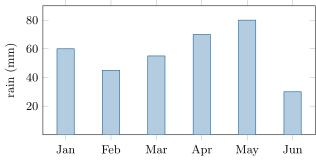
Readings: the wettest month is May ( mm); June got half of April’s rain ( against ? no — half of is , so not quite half: reading precisely matters!); total for the six months: mm.
Example 36.7 (A changing quantity)
A plant’s height, measured every week:
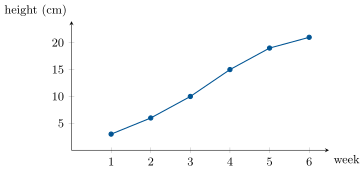
The plant grew fastest between weeks and ( cm) and slowed down at the end ( cm in week ).
36.3 Exercises
Exercise 36.1 ★
Solve in steps: “A club rents a bus for and buys museum tickets at each. What is the total cost of the trip?”
Solution
Solution of Exercise 36.1.
Tickets: . Total: .
Exercise 36.2 ★
Solve with “per one”: “ kg of apples cost . What do kg cost?”
Solution
Solution of Exercise 36.2.
Per one kg: . Five kg: .
Exercise 36.3 ★
Solve: “Six friends share equally the cost of a picnic. How much does each pay?”
Solution
Solution of Exercise 36.3.
: each pays .
Exercise 36.4 ★
Sam has . He buys a T-shirt at and a cap at . How much money has he left?
Solution
Solution of Exercise 36.4.
Spent: . Left: .
Exercise 36.5 ★
Using the rainfall chart of Example 36.6: which months got more than mm? How much more rain fell in May than in June?
Solution
Solution of Exercise 36.5.
More than mm: January (), March (), April (), May (). May minus June: mm.
Exercise 36.6 ★
Using the plant chart of Example 36.7: how tall was the plant in week ? Between which weeks did it grow by exactly cm?
Solution
Solution of Exercise 36.6.
Week : cm. Growth of cm: between weeks and (), and between weeks and ().
Exercise 36.7 ★
Draw a bar chart for the number of goals a team scored: September , October , November , December . Choose the graduation, and give the total.
Solution
Solution of Exercise 36.7.
Four bars of heights , , , (graduation every or goals). Total: goals.
Exercise 36.8 ★
A pack of yogurts costs ; sold alone, one yogurt costs . Compute the “per one” price in the pack, and how much one saves per yogurt by buying the pack.
Solution
Solution of Exercise 36.8.
Pack per one: . Saving per yogurt: (ten cents).
Exercise 36.9 ★★
“A cinema sold tickets at on Saturday and tickets at the same price on Sunday. How much more money did Saturday bring than Sunday?” Solve it two ways: computing both days’ takings, or computing with the difference in tickets — and check that the answers agree.
Solution
Solution of Exercise 36.9.
Way 1: Saturday ; Sunday ; difference .
Way 2: more tickets, each worth : . Same answer — the difference of the takings is the taking of the difference.
Exercise 36.10 ★★
A recipe for people needs g of rice. Aline cooks for people. How much rice does she need? (Per one person first — decimals allowed.)
Solution
Solution of Exercise 36.10.
Per person: g. For ten: g of rice.
Exercise 36.11 ★★
Invent a three-step problem using money whose final answer is , write its full solution in the style of Method 36.1, and test it on a classmate.
Solution
Solution of Exercise 36.11.
Many correct problems — for instance: “Milo buys juices at each and a sandwich at . He pays with a voucher. How much of the voucher is left?” Solution: juices ; total spent ; left .