Primary & Middle School Mathematics · Grades 1–9
23Division
Grade 3 divided with the tables and small remainders (Chapter 17); this chapter installs the full written method — long division — which handles any number, digit group by digit group.
23.1 The long division method
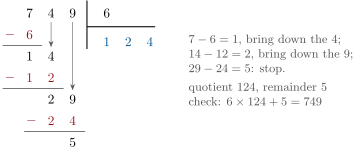
Method 23.1 (Long division by a one-digit number)
To divide by :
- take the leftmost digit, (hundreds): goes time into ; write in the quotient, subtract , remainder ;
- bring down the next digit, : now divide (tens): ; write , remainder ;
- bring down the : divide : ; write , remainder ;
- no digit left: the quotient is , the remainder .
Check: , and .
Example 23.2 (A zero in the quotient)
Divide by : hundreds, ; tens, bring down the : goes times into — write the ! — remainder ; units, bring down the : . Quotient , remainder . Forgetting the middle zero (writing ) is the classic mistake; the check catches it immediately.
Example 23.3 (Estimating the quotient’s size)
Before dividing by , frame the answer: and , so the quotient is between and — it will have three digits. This one-line estimate prevents most misplaced-digit errors.
23.2 Choosing what the question asks
Method 23.4 (Quotient, remainder, or quotient plus one)
As in Method 17.5, the story decides:
Example 23.5
books must be packed in boxes of .
How many full boxes? . How many books are not in a full box? . How many boxes to pack all the books? . Three questions, one division.
Example 23.6 (Fair sharing of money)
Four friends share the cost of a gift equally: exactly (remainder ). Each pays . When the remainder is zero, the division “comes out even” and the sharing is perfectly fair.
23.3 Exercises
Exercise 23.1 ★
Frame each quotient as in Example 23.3 (between which two “round” numbers?), then compute the long division: ; .
Exercise 23.2 ★
Compute the long divisions and check each one: ; ; .
Exercise 23.3 ★
Careful with the zero (see Example 23.2): ; ; .
Exercise 23.4 ★
Write the check equality () for: ; .
Exercise 23.5 ★
eggs are put in boxes of . How many boxes are filled?
Solution
Solution of Exercise 23.5.
: twenty-six boxes are filled, none left over.
Exercise 23.6 ★
A ribbon of cm is cut into pieces of cm. How many pieces, and what length is left over?
Solution
Solution of Exercise 23.6.
: thirty-one pieces, and cm of ribbon left.
Exercise 23.7 ★
students go to a show in buses of seats. How many buses are needed? (Which case of Method 23.4 is this? Divide by using multiples: .)
Solution
Solution of Exercise 23.7.
: seven buses carry students, remain — the “plus one” case: buses are needed.
Exercise 23.8 ★
Three friends share marbles equally. How many marbles each? Check with a multiplication.
Solution
Solution of Exercise 23.8.
: each gets marbles. Check: .
Exercise 23.9 ★
Find the dividend: the division by gives quotient and remainder .
Solution
Solution of Exercise 23.9.
Dividend .
Exercise 23.10 ★★
A librarian shelves books, per shelf. Shelves come in bookcases of shelves. How many shelves are needed? How many bookcases must be bought? (Two divisions, both with a “plus one” question.)
Solution
Solution of Exercise 23.10.
Shelves: : full shelves and books more — shelves are needed. Bookcases: : eight full bookcases and one extra shelf — bookcases must be bought.
Exercise 23.11 ★★
In a division by , the quotient equals the remainder. What are the possible dividends? List them all. (The remainder must stay below .)