Primary & Middle School Mathematics · Grades 1–9
5Shapes and Space
Windows are rectangles, wheels are circles, roofs hide triangles: shapes are everywhere. This chapter learns to recognize them by counting sides and corners, and to say precisely where things are: left, right, above, below, between.
5.1 The four basic shapes
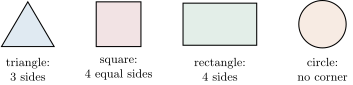
Definition 5.1 (Square, rectangle, triangle, circle)
- the triangle has sides and corners;
- the square has equal sides and corners;
- the rectangle has sides and corners, with opposite sides equal (a stretched square);
- the circle is perfectly round: no sides, no corners.
Example 5.2 (Tilted shapes are still shapes)
A square standing on its corner is still a square — four equal sides, four corners — even if it looks like a kite. Turning a shape does not change what it is.
Example 5.3 (Shape hunt)
In the classroom: the board is a rectangle, the clock a circle, a folded napkin can be a triangle, some windows are squares. Real objects are not perfect shapes, but their faces are close to them (solids and their faces return in Chapter 11).
5.2 Where is it?
Definition 5.4 (Position words)
To say where something is: left / right, above / below, on / under, in front of / behind, between, inside / outside.

5.3 Paths on a grid
Method 5.5 (Describing a path)
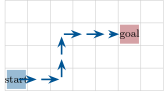
On grid paper, a path is a list of steps: (one square right), (left), (up), (down).
- To follow a path: start on the marked square and obey the arrows one by one;
- to describe a path: walk it in your head and write the arrows in order;
- two different paths can join the same two squares — some shorter, some longer.
5.4 Exercises
Exercise 5.1 ★
For each shape, count the sides and corners and name it: a shape with corners; a round shape with no corner; a shape with equal sides.
Solution
Solution of Exercise 5.1.
corners: a triangle. Round, no corner: a circle. equal sides: a square.
Exercise 5.2 ★
Find at home: two rectangles, one circle, one triangle, one square. (Doors? plates? road signs?)
Solution
Solution of Exercise 5.2.
Answers vary: a door and a book are rectangles; a plate or a clock is a circle; a road-warning sign is a triangle; a tile can be a square.
Exercise 5.3 ★
True or false? “A square turned on its corner stops being a square.” Explain with Example 5.2.
Solution
Solution of Exercise 5.3.
False: a square turned on its corner still has four equal sides and four corners — turning does not change the shape.
Exercise 5.4 ★
Draw on grid paper: a square of squares by ; a rectangle of by ; a triangle using a diagonal of the grid.
Solution
Solution of Exercise 5.4.
Grid drawings: the square is squares, the rectangle , and the triangle uses a slanted grid line as one side.
Exercise 5.5 ★
Place three toys in a row. Describe the row with position words: which is between the others? Which is on the left?
Solution
Solution of Exercise 5.5.
Answers vary. Example: the ball is on the left, the car is between the ball and the doll, the doll is on the right.
Exercise 5.6 ★
Draw a circle. Draw a cross inside it, a star outside it, and a dot on the circle itself.
Solution
Solution of Exercise 5.6.
The cross is drawn inside the circle, the star outside, and the dot right on the circle’s line.
Exercise 5.7 ★
On grid paper, mark a start square. Follow: . Mark the arrival. Then write the path that goes straight back to the start.
Solution
Solution of Exercise 5.7.
Following moves squares right and up. The way back is then (or any path returning to the start).
Exercise 5.8 ★
How many corners in total: two triangles and one square? One circle and two rectangles?
Solution
Solution of Exercise 5.8.
Two triangles and one square: corners. One circle and two rectangles: corners.
Exercise 5.9 ★★
Take matches. Can you outline a square using all of them, with whole matches and the same number on each side? How many matches per side? Could you do it with matches?
Solution
Solution of Exercise 5.9.
matches make a square with matches on each side (). With matches it cannot be done: does not split into equal whole parts (each side would need matches and a half).