Primary & Middle School Mathematics · Grades 1–9
51Triangles and Angles
Can you draw a triangle with sides , and ? With angles , and ? This chapter answers both questions with two of the most useful facts of plane geometry: the triangle inequality and the angle sum — plus the angle vocabulary that comes with crossing and parallel lines.
51.1 Angles around crossing lines
Definition 51.1 (Angle pairs)
- Two angles are complementary when their measures add up to , supplementary when they add up to .
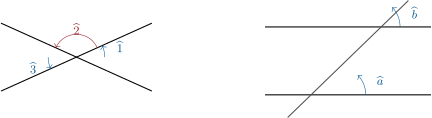
- When two lines cross, the angles facing each other across the crossing point are vertically opposite.
- When a line crosses two other lines, angles located in the same position at each crossing are corresponding angles; angles between the two lines on opposite sides of the crossing line are alternate angles.
Theorem 51.2 (Angle equalities)
- Vertically opposite angles are equal.
- If two lines are parallel, corresponding angles are equal, and alternate angles are equal. Conversely, equal corresponding (or alternate) angles force the lines to be parallel.
Proof of 1. The two angles and on one side of a line make a straight angle: . The vertically opposite angle of also satisfies (same reason). So . Point 2 is admitted at this level. ∎
51.2 The sum of the angles of a triangle
Theorem 51.3 (Angle sum)
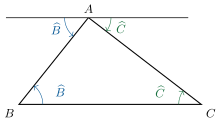
In every triangle, the three angles add up to .
Proof. Let be a triangle. Draw the line through parallel to . At the vertex , three angles line up along this parallel and make a straight angle, : the middle one is , and the two outer ones are alternate angles with and (parallel lines!), so they equal and . Hence . ∎
Example 51.4
Two angles of a triangle measure and . The third measures
Special cases worth memorizing: each angle of an equilateral triangle is ; in a right triangle the two acute angles are complementary (they add up to ); the base angles of an isosceles triangle are equal, so each is .
Example 51.5 (No triangle with two right angles)
A triangle with two angles of would already use up , leaving for the third — impossible. The angle sum forbids many triangles at once.
51.3 The triangle inequality
Theorem 51.6 (Triangle inequality)
In every triangle, each side is shorter than the sum of the two others: for a triangle with sides , , ,
Conversely, three lengths with the largest smaller than the sum of the two others can always be made into a triangle. If the largest equals the sum of the others, the “triangle” is flat: the three vertices are aligned.
Proof. Admitted at this level. ∎
Example 51.7
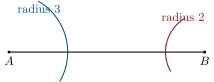
Can sides be , and ? Test the largest: is ? No — no such triangle exists. The compass shows why: arcs of radii and drawn from the two ends of a segment of length never meet.
Sides , and ? Largest: : yes, the triangle exists (checking the largest side is enough).
Method 51.8 (Existence and construction of a triangle)
Given three lengths:
- compare the largest with the sum of the two others; if it is not strictly smaller, stop: no triangle;
- otherwise construct as in Method 41.2 (base segment, two compass arcs);
- after any construction from angles, check mentally that the given angles sum to less than — with the third angle making exactly .
51.4 Exercises
Exercise 51.1 ★
Give the complement (to ) and the supplement (to ) of: ; ; .
Solution
Solution of Exercise 51.1.
Complements: ; ; . Supplements: ; ; .
Exercise 51.2 ★
Two lines cross; one of the four angles measures . Give the measures of the three others, with a reason for each.
Solution
Solution of Exercise 51.2.
The vertically opposite angle also measures (Theorem 51.2); the two remaining angles are supplementary to it: each.
Exercise 51.3 ★
Compute the third angle of a triangle whose first two angles measure: (a) and ; (b) and ; (c) and .
Solution
Solution of Exercise 51.3.
(a) . (b) . (c) .
Exercise 51.4 ★
An isosceles triangle has its apex angle equal to . Compute its two base angles. Another isosceles triangle has a base angle of : compute its apex angle.
Solution
Solution of Exercise 51.4.
Apex : the base angles share equally: each.
Base angle : the two base angles are equal, so the apex is .
Exercise 51.5 ★
Which of these triples can be the sides of a triangle? Justify by the triangle inequality (largest side!):
Solution
Solution of Exercise 51.5.
: : triangle exists.
: : impossible.
: : flat “triangle” — the points are aligned, no genuine triangle.
: : equilateral triangle.
Exercise 51.6 ★
A triangle has angles , and . Find and the three angles. What kind of triangle is it?
Exercise 51.7 ★
Construct a triangle with cm, and (protractor at and at ). Before constructing, predict the measure of , then check on your figure.
Solution
Solution of Exercise 51.7.
Prediction: ; the protractor on the finished figure confirms it.
Exercise 51.8 ★★
Two parallel lines are cut by a third line, making an angle of at the first crossing (between the crossing line and one parallel). Draw the situation and give the measures of all eight angles formed.
Solution
Solution of Exercise 51.8.
At the first crossing, the four angles are , , , (vertically opposite pairs and supplements). The parallel line reproduces the same four measures at the second crossing (corresponding angles): eight angles in all, four of and four of .
Exercise 51.9 ★★
Two sides of a triangle measure cm and cm. Between which two values must the third side lie? Give a whole-number length that works and one that does not.
Solution
Solution of Exercise 51.9.
Let be the third side. The triangle inequality demands and also , i.e. . So : the length cm works; the length cm (or cm) does not.
Exercise 51.10 ★★
In a triangle , and . Compute and .
Solution
Solution of Exercise 51.10.
, and , so : and .
Exercise 51.11 ★★★
The three angles of any quadrilateral can be studied by cutting it along a diagonal into two triangles. Use this to prove that the four angles of every quadrilateral add up to , and deduce the angle sum of a pentagon (five sides).
Solution
Solution of Exercise 51.11.
The diagonal splits into triangles and . The four angles of the quadrilateral are exactly the six angles of the two triangles, regrouped (the angles at and at are each split in two). Total: . A pentagon splits from one vertex into three triangles: .
51.5 Problem: Walking around the block
Problem 51.1
Weekend problem — the angles of any polygon: inside, always of turning outside, and why only three regular shapes tile a floor
Exercise 51.11 cut a quadrilateral into two triangles and found . This problem pushes the idea to polygons with any number of sides, then discovers a second, completely different proof — by walking around the shape and adding up the turns — and ends on the floor of your bathroom: among all regular polygons, exactly three can tile a plane without gaps or overlaps, and the bees have chosen theirs.
Part I — The angles inside.
- From one vertex of a hexagon (six sides), draw all the diagonals leaving that vertex. Into how many triangles is the hexagon cut, and what is the sum of all its interior angles (Theorem 51.3)?
- Generalize: from one vertex of a polygon with sides, how many triangles does the fan of diagonals produce? Deduce the formula for the sum of the interior angles, and check it for , , , .
- Compute the sum of the interior angles of a decagon ( sides) and of a dodecagon ( sides).
- In a regular polygon all interior angles are equal. Compute the interior angle of the equilateral triangle, the square, the regular pentagon, hexagon and octagon.
- Explain, without any formula, why the angle sum grows by exactly each time the polygon gains one vertex.
Part II — The walk around the block. Walk along the boundary of a polygonal block, always forward. At each corner you turn by some angle — the exterior angle of that corner; turning continues until you are back at your starting point, facing your starting direction.
- At a corner whose interior angle is , by how much do you turn? (Interior and exterior angle are supplementary.) Compute the three turns for a triangle with angles , , .
- Add up the three turns of question 6. What full-circle fact do you observe?
- Explain why the turns of a complete walk around any polygon — three sides or thirty — always total exactly . (What has your nose done, all turns combined, when you arrive back?)
- Deduce the interior-angle formula a second time: at each of the corners, interior turn ; sum over all corners and use question 8.
- In a regular polygon, all the turns are equal, so each exterior angle is . Use this to answer instantly: which regular polygon has interior angles of ? And why does no regular polygon have interior angles of ?
Part III — Tiling the floor. Around every point of a tiled floor, the corners of the meeting tiles must total exactly — no gap, no overlap (Problem 40.1).
- For each of the equilateral triangle, the square and the regular hexagon: how many copies meet at a corner point of the tiling? Verify the each time.
- Show that regular pentagons cannot tile the floor: what do three corners total, and what would four total?
- Show that no regular polygon with more than six sides can tile: at least three tiles must meet at each corner (each angle is less than ), and what happens to three corners of or more? Conclude the complete list of regular tilers.
- Bathroom floors often mix regular octagons with small squares. Verify that this corner works: . Another classic mixes a square, a regular hexagon and a regular dodecagon at each corner: verify it too (the dodecagon’s interior angle follows from question 10’s method).
- The bees’ choice: honeycomb cells are regular hexagons. Verify their corners ( angles), and explain in one sentence — with the help of Dido’s discovery (Problem 43.1) — why, of the three possible regular tiles, the hexagon is the cheapest in wax for the honey it holds.
Solution
Solution of Problem 51.1.
1. The diagonals from one vertex of a hexagon cut it into triangles, so the interior angles total .
2. From one vertex, diagonals go to all vertices except itself and its two neighbours: diagonals, cutting the polygon into triangles. Every interior angle of the polygon is distributed among the triangles, so the sum is
Check: : ; : (Exercise 51.11); : ; : .
3. Decagon: . Dodecagon: .
4. Dividing by : triangle ; square ; pentagon ; hexagon ; octagon .
5. Adding a vertex adds one more triangle to the fan: the new polygon needs triangles where the old needed . One extra triangle, one extra .
6. The walker turns by the supplement: . For the –– triangle, the turns are , and .
7. : one full turn.
8. Over the whole walk, your nose starts and ends pointing the same way, having swept around exactly once: all the turning done at the corners amounts to one complete revolution, — whatever the number of corners and the shape of the block. (The fact is beautifully independent of .)
9. At each corner, interior turn . Summing over the corners:
— the formula of question 2, re-proved by walking.
10. Interior means each turn is , and : the regular dodecagon. Interior would mean turns of , and is not a whole number of corners: no such regular polygon exists.
11. Triangle (): meet, . Square (): meet. Hexagon (): meet, . All three close up perfectly.
12. Three pentagon corners: — a gap of remains. Four corners: — overlap. Neither works: regular pentagons cannot tile the plane.
13. At a tiling corner at least tiles meet. A regular polygon with more than six sides has interior angles greater than (question 4 and the growth of the angle with ), so three corners exceed : overlap, impossible. With six sides exactly, works; below six, questions 11 and 12 sort the cases. The complete list of regular tilers: triangle, square, hexagon.
14. Octagons and squares: : the corner closes — the classic street pattern. Square, hexagon, dodecagon: the dodecagon’s turn is , so its interior angle is , and : it works too.
15. Honeycomb corners: , perfect. Among triangle, square and hexagon tiles of equal area, the hexagon has the shortest boundary — it is the closest of the three to Dido’s circle (Problem 43.1) — so hexagonal cells enclose the same honey with the least wax: the bees tile like geometers.