Primary & Middle School Mathematics · Grades 1–9
21Large Numbers
Thousands were the ceiling of Chapter 14; now the ceiling rises to millions. The trick that makes huge numbers readable is to cut their digits into groups of three — the classes.
21.1 Classes of three digits
Definition 21.1 (Classes)
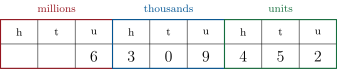
Starting from the right, the digits of a number are grouped in classes of three: the class of units, the class of thousands, the class of millions. Each class has its own units, tens and hundreds. For instance
read “six million three hundred nine thousand four hundred fifty-two”.
Example 21.2 (Writing with the classes)
“Twelve million forty thousand five hundred” has in the millions class, in the thousands class, in the units class:
The zeros of are essential: each class (except the leftmost) must show its three digits.
Example 21.3 (How many thousands?)
The number contains thousands (everything left of the units class): . Asking “how many thousands” is not asking for one digit, but for a whole prefix of the number.
21.2 Comparing and rounding
Method 21.4 (Comparing large numbers)
Exactly as in Method 14.4, with the classes as a shortcut: more digits wins; same length, compare from the left — class by class, then digit by digit.
Example 21.5
and : millions equal (), thousands class , so
Definition 21.6 (Rounding)
To round a number to the nearest thousand (or ten, hundred, million …), replace it by the closest multiple of . If the number sits exactly halfway, round up. In practice: look at the digit just below the rounding place — or more rounds up, or less rounds down.
Example 21.7
rounded to the nearest thousand: the hundreds digit is , so round up: . Rounded to the nearest hundred: . Rounded to the nearest ten thousand: .

Example 21.8 (Orders of magnitude in the world)
Rounding is how large numbers are actually used: a country of inhabitants is “about million”; a city of people is “about ”. The exact figure changes every day anyway — the rounded one carries the useful information.
21.3 Exercises
Exercise 21.1 ★
Write in digits, with the classes separated: “three million five hundred twenty thousand”; “seven million eight”; “two hundred forty thousand sixty”.
Solution
Solution of Exercise 21.1.
; ; .
Exercise 21.2 ★
Write in words: ; ; .
Solution
Solution of Exercise 21.2.
: five million two hundred four thousand three hundred.
: ten million fifty thousand.
: nine hundred ninety-nine thousand nine hundred ninety-nine.
Exercise 21.3 ★
In : which digit is the tens of thousands? The hundreds of the millions class? How many thousands does the number contain (see Example 21.3)?
Solution
Solution of Exercise 21.3.
Tens of thousands: . Hundreds of the millions class: there is no hundreds-of-millions digit in a seven-digit number — the millions class of contains only the digit (units of millions). Thousands contained: (since ).
Exercise 21.4 ★
Copy and complete with or :
Solution
Solution of Exercise 21.4.
; (thousands class ); .
Exercise 21.5 ★
Order from smallest to biggest: ; ; ; .
Solution
Solution of Exercise 21.5.
.
Exercise 21.6 ★
Round : to the nearest ten; to the nearest hundred; to the nearest thousand; to the nearest ten thousand.
Solution
Solution of Exercise 21.6.
To the ten: . To the hundred: . To the thousand: . To the ten thousand: .
Exercise 21.7 ★
Round to the nearest million: ; ; .
Exercise 21.8 ★
Count by steps: three steps of from ; two steps of from . What happens to the classes as you cross a million?
Solution
Solution of Exercise 21.8.
: the second step crosses the million, and a new class lights up on the left.
: same crossing at the first step.
Exercise 21.9 ★
A stadium holds spectators. A newspaper writes “more than fans”; a radio says “about ”. Are both right? To which place did each round?
Exercise 21.10 ★★
Using each of the digits to exactly once, write the biggest possible seven-digit number, the smallest one, and the one closest to .
Solution
Solution of Exercise 21.10.
Biggest: . Smallest: . Closest to : just below works best — is away, while just above, , is only away: the closest is .
Exercise 21.11 ★★
What is the biggest whole number that rounds to when rounding to the nearest thousand? And the smallest?