Primary & Middle School Mathematics · Grades 1–9
70Solids and Volumes
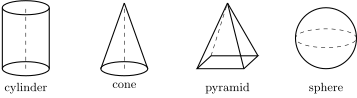
Space geometry begins with a small family of solids — prisms, cylinders, pyramids, cones, spheres — and two questions: how much do they hold (volume), and what do you see when you slice them (sections)? The chapter closes with a fact of great practical importance: scaling a solid by multiplies its volume by .
70.1 The classical solids and their volumes
Theorem 70.1 (Volume formulas)
Write for the area of the base and for the height (the distance between the base and the opposite face or apex).
For a cylinder and a cone of radius , the base area is ; the sphere’s surface area is .
Proof. Admitted at this level. ∎
Example 70.2
A cylindrical can has radius cm and height cm:
A cone with the same base and height holds one third of that: cm. A sphere of radius cm: cm.
Example 70.3 (A pyramid step by step)
A pyramid has a square base of side m and height m.
Mind the units: if the side were given in cm and the height in m, one of them would have to be converted first.
70.2 Sections by planes
Proposition 70.4 (Sections of the classical solids)
Cutting a solid by a plane produces a flat figure, its cross-section:
- a prism or cylinder cut parallel to its base gives a copy of the base, at every height;
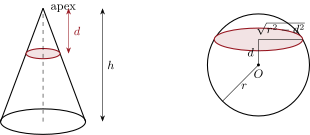
- a pyramid or cone cut parallel to its base gives a reduction of the base: at distance from the apex, the scale factor is ;
- a sphere of radius cut by a plane at distance from the center gives a circle of radius (by the Pythagorean theorem).
Proof. Admitted at this level. ∎
Example 70.5
A cone has base radius and height . The section by a plane parallel to the base, at distance from the apex, is a disk scaled by : its radius is .
A sphere of radius is cut by a plane at distance from its center: the section is a circle of radius .
70.3 Scaling solids
Theorem 70.6 (Effect of a scaling on lengths, areas, volumes)
When a solid is enlarged or reduced by the scale factor :
Proof. Admitted at this level. ∎
Example 70.7
A model car at scale : lengths are those of the real car multiplied by , painted surface multiplied by , and volume by .
Doubling the radius of a sphere () multiplies its volume by : check on the formula, .
Example 70.8 (Truncated cone)
A cone of height and base radius (volume ) is cut at distance from the apex, and the small cone above the cut is removed. The small cone is the reduction by , so its volume is . The remaining solid (a truncated cone) has volume .
70.4 Exercises
Exercise 70.1 ★
Compute the volumes: a box (rectangular prism) of dimensions ; a cylinder of radius and height (exact value with , then rounded to the unit).
Exercise 70.2 ★
Compute the volume of a cone of radius and height , and of a pyramid with rectangular base and height .
Exercise 70.3 ★
Compute the volume and the surface area of a sphere of radius (exact values with ).
Exercise 70.4 ★
A sphere of radius is cut by a plane at distance from its center. What is the radius of the section circle?
Exercise 70.5 ★★
A cone has base radius and height . A plane parallel to the base cuts it at distance from the apex. Compute the radius of the section, then the volume of the small cone above the cut.
Exercise 70.6 ★★
A cylindrical glass of inner radius cm contains water to a height of cm. A ball of radius cm is fully submerged in it. By how much does the water level rise? (The added volume spreads over the glass’s base area; give the exact rise, then round to the millimeter.)
Exercise 70.7 ★★
A recipe fills a spherical mold of radius cm. You only have a spherical mold of radius cm. How many small molds can you fill? (Answer without computing either volume explicitly.)
Solution
Solution of Exercise 70.7.
The small mold is the reduction of the large one by , so its volume is of the large one: the recipe fills small molds.
Exercise 70.8 ★★
The Great Pyramid of Giza has a square base of side about m and a height of about m. Estimate its volume, and express it in millions of cubic meters.
Solution
Solution of Exercise 70.8.
m — about million cubic meters.
Exercise 70.9 ★★★
A cone-shaped funnel of radius cm and height cm, apex down, is filled with water up to half of its height (measured from the apex).
- What fraction of the funnel’s volume is filled?
- If instead it is filled with half of its volume of water, show that the water height satisfies , and give to the millimeter ().
Solution
Solution of Exercise 70.9.
1. The water forms a cone scaled by (apex down, half the height), so its volume is of the funnel’s: one eighth, much less than half!
2. Water up to height forms a cone scaled by , of volume times the funnel’s. Half the volume means , i.e. . Then , so cm: the second half of the volume occupies only the top cm — the wide part of the cone holds most of the water.
70.5 Problem: Archimedes’ tombstone
Problem 70.1
Weekend problem — the sphere is two thirds of its cylinder (twice over), the 1:2:3 stack, and the square–cube law that forbids giants
Archimedes proved many theorems, but one made him so proud that he asked for its figure to be carved on his tomb: a sphere nested in its tightest cylinder. A century later the Roman writer Cicero, searching the brambles near Syracuse, recognized the grave “by the sphere and the cylinder”. This problem retrieves what the carving encodes — a double two-thirds miracle — then follows volumes and surfaces (Theorem 70.1, Theorem 70.6) to a law that governs giants, ants and cooling planets.
Part I — The carving decoded. A sphere of radius sits exactly inside a cylinder: same radius, height .
- Compute the cylinder’s volume in terms of .
- Compute the ratio of the sphere’s volume to the cylinder’s. Why might Archimedes have liked that the answer contains no and no ?
- Now the surfaces: compare the sphere’s surface area with the cylinder’s total surface (lateral part plus the two lids). What ratio appears — again?
- The empty space between sphere and cylinder has volume . Show that this leftover exactly equals the volume of two cones of radius and height .
- A basketball of radius cm is sold in the tightest cylindrical box. Compute both volumes (to the nearest cm) and the percentage of the box that is empty.
Part II — Bowls, molds and moons.
- A hemispherical bowl has radius cm. Compute its capacity, in cm and in liters (to the deciliter).
- The 1:2:3 stack: a cone, a hemisphere and a cylinder, all of radius cm and height cm. Compute the three volumes and verify the legendary proportion . (Archimedes would have appreciated this one, too.)
- A chocolate sphere of radius cm is melted into a cylindrical mold of radius cm. What height does the chocolate reach? (Exact fraction, then to the millimeter.)
- The Earth’s radius is about km, the Moon’s about km. Compute the ratio of the radii, then — with Theorem 70.6 — the ratio of the volumes: how many Moons would fit into a hollow Earth, by volume?
- From the same theorem: what is the Earth–Moon ratio of surface areas? And in general, when a balloon’s radius doubles, what happens to its volume and to its surface? State the square–cube law: as a shape scales up, volumes outrun surfaces.
Part III — The square–cube law rules the world.
- Galileo’s argument against giants: imagine a human scaled up by a factor , same proportions. By what factor does the weight grow (weight follows volume)? By what factor does the cross-section of the bones grow (an area)? By what factor, then, does the pressure on each square centimeter of bone grow — and what happens to the giant?
- The same law in reverse explains ant heroics: strength follows muscle cross-section (an area), weight follows volume. For an animal times smaller in every direction, by what factors do weight and strength shrink, and by what factor does the strength-to-weight ratio improve?
- Heat is produced by the body’s volume and lost through its surface. Show that for a sphere the surface-to-volume ratio is , and compute it for and . Which cools faster, a mouse or a bear — and why do babies need hats in winter?
- Two spherical oranges of radii cm and cm are sold at the same price. Compute the ratio of their volumes: how much more orange does the big one give for the same money?
- Finale: describe precisely what the tombstone figure encodes — the two “two thirds” of questions 2 and 3 — and answer Cicero in one sentence: why would a mathematician choose, over every conquest of his engineering genius, a sphere in a cylinder?
Solution
Solution of Problem 70.1.
1. .
2. . The and the cancel: the proportion is universal — true for a marble and for a planet. A relation between shapes, not between numbers: exactly the kind of truth worth carving in stone.
3. Sphere: . Cylinder: lateral , plus two lids : total . Ratio: — the same two thirds, for surfaces. (And a bonus: the sphere’s area exactly equals the cylinder’s lateral area.)
4. Leftover: . Two cones of radius and height : . Equal.
5. Ball: cm; box: cm. Empty: one third of the box, about — guaranteed by question 2, whatever the ball’s size.
6. Half a sphere: cm L.
7. Cone: cm. Hemisphere: cm. Cylinder: cm. Ratios: exactly.
8. gives cm exactly.
9. Radii: . Volumes scale as the cube (Theorem 70.6): . About fifty Moons fit in the Earth.
10. Surfaces scale as the square: . Doubling a balloon’s radius multiplies its volume by but its surface by only : as things grow, volume (weight, content, heat produced) outruns surface (skin, material, heat lost) — the square–cube law.
11. Weight: . Bone cross-section: . Pressure — weight per area of bone: . Bones built for human pressure receive ten times more: the giant’s skeleton snaps under its own weight. Giants are geometrically impossible; large animals need disproportionately thick bones (compare an elephant’s legs with a gazelle’s).
12. Weight: . Strength (muscle cross-section): . Strength-to-weight: . The ant lifting fifty times its weight is not a super-athlete — it is merely small; a human shrunk to ant size could do likewise.
13. : for the ratio is , for it is — halving the size doubles the surface available per unit of heat-producing volume. Small bodies bleed heat: the mouse must eat constantly, the bear can hibernate, and the baby — small sphere, large — needs the hat.
14. : the big orange holds nearly twice the fruit for the same price. Buy radius.
15. The carving says: sphere of the cylinder in volume, and of it in total surface — two exact, universal proportions linking the roundest solid to the simplest one. Cicero’s answer: because a theorem is the only monument that neither armies nor centuries erode — Archimedes’ machines burned with Syracuse, but the two thirds are still exactly two thirds.