Primary & Middle School Mathematics · Grades 1–9
53Areas and Volumes
Grade 6 measured rectangles, right triangles and boxes (Chapter 43). With a pair of scissors — cut a piece here, glue it there — the same ideas now give the areas of parallelograms, of all triangles and of the disk, and the volumes of prisms and cylinders.
53.1 Area of a parallelogram
Theorem 53.1 (Parallelogram)
A parallelogram with a side of length (its base) and distance between that side and the opposite one (its height) has area
Proof by scissors. Cut off the right-angled triangle sticking out on one side and glue it on the other: the parallelogram becomes a rectangle with the same area. ∎

Remark 53.2
The height is the perpendicular distance between the two bases, not the length of the slanted side! A very slanted parallelogram can have long sides and a small area.
53.2 Area of a triangle
Theorem 53.3 (Triangle)
A triangle with base and corresponding height (the perpendicular distance from the opposite vertex to the base line) has area
Proof. Two copies of the triangle, one turned by a half-turn around the midpoint of one side, fit together into a parallelogram with base and height (that is central symmetry at work, Proposition 52.4). The triangle is half of it: . ∎
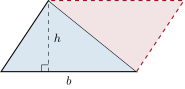
Example 53.4
A triangle has a base of cm and the corresponding height measures cm:
For a right triangle, the two legs are a base and its height: we recover the formula of Proposition 43.6.
53.3 Area of a disk
Theorem 53.5 (Disk)
Idea of proof. Cut the disk into many thin equal slices and lay them head to tail: they almost form a parallelogram of height whose base is half the circumference, (Proposition 43.3). Its area is close to , and the approximation becomes perfect as the slices get thinner. A complete proof needs integral calculus, from the High School volume. ∎
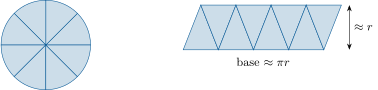
Example 53.6
A round table top has radius cm. Its area is cm, a bit more than m. Watch the difference: the perimeter uses , the area uses .
53.4 Prisms and cylinders
Definition 53.7 (Prism, cylinder)
A prism is a solid with two identical parallel polygonal faces (the bases) joined by rectangles; a cylinder is the same with disks as bases. The height is the distance between the two bases.
Theorem 53.8 (Volumes)
For a prism or a cylinder with base area and height :
Proof. Admitted at this level. ∎
Example 53.9
A tent is a prism lying on its side: its bases are triangles of base m and height m, and the tent is m long.
A tin can of radius cm and height cm: cm, roughly half a liter.
53.5 Exercises
Exercise 53.1 ★
Compute the area of a parallelogram with base cm and height cm; of another with base m and height m.
Solution
Solution of Exercise 53.1.
cm; m.
Exercise 53.2 ★
A parallelogram has sides cm and cm, and the height relative to the cm base measures cm. Compute its area. Why is the answer not cm?
Solution
Solution of Exercise 53.2.
cm. The answer is not because the cm side is slanted: the formula uses the height (perpendicular distance), which is cm.
Exercise 53.3 ★
Compute the area of a triangle with base cm and height cm; of a right triangle with legs and ; of a triangle with base m and height m.
Solution
Solution of Exercise 53.3.
cm; ; m.
Exercise 53.4 ★
Compute the area of a disk of radius cm, then of a half-disk of radius cm (exact values with , then rounded to the unit).
Exercise 53.5 ★
Compute the perimeter and the area of a disk of radius cm. Which of the two answers is in cm and which in cm?
Exercise 53.6 ★
Compute the volume of a prism with base area cm and height cm; of a cylinder of radius cm and height cm (exact, then rounded).
Exercise 53.7 ★
A triangle has area cm and base cm. Find the corresponding height, writing the equation first.
Solution
Solution of Exercise 53.7.
, so and cm.
Exercise 53.8 ★★
Draw any triangle and measure carefully the three base–height pairs. Compute for each pair: the three results should agree (up to measuring error). Why?
Solution
Solution of Exercise 53.8.
The three products agree because each one computes the same quantity — the area of the triangle. This gives a practical check of constructions, and a way of computing a height from another base–height pair (used in Exercise 53.12).
Exercise 53.9 ★★
A trapezoid-shaped garden can be split, by one diagonal, into two triangles sharing the same height m, with bases m and m. Compute its total area. Can you guess a general formula for the trapezoid?
Exercise 53.10 ★★
A cylindrical vase of radius cm contains water to a height of cm. All the water is poured into an empty box cm cm at the base. What water height is reached in the box? (Same volume, different base.)
Exercise 53.11 ★★
A pizza of diameter cm costs euros; one of diameter cm costs euros. Compute the two areas and the price per cm. Which pizza is the better deal?
Exercise 53.12 ★★★
The two legs of a right triangle measure cm and cm, and its hypotenuse measures cm. Compute its area with the legs, then use that area to find the height relative to the hypotenuse.
Solution
Solution of Exercise 53.12.
With the legs: cm. With the hypotenuse as base: , so cm.
53.6 Problem: The vanishing square
Problem 53.1
Weekend problem — a famous “proof” that , unmasked by areas and slopes, with pizzas and rings for dessert
A magician cuts an square into four pieces, slides them around, and reassembles them into a rectangle. The audience counts: , but — a square unit has appeared out of thin air! This chapter’s area formulas are exactly the tools that catch the trick. The problem then puts honest area reasoning to work: on trapezoids, on tilted stacks, on pizza economics — and finally returns to the magician for a second, even stranger performance.
Part I — The trick, performed and unmasked. The four pieces of the square are: two right triangles with legs and , and two right trapezoids with parallel sides and and height .
- Compute the area of the original square and the area of the claimed rectangle. State the scandal in one line.
- Compute the area of each of the four pieces (Theorem 53.3; for the trapezoids, cut or use Exercise 53.9).
- Add the four areas. Which of the two figures — square or rectangle — can the pieces really fill?
- In the rectangle arrangement, a triangle’s hypotenuse (rising across ) is supposed to continue a trapezoid’s slanted edge (rising across ) in one straight “diagonal”. Test the alignment: are across and across the same steepness (Theorem 49.3)?
- Explain where the sixty-fifth square hides: what shape is the gap along the false diagonal, what is its exact area, and why does the eye miss it? (How wide, on average, is a sliver of that area stretched over the rectangle’s diagonal, roughly units long?)
Part II — Honest area reasoning.
- Draw two parallel lines cm apart, a base of cm on one of them, and three different triangles on that base with apexes at various points of the other line. Compute the three areas. Why are they all equal, however the apex slides along its line?
Prove the trapezoid formula in general: a trapezoid with parallel sides and and height , cut along a diagonal, gives two triangles of the same height . Conclude:
- Apply it to a trapezoid with cm, cm, cm.
- Carpenters use the same formula in disguise: area (average of the two parallel sides) height. Explain why this is the same rule, and recompute question 8 that way.
- Tilt a neat stack of playing cards into a slanted stack. Explain why the volume has not changed, and what this says about the height in the prism formula (Theorem 53.8): which height must one take for a slanted stack — the slanted length or the vertical one? (Compare Exercise 53.2, one dimension up.)
Part III — Rings, pizzas, and the magician’s return.
- A circular pond of radius m sits at the center of a circular lawn of radius m. Compute the area of the grass ring (exact with , then rounded to the m).
- Find the radius of the single disk whose area equals that ring’s area exactly. (The three radii you now have form a famous triple, whose story is told in Chapter 58.)
- Which is more pizza: one pizza of diameter cm, or two pizzas of diameter cm? Compute and compare.
- To double a pizza’s area, by roughly what factor must its radius grow? Check the candidate (recall that areas follow the square of the scaling factor, Problem 44.1), and say where the exact factor — the number whose square is — makes its official entrance (Example 58.9).
- The magician returns: he cuts a square with the numbers , , playing the roles that , , played before, and reassembles an rectangle. Compute both areas: what vanishes this time? The numbers are consecutive terms of the sequence of Problem 47.1 — state the pattern of the magician’s gains and losses, and the moral: why do areas never lie?
Solution
Solution of Problem 53.1.
1. Square: . Rectangle: . The same four pieces appear to cover square units in one figure and in the other: one unit of area has been created from nothing — supposedly.
2. Each triangle: . Each trapezoid: .
3. : the pieces total , so they can fill the square exactly — and can not fill the -unit rectangle. The rectangle picture must contain a hole.
4. Same steepness would mean across proportional to across ; cross products: and . Not equal: the hypotenuse and the slanted edge do not line up. The “diagonal” of the rectangle is a lie — two slightly different slopes meeting at a shallow angle.
5. Along the false diagonal the four pieces leave a long, extremely thin gap — a sliver in the shape of a very flat parallelogram — whose area is exactly the missing square unit. Stretched along a diagonal about units long, its average width is about units: on a real drawing, thinner than the pencil line that hides it.
6. Each triangle has base cm and height cm — the distance between the parallels, wherever the apex sits — so each area is cm (Theorem 53.3). Sliding the apex along the parallel changes the shape, never the base or the height: equal areas forever.
7. The diagonal cuts the trapezoid into a triangle with base and one with base , both of height (the distance between the parallel sides):
8. cm.
9. The average of the parallel sides is , so (average) : the same formula, factored differently. Check: average , and cm.
10. The slanted stack contains exactly the same cards — the same layers, each of the same area — so the same volume. In , the height must be measured perpendicular to the base (the vertical height of the stack), not along the slant: exactly as the parallelogram’s area wants the perpendicular height, not the slanted side (Exercise 53.2), one dimension up.
11. Ring m (Theorem 53.5).
12. A disk of area has radius , since . The radii , , : the most famous triple in mathematics, starring in Chapter 58.
13. One cm pizza: radius , area cm. Two cm pizzas: radius , together cm. The single large pizza is more pizza than the two mediums.
14. Scaling the radius by scales the area by — almost the double. The exact factor is the number whose square is , about : the diagonal number of Example 58.9. (Rule of thumb: half again as wide is twice the pizza, nearly.)
15. , but : this time one square unit disappears — the pieces overlap in a thin sliver instead of leaving a gap. With consecutive terms of the Hemachandra–Fibonacci sequence, the products flip between one more and one less than the square (, then ): the magician alternately “gains” and “loses” a unit. Areas never lie: pieces totalling cover , wherever they slide — every missing or extra unit is hiding in a sliver, waiting for a slope check to expose it.