Primary & Middle School Mathematics · Grades 1–9
18Shapes and Right Angles
Squares, rectangles, triangles, circles: the shapes are old friends. This chapter looks at them with a geometer’s eye — what exactly makes a square a square? — and introduces the tool that decides: the set square and its right angle.
18.1 The right angle
Definition 18.1 (Right angle)
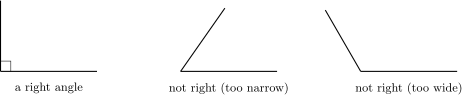
A right angle is the corner angle of a sheet of paper, or of the set square. Two lines making a right angle are perpendicular. In figures, a right angle is marked with a small square in the corner.
Method 18.2 (Checking a right angle)
- Place the corner of the set square exactly on the corner to test;
- slide one edge of the set square along one side of the angle;
- if the other side of the angle runs exactly along the other edge, the angle is right — if it opens wider or narrower, it is not.
18.2 The shapes and their rules
Definition 18.3 (Square, rectangle, triangle)
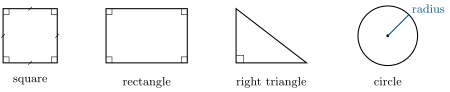
- A rectangle has sides and right angles; its opposite sides have the same length.
- A square is a rectangle whose sides all have the same length.
- A triangle has sides; a right triangle has one right angle.
- A circle is drawn with the compass: all its points are at the same distance (the radius) from the center.
Example 18.4 (Why marks matter)
A shape drawn slightly tilted can look like a square without being one. The marks tell the truth: right-angle squares tick marks a real square. When you draw, put the marks; when you read a figure, trust only the marks and the given measures.
18.3 Drawing on grid paper
Method 18.5 (Constructions on a grid)
Grid paper offers free right angles: its lines are perpendicular.
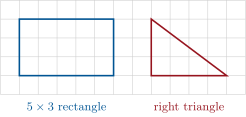
- To draw a rectangle by : choose a crossing point, count squares right, squares up, and close the shape along the grid lines;
- to check equal lengths, count squares;
- diagonal steps make tilted lines: going “ right, up” repeatedly draws a line.
Example 18.6 (A construction program)
A figure can be described by instructions: “1. Draw a square of side cm. 2. Draw the circle with center passing through .” Following a program line by line, anyone can redraw the same figure — and writing one forces you to name every point. Try it with a partner: one writes, the other draws.
18.4 Exercises
Exercise 18.1 ★
In the classroom, find (without measuring) three right angles and one angle that is not right. How can you check each one?
Solution
Solution of Exercise 18.1.
Typical right angles: the corners of the board, of a sheet of paper, of the door. A non-right angle: the opening of a pair of scissors, the hands of the clock at 1 o’clock. Each is checked with the set square (Method 18.2) — never just by eye.
Exercise 18.2 ★
Draw a rectangle of cm by cm with ruler and set square. Mark its right angles and its equal sides.
Solution
Solution of Exercise 18.2.
Construction: one side of cm, right angles at both ends with the set square, sides of cm, close the shape. Marks: little squares in the corners, one tick on each cm side, a double tick on each cm side.
Exercise 18.3 ★
Draw a square of side cm. How many right angles does it have? How many equal sides? Mark everything.
Exercise 18.4 ★
On grid paper, draw: a square; a rectangle; a right triangle with legs of and squares.
Solution
Solution of Exercise 18.4.
Grid constructions; the grid guarantees the right angles, and counting squares guarantees the lengths.
Exercise 18.5 ★
True or false? Explain. “Every square is a rectangle.” “Every rectangle is a square.” “A triangle can have two right angles.” (Try to draw one!)
Solution
Solution of Exercise 18.5.
“Every square is a rectangle”: true — it has right angles, which is all a rectangle asks.
“Every rectangle is a square”: false — a rectangle has unequal sides.
“A triangle can have two right angles”: false — the two sides drawn from the two right angles would be perpendicular to the same base line, hence never meet to close the triangle.
Exercise 18.6 ★
Draw a circle of radius cm. Mark its center , a point on the circle, and draw the radius . How long is ? And if is another point of the circle, how long is ?
Solution
Solution of Exercise 18.6.
cm (the radius). cm too: every point of the circle is at the same distance from the center.
Exercise 18.7 ★
Follow this program: “1. Draw a rectangle with cm and cm. 2. Mark the point in the middle of . 3. Join to and to .” What shapes has the rectangle been cut into?
Solution
Solution of Exercise 18.7.
The rectangle is cut into three triangles: two right triangles ( and , right-angled at and ) and the middle triangle .
Exercise 18.8 ★
Sort the shapes: which of these have at least one right angle? A square; a (non-square) rectangle; a right triangle; a circle; the letter L drawn with thick strokes.
Solution
Solution of Exercise 18.8.
With at least one right angle: the square, the rectangle, the right triangle, and the letter L (its inner and outer corners). The circle has no corner at all.
Exercise 18.9 ★★
On grid paper, draw a tilted square whose sides go “ right, up” (and the matching turns). Count squares to convince yourself the four sides have the same length.
Solution
Solution of Exercise 18.9.
Each side crosses “ right, up” (or the turned versions “ right, down”, etc.): every side is the diagonal of a block of squares, so all four have the same length.
Exercise 18.10 ★★
Write a construction program (numbered instructions, named points) for: a square of side cm sitting on top of a rectangle cm cm, like a house on its ground floor. Test your program on a classmate.
Solution
Solution of Exercise 18.10.
One correct program: “1. Draw a rectangle with cm (bottom) and cm. 2. On top of the side , draw the square of side cm, outside the rectangle.” Any clear, numbered, complete program is correct — test it by following it word for word.
Exercise 18.11 ★★
How many squares can you find in a grid of small squares? (Count the , the and the ones.)
Solution
Solution of Exercise 18.11.
squares: . squares: . : . Total: squares.