Primary & Middle School Mathematics · Grades 1–9
46Negative Numbers
Temperatures below zero, floors below ground, money owed: many quantities go below . Negative numbers extend the number line to the left of zero. This chapter teaches how to compare them and how to add and subtract them — their multiplication waits for Chapter 54.
46.1 Relative numbers
Definition 46.1 (Relative numbers)
A relative number is made of a sign ( or ) and a distance to zero: and are both at distance from , on opposite sides. Positive numbers are usually written without their sign: . The numbers and are opposites of each other.

Method 46.2 (Comparing relative numbers)
On the number line, smaller means further left. In practice:
- a negative number is always smaller than a positive one: ;
- between two positives, the usual order;
- between two negatives, the one with the larger distance to zero is the smaller: .
Example 46.3
Order from smallest to largest: ; ; ; ; . Negatives first, the most negative leading:
46.2 Adding relative numbers
Think of a relative number as a movement along the line: means “walk steps right”, means “walk steps left”. Adding numbers means chaining the walks.
Method 46.4 (Adding two relative numbers)
- Same sign: add the distances, keep the common sign: .
- Opposite signs: subtract the smaller distance from the larger, take the sign of the larger: and .
- Opposites cancel: .

Example 46.5
Step by step, grouping as convenient:
46.3 Subtracting relative numbers
Theorem 46.6 (Subtraction rule)
Subtracting a relative number is the same as adding its opposite:
Why it works. is the number that added to gives . Check that does the job: . ∎
Example 46.7
Every subtraction becomes an addition, then Method 46.4 applies:
The last line is the famous one: subtracting a negative means adding. Removing a debt makes you richer!
Example 46.8 (Temperature differences)
In one day the temperature went from degrees to degrees. The rise is the difference
On the number line: from up to is degrees, from to is more.
46.4 Coordinates in the whole plane
Definition 46.9 (Coordinates with signs)
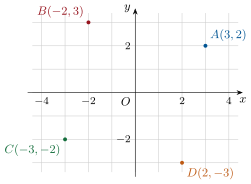
With two perpendicular graduated axes crossing at the origin , every point of the plane gets two relative coordinates : negative means left of the vertical axis, negative means below the horizontal axis.
46.5 Exercises
Exercise 46.1 ★
Give the opposite of: ; ; ; . Then complete: “two numbers are opposites when their sum is ?”.
Exercise 46.2 ★
Copy and complete with or :
Solution
Solution of Exercise 46.2.
; ; ; .
Exercise 46.3 ★
Order from smallest to largest: ; ; ; ; ; .
Solution
Solution of Exercise 46.3.
.
Exercise 46.4 ★
Compute:
Solution
Solution of Exercise 46.4.
; ; ; .
Exercise 46.5 ★
Transform into additions, then compute:
Solution
Solution of Exercise 46.5.
.
.
.
.
Exercise 46.6 ★
Compute by grouping cleverly (opposites first):
Solution
Solution of Exercise 46.6.
(positives together, negatives together).
.
Exercise 46.7 ★
The temperature was degrees this morning; it rose by degrees during the day, then dropped by degrees at night. Write a single computation giving the final temperature, and compute it.
Solution
Solution of Exercise 46.7.
: it is degrees at night.
Exercise 46.8 ★
Plot in a coordinate system: ; ; ; ; . Which point lies on an axis?
Solution
Solution of Exercise 46.8.
Free plot; lies on the vertical axis (its first coordinate is ).
Exercise 46.9 ★★
Compute the difference between the highest and lowest temperature: Moscow in January, max degrees, min degrees; Helsinki, max , min .
Exercise 46.10 ★★
A diver is at altitude m (twelve meters below the surface). She rises m, then descends m. At what altitude is she? How far must she still rise to reach the surface?
Solution
Solution of Exercise 46.10.
: she is at m. To reach the surface (altitude ) she must rise m.
Exercise 46.11 ★★
Plot , , . Find the coordinates of the point so that is a rectangle, and compute its perimeter (count the grid squares for the side lengths).
Solution
Solution of Exercise 46.11.
: same first coordinate as , same second coordinate as . Sides: (from to ) and (from down to ), so the perimeter is .
Exercise 46.12 ★★★
In the magic square below, every row, column and diagonal must have the same sum. Copy and complete it:
(Start by finding the magic sum using the diagonal that is almost complete.)
Solution
Solution of Exercise 46.12.
The complete diagonal gives the magic sum . Then, cell by cell: top-left ; middle-right ; bottom-right ; bottom-middle .
Every row, column and diagonal sums to .
46.6 Problem: The year zero that never was
Problem 46.1
Weekend problem — relative numbers on the timeline of history: durations across the era boundary, the astronomers’ trick, and the net-change principle
The number line of this chapter has a famous real-world twin: the timeline of history, with the years BC stretching left and the years AD stretching right. But the historians’ line hides a trap that has spoiled many a computation: there is no year zero — the year 1 BC is followed immediately by AD 1. This problem computes with temperatures, lifts and bank accounts, then repairs history’s broken zero the way astronomers do: with relative numbers.
Part I — Warm-ups, and a first trap.
- The summit of Mont Blanc is at altitude m; the shore of the Dead Sea at m. Compute the difference in altitude between them.
- A bank account holds euros (an overdraft). Its owner deposits euros, pays a bill of euros, then deposits euros. Write the balance as a single chain of additions and compute it. What single deposit would have brought the original back to exactly ?
- Julius Caesar was born in BC and died in BC. Counting BC years as negative numbers ( BC as , BC as ), compute : how many years did Caesar live?
- Emperor Augustus was born in BC and died in AD . The same recipe gives years — but historians insist he died at . Their objection: the count walks through a year that never existed. Which one?
- Astronomers repair the timeline by relabelling: AD years keep their number ( stays ), but BC becomes , BC becomes , and generally the year BC becomes . Convert BC, and redo the computation of question 4 with the astronomers’ numbers. Does the answer now satisfy the historians?
Part II — Computing across the eras. From now on, use the astronomers’ relabelling for every computation, converting back to BC/AD at the end (a year labelled or negative is the historians’ year BC).
- Convert to astronomers’ numbers: BC; BC; AD ; and BC, the legendary founding of Rome.
- How many years passed from the founding of Rome ( BC) to the fall of the Western Empire (AD )?
- A comet returns every years and appeared in BC. Give the historians’ years of its next three appearances, and of the appearance just before BC.
- How many years passed from BC to AD ? (The tempting answer is ; the timeline says otherwise.)
- A child born in BC turned ten years old in which year (BC or AD)?
Part III — The net-change principle.
- The distance between two numbers on the line is the larger minus the smaller — always positive. Compute the distance between and , then between and .
- A lift starts at floor and makes the moves , , , , . Compute the final floor by grouping cleverly (Method 46.4, opposites first where possible). Would performing the moves in a different order change the destination? Why?
- Day by day, the temperature changes by , , , , , , degrees over a week. Compute the net change. If the week started at degrees, where did it end? State the principle: final value starting value (sum of all changes).
- A hiker’s walk brings her back exactly to her starting altitude. What must the sum of all her altitude changes be, and why? Of her six recorded changes, five are , , , , (in hundreds of meters): find the sixth.
- The finale, back in Rome. A historian computes: “the Republic ran from BC to BC, then the Empire to AD ; in all, from BC to AD , that is years of Roman state.” Redo the computation with astronomers’ numbers. What is the correct total — and which year, once again, caused the error?
Solution
Solution of Problem 46.1.
1. m (Theorem 46.6: subtracting a negative means adding).
2. Balance:
To return the initial to , deposit its opposite: euros.
3. : Caesar lived years. (No trap here: both years are on the same side of the era boundary.)
4. The year : counting from up to passes through , but the historians’ calendar jumps straight from BC to AD — the year never existed, so the naive count is one year too long.
5. BC becomes . Then years: exactly the historians’ figure. On the astronomers’ relabelled line there are no gaps, so ordinary subtraction gives true durations.
6. BC ; BC ; AD ; BC .
7. years.
8. BC is . Next appearances: , then , then : the years AD , AD and AD . Before: , which is the historians’ year BC.
9. BC is , so years — not . The missing year zero strikes whenever a duration crosses the era boundary.
10. BC is ; ten years later is : the child turned ten in AD .
11. Between and : . Between and : .
12. Grouping opposites and friends:
the lift ends at floor . The order does not matter: a sum of relative numbers can be reorganized freely (each move is walked along the same line, and the total walk is the same).
13. Net change: degree. Starting at : final temperature degrees. In general, the final value is the starting value plus the sum of all the changes — no need to follow the ups and downs one by one.
14. Back to the start means net change : the ups and downs must cancel exactly. The five known changes sum to , so the sixth change is the opposite: (three hundred meters up).
15. Astronomers: BC , and years. The historian’s counts one year too many — once more the phantom year zero, silently included in the addition but absent from history. (As a check, the two eras: Republic to , years; Empire to , years; .)