Primary & Middle School Biology · Grades 1–9
22What Plants Need
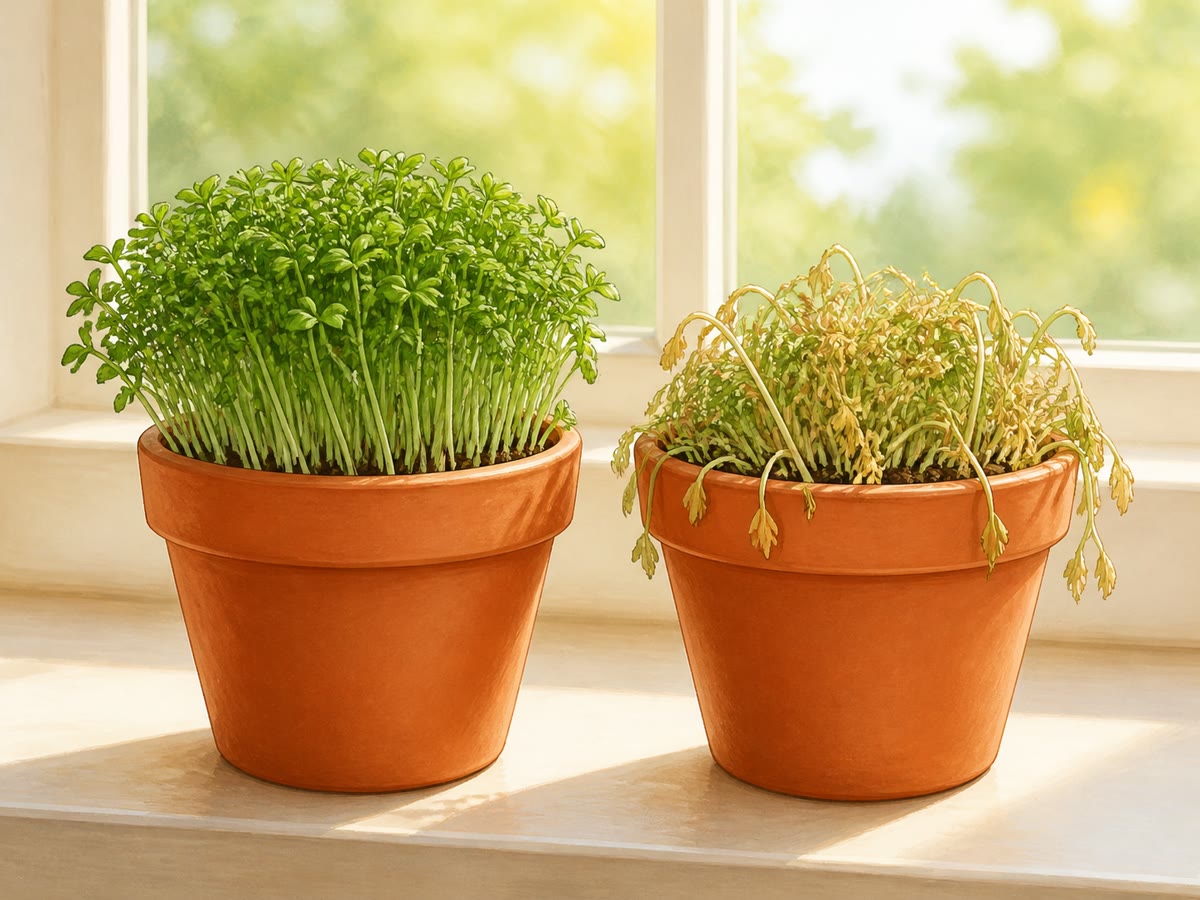
Two pots of cress stand on the same windowsill, sown the same day. One is watered, one is not — and within a week the difference is written in green and yellow. With pots, seeds and patience you can make plants themselves answer the question of this chapter: what exactly does a plant need to live and grow?
22.1 Asking plants questions: the fair test
Method 22.1 (The fair test)
To find out whether a plant needs something — water, light, soil, warmth:
- take two pots of the same plants, sown the same way;
- treat them exactly alike in everything except the one thing tested — one gets it, the other does not;
- wait days or weeks, and compare;
- any difference must come from the one thing you changed: the test was fair.
The untouched pot is called the control: it shows what happens when nothing is missing.
Example 22.2 (Why two pots and not one)
Suppose a single unwatered pot wilts. Was it the missing water — or a cold snap, or bad seeds? With a watered twin standing green beside it, grown from the same packet in the same room, the doubt disappears: the twins differed in water alone. One-pot experiments convince nobody, least of all a biologist.
22.2 What the tests reveal
Proposition 22.3 (The needs of a plant)
Fair tests, run for each need in turn, show that a plant needs:
- water — the unwatered pot wilts and dies;
- light — the cupboard pot grows pale, long and weak, then gives up: no light, no plant food made;
- air — sealed away from fresh air, growth stops;
- warmth — in the cold, seeds wait (Proposition 9.5) and growth freezes to a halt;
- mineral salts: tiny amounts of nourishing substances that the roots drink dissolved in the soil’s water — in pure water alone, a plant soon runs short.
Proof. Admitted at this level. ∎
Example 22.4 (The pale prisoner)
The cupboard test of Exercise 3.8, done properly with a lit twin, gives a striking result: the prisoner is not just sad but pale yellow — it stopped making its green substance — and strangely tall, stretched out as if searching for the missing light. Growth without light is spending without earning; the seed’s reserves once burnt, it stops.
Remark 22.5 (Why gardeners feed the soil)
Compost and manure are not plant “meals” — plants eat nobody. They restock the soil’s mineral salts, which harvests carry away year after year. The compost bin of Example 13.9 closes the loop: what the soil gave the vegetables, the peelings give back to the soil.
22.3 What plants do with what they take
Proposition 22.6 (Plants make their own matter)
Animals grow by eating other living things. A plant eats no one: with water and mineral salts from the soil, air, and the energy of light caught by its green leaves, it makes its own matter — new stems, leaves, roots and seeds. That is why light is food-and-drink serious for a plant, and why the green leaf faces the sky.
Proof. Admitted at this level. ∎
Example 22.7 (A tree from almost nothing)
Plant a pip in a large pot of weighed soil, wait years, and a small tree stands there — yet the soil has lost almost none of its weight. The tree’s wood was not scooped out of the pot: it was made, from water, air and light, in the green workshops of the leaves. Where the matter of living things comes from will keep us busy again in later years.
Remark 22.8 (Green makes everyone’s living)
Recall Proposition 19.3: every food chain starts with a plant. Now we see why that must be so — plants are the only link that makes new matter from non-living ingredients. Every mouthful anyone eats, anywhere, was made in a leaf first.
22.4 Exercises
Exercise 22.1 ★
List the five needs of a plant.
Solution
Solution of Exercise 22.1.
Water, light, air, warmth, and mineral salts (drunk dissolved in the soil’s water).
Exercise 22.2 ★
In a fair test, how many things may differ between the two pots? What is the untouched pot called?
Solution
Solution of Exercise 22.2.
Exactly one — the thing being tested; everything else must be identical. The untouched pot is the control.
Exercise 22.3 ★
Describe the appearance of a plant grown a fortnight in the dark. Which need was missing, and what could it not make?
Solution
Solution of Exercise 22.3.
Pale yellow instead of green, strangely tall and stretched, weak — then it gives up. Light was missing, so the plant could not make its green substance, nor its food.
Exercise 22.4 ★
What are mineral salts, and how does the plant take them in?
Solution
Solution of Exercise 22.4.
Tiny amounts of nourishing substances present in the soil. The roots drink them dissolved in the soil’s water.
Exercise 22.5 ★
Why do gardeners spread compost, if plants do not eat?
Solution
Solution of Exercise 22.5.
Because harvests carry the soil’s mineral salts away year after year; compost restocks them. It feeds the soil, and the soil’s water then carries the salts into the roots.
Exercise 22.6 ★
How does a plant’s way of growing differ from an animal’s, by Proposition 22.6?
Solution
Solution of Exercise 22.6.
An animal grows out of the living things it eats; a plant eats no one — it makes its own matter from water, mineral salts, air and the energy of light caught by its green leaves.
Exercise 22.7 ★
In Example 22.7, the pot’s soil hardly lost weight while the tree grew. Where did the tree’s matter come from?
Solution
Solution of Exercise 22.7.
Not from the soil: from water, from the air, with light providing the energy — built in the green leaves. (The soil contributed only water and small amounts of mineral salts.)
Exercise 22.8 ★
Try it: design and run the water fair-test of the figure with cress — two pots, one difference. Note what you see after one week.
Solution
Solution of Exercise 22.8.
Open answer. Expected: the watered pot green and upright, the dry twin wilting within days — and since only water differed, water gets the credit.
Exercise 22.9 ★★
Lucas “proves” plants need music: he sang to one pot for a month, and it thrived. What is missing from his experiment, by Method 22.1? Design the version that would actually test it.
Solution
Solution of Exercise 22.9.
There is no control: one pot, and everything at once — perhaps the pot simply had good light and diligent watering (singers visit their plants often!). The fair version: two identical pots, same seeds, soil, window and watering; sing to one only; compare after a month. Only then would a difference point to the singing.
Exercise 22.10 ★★
A water plant grows fully submerged, rootless, yet healthy. Which of the five needs is it plainly still meeting, and how — and which need does its water supply in the soil’s place?
Solution
Solution of Exercise 22.10.
Light: it grows submerged but in lit water, its green leaves still catching the light through it. The water around it also supplies what soil water supplies — dissolved mineral salts, drunk over its whole surface instead of through roots.
Exercise 22.11 ★★★
Two identical pots of mint: one in pure rainwater sand, one in garden soil, both watered and lit alike. After two months the sand pot is small and yellowing. Which need does this fair test isolate — and why did the sand plant grow at all at first?
Solution
Solution of Exercise 22.11.
Mineral salts: water, light, air and warmth were equal, and pure sand with rainwater provides almost no salts. It grew at first on the reserves packed in its own tissues (as the buried seedling grew on the seed’s store) — reserves spent, the shortage showed.