Primary & Middle School Biology · Grades 1–9
39How Plants Spread
A new road cutting is bulldozed in March: raw, bare earth, not a green speck. Come back in September and it is stitched all over with seedlings — poppies, dandelions, willow shoots, grasses. Nobody sowed it. Yet plants, which cannot walk a single step, colonized the bare ground within months. This chapter is about their travel department.
39.1 Plants travel as seeds and spores
Proposition 39.1 (Sedentary plants, traveling beginnings)
An adult plant is fixed for life (Definition 3.1) — so a species spreads by sending out its beginnings: seeds and fruits (Chapter 31), spores (Definition 24.1), or runners and other vegetative advances (Definition 24.5). Occupying new ground this way is called colonization.
Proof. Admitted at this level. ∎
Definition 39.2 (Dispersal)
Dispersal is the carrying of seeds, fruits or spores away from the parent plant. The carriers are few and ancient: the wind, animals, water — and some fruits that fling their seeds themselves.
Example 39.3 (Why leave home at all?)
A seed dropped at the parent’s foot germinates in the parent’s shade, among the parent’s roots — competing for the very light and water of Proposition 22.3 with a rival a hundred times its size. Dispersal is the escape from that losing match: distance is the first gift a plant gives its young.
39.2 The carriers, and the fruits built for them
Proposition 39.4 (Built to match the carrier)
Fruit and seed shapes match their carriers — Definition 28.1’s fit, applied to luggage:
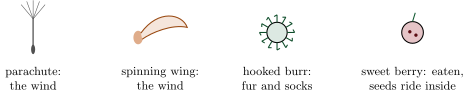
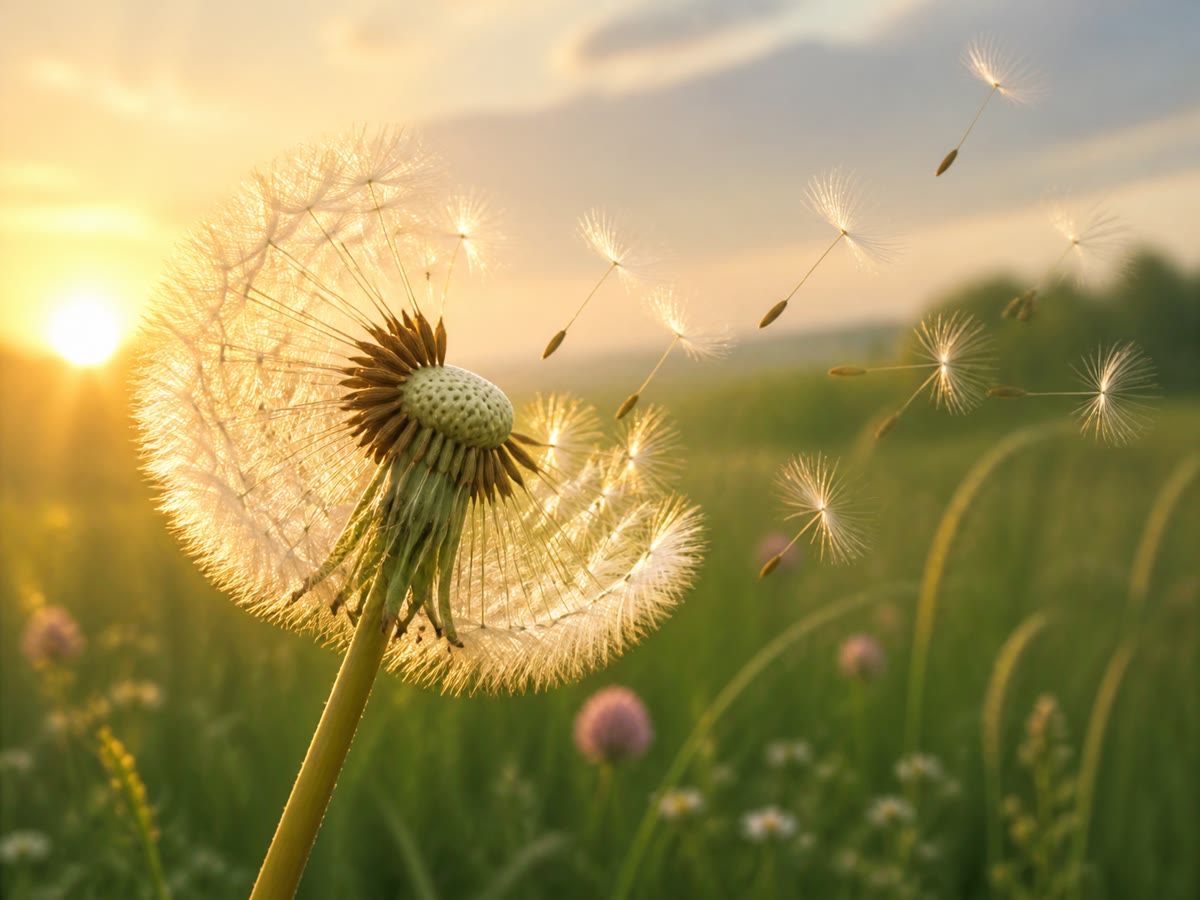
- wind: parachutes (the dandelion’s plumed seeds), wings (maple and ash keys that spin down slantwise), or dust-fine spores that simply float (the fern’s millions);
- animals, outside: burrs — burdock, cleavers — whose hooks grip fur and socks and ride until groomed off;
- animals, inside: sweet fleshy fruits — cherries, blackberries, rose hips — eaten whole; the tough-coated seeds pass through unharmed and are deposited elsewhere, with fertilizer (Exercise 16.10’s answer, completed);
- water: floating fruits — the alder’s tiny rafts, the coconut’s ocean-going shell;
- self-flinging: pods that dry, tense and snap — gorse and violets shoot seeds metres from the parent.
Proof. Admitted at this level. ∎
Example 39.5 (Reading the roadside)
September’s road cutting, decoded: dandelions and willows — plumed seeds, flown in on the wind; poppies — their tiny seeds lay already in the moved earth, waiting as only seeds can (Exercise 9.9); blackberry seedlings under the fence posts — deposited by perching birds, fertilizer included; burdock by the path — carried in on a dog. Every colonist’s arrival route is written in its equipment.
Method 39.6 (Naming the carrier from the fruit)
- look for flight gear — plumes, wings, dust fineness: the wind;
- look for hooks: animal fur, outside;
- fleshy, colored, sweet? animal gut, inside — check the seeds for tough coats;
- buoyant, near water? water;
- a dried, twisted, sprung pod? self-flinging;
- test your verdict: drop it, float it, press it to a woolly sleeve.
39.3 Colonizing without seeds
Example 39.7 (The ground advance)
Alongside the airborne arrivals, some colonists walk on their own vegetative feet (Chapter 24): couch grass advances underground by creeping stems, metre by metre; brambles arch over and root where their tips touch; the strawberry’s runners hop across open ground. Slow, short-range — and unstoppable across a neglected garden, as any gardener knows.
Remark 39.8 (Two-speed colonization)
The two systems divide the work. Seeds and spores are the long-range service — rare lucky landings far away, the dandelion crossing the town. Vegetative advance is the short-range service — dense, sure occupation of the ground next door. The bramble patch spreading from the hedge uses both at once: arching stems for the metre, bird-carried seeds for the mile.
39.4 Exercises
Exercise 39.1 ★
What is colonization? What is dispersal, and what are the main carriers?
Exercise 39.2 ★
Why is a seed better off germinating far from its parent?
Exercise 39.3 ★
Name the carrier for each: the dandelion’s plume, the burdock burr, the cherry, the maple key, the coconut.
Exercise 39.4 ★
How do a bird-eaten blackberry’s seeds survive the journey, and what do they arrive with?
Solution
Solution of Exercise 39.4.
Their tough coats let them pass through the bird’s digestion unharmed; they arrive deposited far from home, with a dose of fertilizer.
Exercise 39.5 ★
Which travel service do gorse and violets use? Describe the mechanism.
Solution
Solution of Exercise 39.5.
Self-flinging: their pods dry, tense like springs, and snap open, shooting the seeds metres from the parent.
Exercise 39.6 ★
Name two vegetative colonists and how each advances.
Exercise 39.7 ★★
Decode the road cutting: for dandelion, poppy, blackberry and burdock, give the arrival route the chapter names.
Exercise 39.8 ★★
Run Method 39.6 on: (a) a plumed thistle seed; (b) a rose hip; (c) a cleavers ball that sticks to your pullover.
Exercise 39.9 ★★
Explain Remark 39.8’s “two-speed” idea with the bramble patch: which system does the metre, which the mile?
Solution
Solution of Exercise 39.9.
The arching, tip-rooting stems do the metre — dense, sure occupation of the ground next door. The bird-eaten berries do the mile — rare long-range landings that found new patches far away.
Exercise 39.10 ★★
The fern colonized the new cutting’s damp north bank but not its dry south bank. Combine Proposition 24.3 and Proposition 37.6 into the explanation.
Solution
Solution of Exercise 39.10.
Spores reach both banks — they float everywhere — but a spore-plant’s reproduction needs dampness, so only the north bank’s conditions accept the arrival. Dispersal delivers; conditions decide who may stay: the inhabitants match the conditions, arrivals notwithstanding.
Exercise 39.11 ★★
An island rises bare from the sea, kilometres offshore. Which dispersal services can reach it at all? Predict the equipment of its first plant colonists.
Solution
Solution of Exercise 39.11.
Only the long-range services: wind (plumed and dust-fine seeds, spores), sea water (floating fruits like the coconut), and birds (gut-carried seeds of fleshy fruits). Predict plumed, dust-fine, floating or berry-borne equipment among the pioneers — no heavy, carrier-less seeds.
Exercise 39.12 ★★★
Sweet flesh is expensive for a plant to build. Using Example 39.3 and the inside-animal service, explain what the cherry tree buys with all that sugar — and why the seeds’ tough coats are the other half of the purchase.
Solution
Solution of Exercise 39.12.
The sugar buys transport: a bird paid in flesh carries the seeds far from the parent’s shade and deposits them with fertilizer — distance, the first gift. The tough coats are the other half because the courier is a digestive tract: the payment must be digestible and the passengers must not be. Sweetness recruits the carrier; the coats survive it.
39.5 Problem: The Abandoned Field
Problem 39.1
Weekend problem — ten years of colonization, watched from one gate
A ploughed field is abandoned in autumn. A naturalist photographs it from the gate every June for ten years, and keeps notes.
Part I — Year one.
- June of year one: the bare earth is dotted with poppies, dandelions and thistles. For each, name the likely source and route — poppies from the soil itself, the others airborne. What equipment made the airborne arrivals possible?
- No blackberries appear in the field’s middle in year one, but three seedlings stand under the old fence posts. Explain the pattern with the inside-animal service — why exactly under the posts?
- The naturalist finds no ferns anywhere, though a wood full of them lies upwind. Ferns’ spores certainly arrived (Example 24.2 counts their millions). What condition of the open field, by Proposition 24.3, refused them?
- Couch grass invades from the field’s edge only, a metre or two a year. Which colonization system is this, and why can it not appear in the field’s middle the way dandelions did?
Part II — The years after.
- By year three, grasses and tall herbs have closed the bare ground, and the poppies have vanished from the standing vegetation. Where are the poppies now, and in what form? (Recall the road cutting and Proposition 38.6.)
- From year four, bramble arcs and young hawthorns dot the field, thickest near the hedges and under the fence line. Name the two services that placed them, and the evidence in the pattern.
- By year eight, willow and birch saplings stand taller than the brambles — both trees with tiny plumed or dust-light seeds. Why are the heavy-seeded oaks and chestnuts still almost absent, and what animal courier eventually plants even them?
- The photographs show the field’s cast changing year by year although no gardener touched it. State the driving rule: what does each year’s vegetation change about the field’s own conditions — light at ground level above all — and who does that change favor next?
Part III — The general lesson.
- Order the colonists by arrival: soil’s waiting seeds, wind-riders, animal-carried shrubs, heavy-seeded trees. Pair each wave with the dispersal service that timed it.
- A town square’s pavement cracks sprout the same year-one cast — poppies, dandelions — but never reach year four’s shrubs. Give two reasons the succession stalls there.
- The naturalist claims: “left alone, this field will be woodland.” Defend the claim with the ten-year trend — and name the meadow exception of Proposition 35.1 that proves “left alone” is the operative phrase.
- Summarize the whole problem in two sentences using the words dispersal, conditions and colonization.
Solution
Solution of Problem 39.1.
1. Poppies: waked from seeds already in the ploughed soil — the annual’s waiting stock. Dandelions and thistles: flown in on the wind, by their plumed seeds.
2. Birds eating blackberries elsewhere perch on the fence posts and deposit the seeds below them, fertilizer included — so the seedlings map the perches, not the wind.
3. Its dryness: an open, sunlit field offers none of the dampness a fern’s delicate spore-grown stages need. Arrival happened; establishment was refused.
4. Vegetative advance — creeping underground stems. It moves only ground-to-adjacent-ground from established plants, so it must walk in from the edge; it has no airborne stage to land in the middle.
5. In the soil, as seeds: annuals beaten in the standing competition persist as the seed bank, waiting for the next bare ground.
6. The inside-animal service (berries eaten, seeds deposited from perches — thickest under fence line and hedges) and, for hawthorn equally, the same bird-courier; the perch-shaped pattern is the evidence.
7. Oak acorns and chestnuts are heavy, carrier-less without help — they fall at the parent’s foot. Their courier is the jay (and the squirrel): burying acorns as winter stores and forgetting some, they plant oaks far from the parent.
8. Each year’s vegetation shades the ground below it, cooling and darkening the surface: the sun-loving pioneers’ own success removes their conditions, and the changed conditions favor shade-bearers next — colonists alter the site, and the altered site chooses new colonists.
9. Wave 1, the soil’s waiting seeds (instant — they were already there). Wave 2, the wind-riders (weeks: the air delivers constantly). Wave 3, animal-carried shrubs (years: perch by perch). Wave 4, heavy-seeded trees (last: they wait for jays’ and squirrels’ buried forgettings).
10. The cracks offer no room: a shrub’s roots need soil volume a pavement seam lacks; and the succession’s later waves need their couriers and conditions — perching birds’ deposits mostly miss the cracks, and the baked dry seam refuses what does arrive. Year one’s wind-riders are the only service the site can accept.
11. The trend runs bare earth, herbs, shrubs, pioneer trees — each wave taller and shadier: extended, it ends in woodland, as the willows and birches already show. The exception: a mowed or grazed meadow, where human touch removes the shrub wave every year — proof that only left alone does the field walk to forest.
12. For example: “Dispersal delivered colonists to the bare field — from the soil, the wind, the birds — and at each stage the field’s conditions decided which arrivals could stay. Colonization thus ran in waves, each wave changing the conditions and choosing the next.”