Primary & Middle School Biology · Grades 1–9
30Biodiversity
Take one square metre of flowering meadow and start counting: a dozen kinds of plants, beetles and bugs beyond counting, spiders, snails, worms below and butterflies above. Now try the same square metre of paved schoolyard. The difference between those two counts has a name — biodiversity — and it has become one of the most important words in biology.
30.1 The diversity of life
Definition 30.1 (Species)
A species is one particular kind of living thing: all the individuals built on the same model, which reproduce among themselves. The house sparrow is a species; so is the common daisy, the red fox, the garden snail. Chapter 21’s classes are boxes of many species: “mammals” holds thousands of them.
Definition 30.2 (Biodiversity)
The biodiversity of a place is the variety of life it holds — above all, how many different species live there, and how well each is doing. A flowering meadow, rich in species, has high biodiversity; a paved yard, almost none.
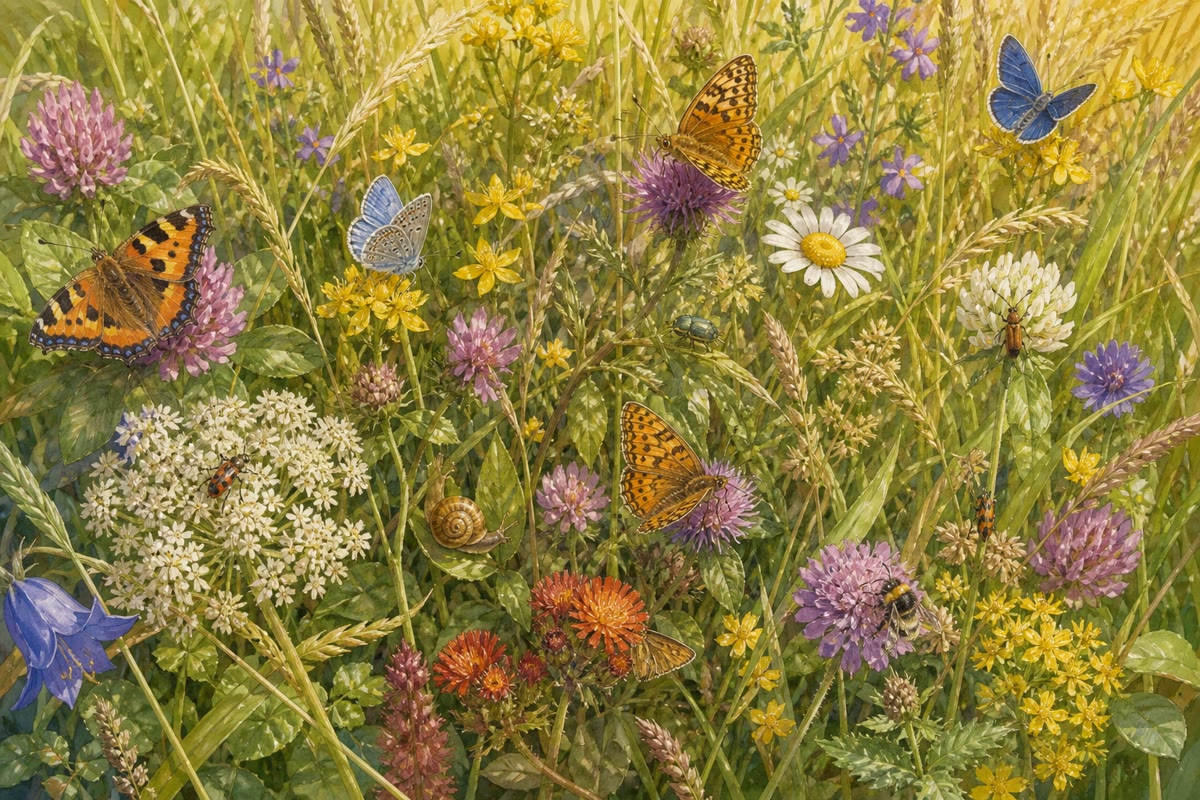
Example 30.3 (Counting the planet)
Scientists have named about two million species so far — and are sure that is only part of the total, since new species are found on every serious expedition: beetles above all (no group has more named species), but also fish, frogs, plants, even occasional mammals. Earth’s full species count is still unknown — most estimates run into the millions beyond what is named.
Remark 30.4 (Diversity at every scale)
Biodiversity shows at several scales at once: many species in one habitat; many different habitats side by side (pond, hedge, meadow — each with its own species, as Example 11.2 showed); and, within one species, no two individuals quite alike — no two garden snails wear exactly the same shell. Variety within variety within variety.
30.2 Why biodiversity matters
Proposition 30.5 (The web needs its threads)
The species of a habitat feed, shelter, pollinate and clean up for one another — they are threads of one web (Remark 19.9). A rich web with many threads can absorb a shock: if one prey species fails, its hunters switch to others. A poor web tears easily: each lost species leaves the survivors fewer options. Biodiversity is the web’s strength.
Proof. Admitted at this level. ∎
Example 30.6 (The orchard test)
An orchard with hedges, wildflower strips and old trees hosts dozens of helper species: bees and hoverflies pollinate the blossom (Remark 16.5), ladybugs eat the plant lice, birds patrol for caterpillars, worms keep the soil open. Grub out the hedges and mow the flowers, and the helpers leave — the fruit grower must then do their jobs alone, jobs the web used to do free.
Example 30.7 (People live from the web)
Everything humans eat traces back to living species (Remark 22.8); most of our medicines were first found in plants, molds and other living things; cotton, wool, timber and leather are species’ products. The web’s threads run straight through every kitchen, pharmacy and wardrobe.
30.3 Biodiversity can be lost — and helped
Proposition 30.8 (How diversity is lost)
A species dwindles when what it depends on is taken:
- its habitat destroyed — the drained pond of Proposition 11.7, the grubbed-out hedge, the paved meadow;
- its environment poisoned — litter and chemicals (Proposition 13.4);
- too many of it taken — overfished, overpicked, overhunted.
A species entirely gone — everywhere, forever — is extinct. Extinction is not like a lost game: there is no next round.
Proof. Admitted at this level. ∎
Method 30.9 (Helping biodiversity, starting small)
The recipes of Method 13.6 scale up:
- keep and plant variety — a hedge of five bushes beats a fence, a flower strip beats bare gravel;
- leave wild corners: dead wood, leaf piles, unmowed grass are habitats (Example 13.2);
- help the helpers: nest boxes, insect shelters, a pond however small (Example 11.8);
- count what lives around you, year after year — what is counted is noticed, and what is noticed gets protected.
Example 30.10 (The return of the storks)
Where wet meadows were restored and nest platforms raised, storks — once nearly gone from whole regions — came back to breed, and with them frogs, dragonflies and meadow flowers. Species return when their threads are retied: protection works, and its results can be watched from the village square.
30.4 Exercises
Exercise 30.1 ★
What is a species? Give three examples from this chapter.
Solution
Solution of Exercise 30.1.
One particular kind of living thing — individuals built on the same model, reproducing among themselves. Examples: the house sparrow, the common daisy, the red fox, the garden snail.
Exercise 30.2 ★
What is biodiversity? Compare the meadow and the paved yard.
Solution
Solution of Exercise 30.2.
The variety of life a place holds — above all its number of species and their health. The flowering meadow holds dozens of plant and animal species in one square metre: high biodiversity. The paved yard holds almost none.
Exercise 30.3 ★
About how many species are named so far? Why is the true number certainly higher?
Solution
Solution of Exercise 30.3.
About two million. Because every serious expedition still finds unnamed species — beetles especially — so millions more must exist beyond the catalogue.
Exercise 30.4 ★
Name the three scales of diversity in Remark 30.4, each with its example.
Exercise 30.5 ★
Why does a species-rich web survive shocks better than a poor one? Use the hunters-switch-prey argument.
Solution
Solution of Exercise 30.5.
In a rich web, a hunter whose prey fails can switch to other prey, and every role has understudies; the shock is absorbed. In a poor web each species has few options, so one loss drags others after it.
Exercise 30.6 ★
List four helper species of the orchard and the free job each does.
Solution
Solution of Exercise 30.6.
Bees and hoverflies: pollinating the blossom. Ladybugs: eating the plant lice. Birds: patrolling for caterpillars. Worms: keeping the soil open.
Exercise 30.7 ★
Give the three ways a species dwindles, with one example each. What does extinct mean?
Solution
Solution of Exercise 30.7.
Habitat destroyed (the drained pond); environment poisoned (litter and chemicals); too many taken (overfishing). Extinct means gone entirely — everywhere, forever.
Exercise 30.8 ★
Try it: count the species — plants and animals, named or described — in one small square you choose outdoors. Then count a paved square for comparison. Your two numbers are a biodiversity measurement.
Solution
Solution of Exercise 30.8.
Open answer. A grassy or planted square typically yields ten or more species; the paved square, close to zero — the difference is the measurement.
Exercise 30.9 ★★
“Losing one beetle species out of thousands cannot matter.” Answer with Proposition 30.5 — and with the fact that nobody knows all the threads a species holds.
Solution
Solution of Exercise 30.9.
Each species is a thread: its loss leaves every neighbor — whatever ate it, whatever it pollinated or cleaned up — with fewer options, and weakens the web’s power to absorb the next shock. And since no one knows all the threads a species holds, no one can certify a loss harmless in advance; extinction being forever, the mistake could never be unmade.
Exercise 30.10 ★★
The stork story is called a success of habitat protection rather than of protecting storks one by one. Explain the difference, using Proposition 11.7 and what returned alongside the storks.
Solution
Solution of Exercise 30.10.
Protecting storks one by one would mean guarding birds; restoring wet meadows rebuilt what the storks depend on — and a habitat feeds all its inhabitants at once, which is why frogs, dragonflies and meadow flowers returned with the storks. No habitat, no inhabitants; habitat restored, inhabitants return.
Exercise 30.11 ★★★
An orchard keeper replaces hedges and flower strips with fences and gravel, then must rent beehives for pollination and spray against plant lice — spending money on jobs once done free. Use Example 30.6 to explain what was really removed — and why the accounts of nature’s free work usually surface only after it stops.
Solution
Solution of Exercise 30.11.
What was removed was not decoration but a workforce: the hedge and flower species housed the pollinators and pest eaters, whose services appeared in nobody’s accounts while free. Nature’s work is invisible bookkeeping — constant, unpaid, unnoticed — so its price is discovered exactly when the workers are evicted and the jobs come back as bills.