Primary & Middle School Biology · Grades 1–9
34Food Webs
Chapter 19 warned us that its neat chains were single threads pulled from a net: the buzzard also takes mice, the lizard also eats flies, the grass feeds rabbits too. This year we stop pulling threads and look at the whole net — the food web — and at what holds it in balance.
34.1 From chains to webs
Definition 34.1 (Food web)
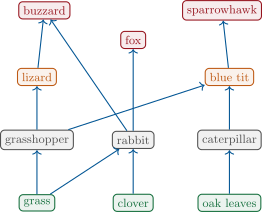
The food web of a habitat is the network of all its food chains at once: every species drawn once, with an arrow (still meaning is eaten by, Remark 19.2) for every meal relationship. Most animals eat several species and are eaten by several — so the chains cross, and the drawing becomes a web.
Example 34.2 (Reading the web)
Two readings of the figure. Follow the rabbit’s arrows: it eats grass and clover, and is eaten by fox and buzzard — four relationships, where a chain showed two. And count the buzzard’s food arrows: lizard and rabbit — lose one, the other remains. The web records exactly the spare options that Proposition 30.5 praised.
34.2 Roles in the web
Definition 34.3 (Producers and consumers)
The web’s species sort into roles:
- the producers: the plants, which make their own matter (Proposition 22.6) — every arrow-path starts on one (Proposition 19.3);
- the consumers: the animals, living on others — herbivores eating producers directly, carnivores eating other consumers, omnivores both (Definition 10.1);
- and, working in the shadows, the decomposers — the rotters of Example 13.9, who feed on dead remains and return their substance to the soil. A later year gives them their own chapter.
Example 34.4 (Sorting the figure)
In the pocket web: producers — grass, clover, oak; herbivorous consumers — grasshopper, rabbit, caterpillar; carnivorous consumers — lizard, blue tit (mostly), fox (an omnivore in truth), buzzard, sparrowhawk. Three floors: green, plant-eating, meat-eating — with every upper floor standing on the ones below.
Proposition 34.5 (The shape of the numbers)
Counting the web’s inhabitants floor by floor gives a constant shape: many producers, fewer herbivores, few carnivores — a meadow of millions of grass plants feeds thousands of grasshoppers, feeding a handful of lizards, feeding one pair of buzzards. Each floor lives on the one below and cannot outnumber its food. That is why great hunters are always rare.
Proof. Admitted at this level. ∎
34.3 Balance, and what disturbs it
Proposition 34.6 (The web’s balance)
Left to itself, a web holds its numbers in rough balance: if rabbits multiply, their hunters eat better and multiply after them, and the surplus melts; if rabbits dwindle, hungry hunters turn to other prey (the spare arrows) and rabbit numbers recover. The corrections of Proposition 19.6, running along many arrows at once, steady the whole.
Proof. Admitted at this level. ∎
Example 34.7 (The classic mistake)
Farmers once campaigned to destroy birds of prey — “chicken thieves”. Where they succeeded, mice and voles, freed of their main hunters, multiplied into plagues that ate far more grain than the hawks’ occasional chicken was worth. The gardener’s snail story (Exercise 19.9), at the scale of a whole countryside: remove a web’s top floor and the floor below erupts.
Method 34.8 (Predicting a disturbance)
To predict what removing (or adding) a species does:
- find the species in the web and list all its arrows, in and out;
- its foods, less eaten, tend to increase; its eaters, poorer, tend to decrease or switch prey;
- follow each change one more step along the web — the second-step effects often surprise;
- check which neighbors have spare arrows (they absorb the shock) and which depended on this species alone (they are in danger).
34.4 Exercises
Exercise 34.1 ★
What is a food web, and why do the chains cross?
Solution
Solution of Exercise 34.1.
The network of all a habitat’s food chains drawn at once — every species once, an arrow for every meal relationship. The chains cross because most animals eat several species and are eaten by several.
Exercise 34.2 ★
Name the three roles of Definition 34.3, with one example of each from the figure (decomposers excepted).
Solution
Solution of Exercise 34.2.
Producers: the plants (grass, clover, oak leaves). Consumers: the animals — herbivores like the rabbit, carnivores like the buzzard. Decomposers: the rotters feeding on dead remains (none drawn in the figure — they work in the shadows under all of it).
Exercise 34.3 ★
From the figure: list everything the blue tit eats, and everything that eats it.
Solution
Solution of Exercise 34.3.
The blue tit eats caterpillars and grasshoppers; it is eaten by the sparrowhawk.
Exercise 34.4 ★
Extract from the figure two complete chains that share the grasshopper.
Solution
Solution of Exercise 34.4.
Grass grasshopper lizard buzzard, and grass grasshopper blue tit sparrowhawk.
Exercise 34.5 ★
State the shape of the numbers, floor by floor. Why can no floor outnumber the one below?
Solution
Solution of Exercise 34.5.
Many producers, fewer herbivores, few carnivores. Because each floor feeds on the one below: eaters can never outnumber what there is to eat.
Exercise 34.6 ★
Why are buzzards rare and grasshoppers countless, in one sentence?
Solution
Solution of Exercise 34.6.
Because a pair of buzzards needs a meadow’s worth of grasshoppers, several lizards deep, to live on — the top of the pyramid stands on the wide floors below.
Exercise 34.7 ★
Rabbits have a good year and multiply. By Proposition 34.6, what happens next — and what melts the surplus?
Solution
Solution of Exercise 34.7.
Their hunters — fox, buzzard — eat better and multiply after them; the extra hunting melts the rabbit surplus, and the numbers settle back toward balance.
Exercise 34.8 ★
Try it: draw the food web of a habitat you know — garden, park, pond — with at least six species and every arrow you can defend. Mark producers green.
Solution
Solution of Exercise 34.8.
Open answer. A defensible garden web: salad and grass (producers) snail, aphid, sparrow; snail hedgehog; aphid ladybug; sparrow and ladybug neighborhood cat or sparrowhawk.
Exercise 34.9 ★★
Run Method 34.8 on removing the lizard from the figure: first-step effects, then one more step.
Solution
Solution of Exercise 34.9.
First step: grasshoppers, less eaten, increase; the buzzard, poorer by one prey, leans harder on rabbits (its spare arrow). Second step: more grasshoppers press the grass harder; more rabbit-hunting nudges rabbits down — easing the grass in turn. The web bends and partly absorbs the loss; the species with no spare arrows would have suffered most, and here everyone had spares.
Exercise 34.10 ★★
Retell Example 34.7 as a chain of predictions: hawks removed, then what, then what? Which step did the campaigners fail to predict?
Solution
Solution of Exercise 34.10.
Hawks removed; then mice and voles, freed of their main hunters, multiply; then the multiplied rodents eat the harvest — more grain than the hawks ever cost. The campaigners predicted step one and stopped; the web ran two steps.
Exercise 34.11 ★★★
In the figure’s web, compare removing the oak (a producer) with removing the sparrowhawk (a top hunter). Which neighbors feel each loss first, in which direction does each disturbance travel, and which loss does the web absorb more easily here? Use Examples 19.7 and 19.8.
Solution
Solution of Exercise 34.11.
The oak’s loss hits its dependents upward: the caterpillar (oak leaves were its only arrow) starves, then the blue tit leans wholly on grasshoppers, then the sparrowhawk feels the thinning — a bottom-up drought like the dry summer. The sparrowhawk’s loss travels downward: blue tits, less hunted, increase, pressing caterpillars and grasshoppers — the hunter-removal story. Here the hawk’s loss is absorbed more easily: its prey has other hunters and the disturbance fades floor by floor, while the oak’s dependents had no spare arrows at all — the caterpillar’s whole floor stood on one producer.