Primary & Middle School Biology · Grades 1–9
1Living or Not Living?
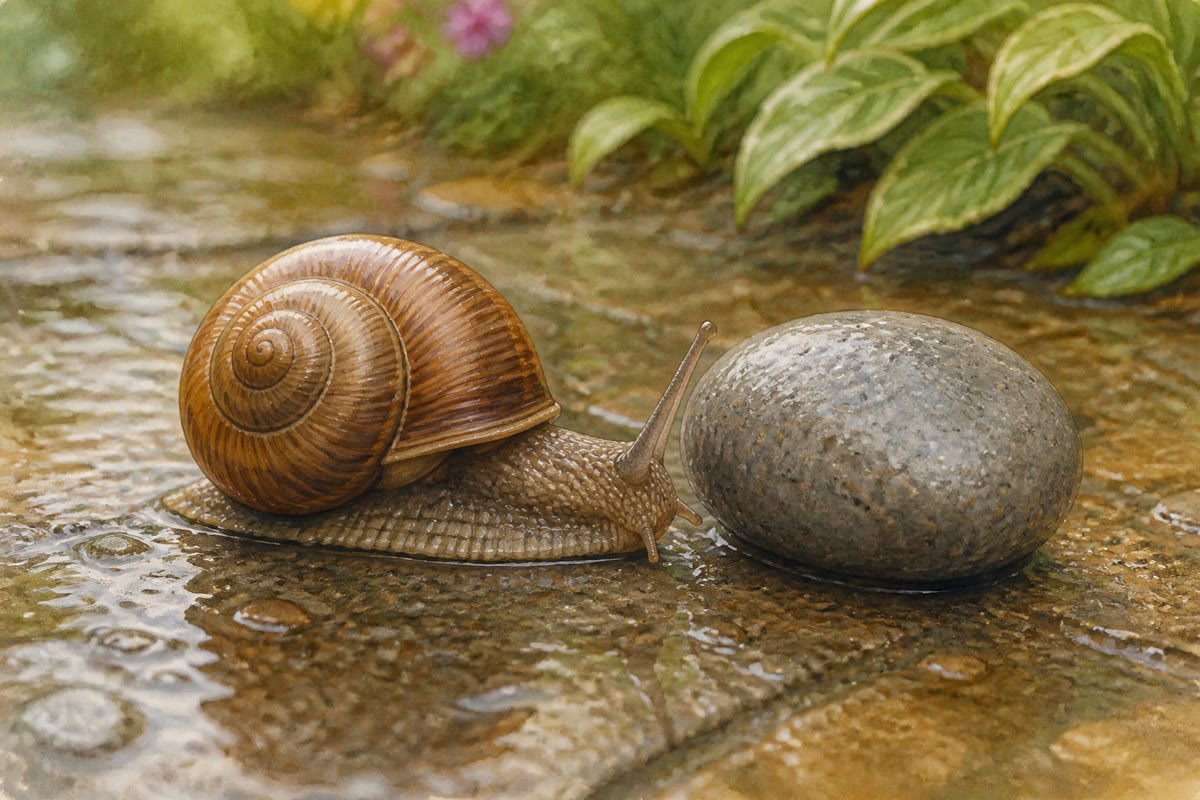
A snail slides slowly across the wet path. Next to it lies a gray pebble, just as small, just as round. The snail and the pebble sit in the same rain — yet one of them is alive and the other is not. How do we know? That is the very first question of biology, the science of living things.
1.1 What living things do
Definition 1.1 (Living thing)
A living thing is something that is alive: it is born, it feeds, it grows, it can have babies, and one day it dies. Animals and plants are living things. Biology is the science that studies them.
Example 1.2 (The snail and the pebble)
The snail was born from a tiny egg. It eats salad leaves. It grows — its shell grows with it. There can be baby snails. So the snail is a living thing. The pebble eats nothing, grows not at all, and never has baby pebbles: the pebble is not living.
Proposition 1.3 (The signs of life)
A living thing shows these signs:
- it is born;
- it feeds — it takes in food or makes its own, like plants do with light;
- it grows;
- it can have babies — new living things like itself;
- it dies one day.
Something that shows none of these signs is not living.
Proof. Admitted at this level. ∎
Remark 1.4 (Every sign counts)
One sign alone is not enough. A car “drinks” fuel, and an icicle grows longer in the cold — but the car was built, not born, and the icicle has no baby icicles. To be alive, a thing must show the signs of life together: born, feeding, growing, making new living things, dying.
1.2 Living, not living, never living
Definition 1.5 (Non-living thing)
A non-living thing is something that is not alive. There are two kinds:
- things that were never alive: a pebble, water, the wind, a bicycle;
- things that are no longer alive or that come from living things: a dead leaf on the ground, a wooden table, a woolly pullover.
Example 1.6 (The wooden table)
A wooden table does not feed and does not grow: it is not living. But its wood once was: it comes from a tree that was born from a seed, grew for many years, and was cut down. The table is non-living — and it comes from a living thing.
Example 1.7 (What about a robot?)
A toy robot moves, makes sounds, and its light blinks like a little eye. Is it alive? Check the signs: it was built in a factory, not born; its battery is not food that makes it grow; it will never have baby robots. The robot moves, but it is not living.
Method 1.8 (How to decide: living or not?)
Ask the questions of life, one by one:
- Was it born? Does it feed? Does it grow?
- Can there be babies of it? Will it die one day?
- If the answers are yes: it is living.
- If the answers are no, ask one more question: does it come from something living, like wood from a tree?
Remark 1.9 (Seeds look asleep)
A dry bean seed in a packet seems as still as a pebble. But put it on wet cotton, and in a few days a little root appears: the seed was alive all along, waiting. Slow, quiet living things are easy to mistake for non-living ones — the questions of life help us look closer.
1.3 Exercises
Exercise 1.1 ★
Say the five signs of life. Which of them can you see a kitten doing today?
Solution
Solution of Exercise 1.1.
Born, feeds, grows, can have babies, dies. Today a kitten can be seen feeding (drinking milk, eating) and growing — it gets bigger week after week.
Exercise 1.2 ★
Living or not living? (a) a butterfly; (b) a bicycle; (c) a daisy; (d) a cloud.
Solution
Solution of Exercise 1.2.
(a) Living — it hatched, feeds on nectar, and there can be baby caterpillars. (b) Not living — built in a factory, never feeds or grows. (c) Living — it grew from a seed. (d) Not living — a cloud grows and shrinks, but it was never born, does not feed and has no babies.
Exercise 1.3 ★
A dead leaf lies on the path. Is it living now? Was it ever living? Where did it come from?
Solution
Solution of Exercise 1.3.
It is not living now. It was living: it grew on the tree, fed by the tree. It comes from a living thing — the tree.
Exercise 1.4 ★
Tom says: “The river is alive — look, it moves and it makes noise!” Use the questions of Method 1.8 to answer him kindly.
Solution
Solution of Exercise 1.4.
Ask the questions of life together: was the river born? Does it feed? Does it grow? Can it have baby rivers? No — moving and making noise are not signs of life on their own. The river is not living, even though many living things live in it.
Exercise 1.5 ★
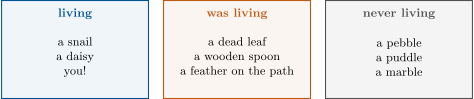
Sort into the three boxes of the figure — living, was living, never living: a spider, a woolly sock, a raindrop, an apple on the tree, a fallen pine cone.
Solution
Solution of Exercise 1.5.
Living: the spider, the apple on the tree. Was living (or comes from a living thing): the woolly sock (wool from a sheep), the fallen pine cone (it grew on a pine). Never living: the raindrop.
Exercise 1.6 ★
A candle flame “eats” the wax, grows taller, and dies when you blow it out. Is the flame a living thing? Which question of life says no?
Solution
Solution of Exercise 1.6.
No. The flame fails the questions of life: it was lit, not born, and above all there are no baby flames that grow up — a flame can be copied to another candle, but it does not have young like a snail or a daisy. (It is a fair question: the flame does trick two of the signs!)
Exercise 1.7 ★
Name two things in your bedroom that come from living things, like the wooden table of Example 1.6. Say which living thing each one comes from.
Solution
Solution of Exercise 1.7.
For example: a wooden chair (from a tree), a cotton T-shirt (from a cotton plant), a woolly blanket (from a sheep), a leather shoe (from a cow), honey on the shelf (from bees).
Exercise 1.8 ★
Try it: put a dry bean on wet cotton near a window, and a pebble on another piece of wet cotton next to it. Look every day for a week. Which one changes? What does that show?
Solution
Solution of Exercise 1.8.
The bean changes: it swells, then a little white root comes out, then a green shoot. The pebble stays exactly the same. This shows the bean was alive — a quiet, waiting living thing — and the pebble is not.
Exercise 1.9 ★★
A toy robot and a snail both move across the floor. Give two questions of life where their answers are different.
Solution
Solution of Exercise 1.9.
Was it born? The snail hatched from an egg; the robot was built. Can it have babies? There can be baby snails; there are no baby robots. (Feeding works too: salad makes the snail grow, the battery does not make the robot grow.)
Exercise 1.10 ★★
Mushrooms do not run like animals and are not green like most plants. With the signs of Proposition 1.3, explain why a mushroom is still a living thing.
Solution
Solution of Exercise 1.10.
A mushroom is born (it appears from tiny beginnings in the soil), it feeds (it takes its food from the soil and from dead leaves), it grows — sometimes in a single night — it makes new mushrooms, and it dies. All the signs of life are there: it is a living thing, even without legs and without green leaves.