Primary & Middle School Biology · Grades 1–9
67Evidence of Evolution
Twice this book has stopped at the edge of a great claim: the kinship tree’s branches all meet (Remark 44.8), and every living thing reads one code (Remark 65.7). The claim they point to has a name — evolution: species change across generations, and all descend from common ancestors. Before the next chapter asks how, this one does what Exercise 44.12 demanded: it lays out the evidence.
67.1 The witness of the rocks
Definition 67.1 (Fossils)
A fossil is a preserved trace of past life — shell, bone, leaf-print, footprint — sealed in sedimentary rock. Rock layers stack in time order, oldest lowest; reading upward reads history. Fossils are the remains half of Definition 37.1’s inventory, kept for millions of years.
Proposition 67.2 (What the layered record shows)
Read in order, the record testifies three times:
- faunas change: each layer-age holds its own cast — no rabbits among the trilobites, no trilobites in the rabbit layers; most species of every deep layer are extinct (Proposition 30.8’s word, with deep time behind it);
- order is nested like the tree: fish appear in deep layers, four-limbed amphibian-kin above them, reptile-kin above those, mammals and birds higher still — the classification’s boxes (Problem 44.1) stack in time exactly as kinship predicts;
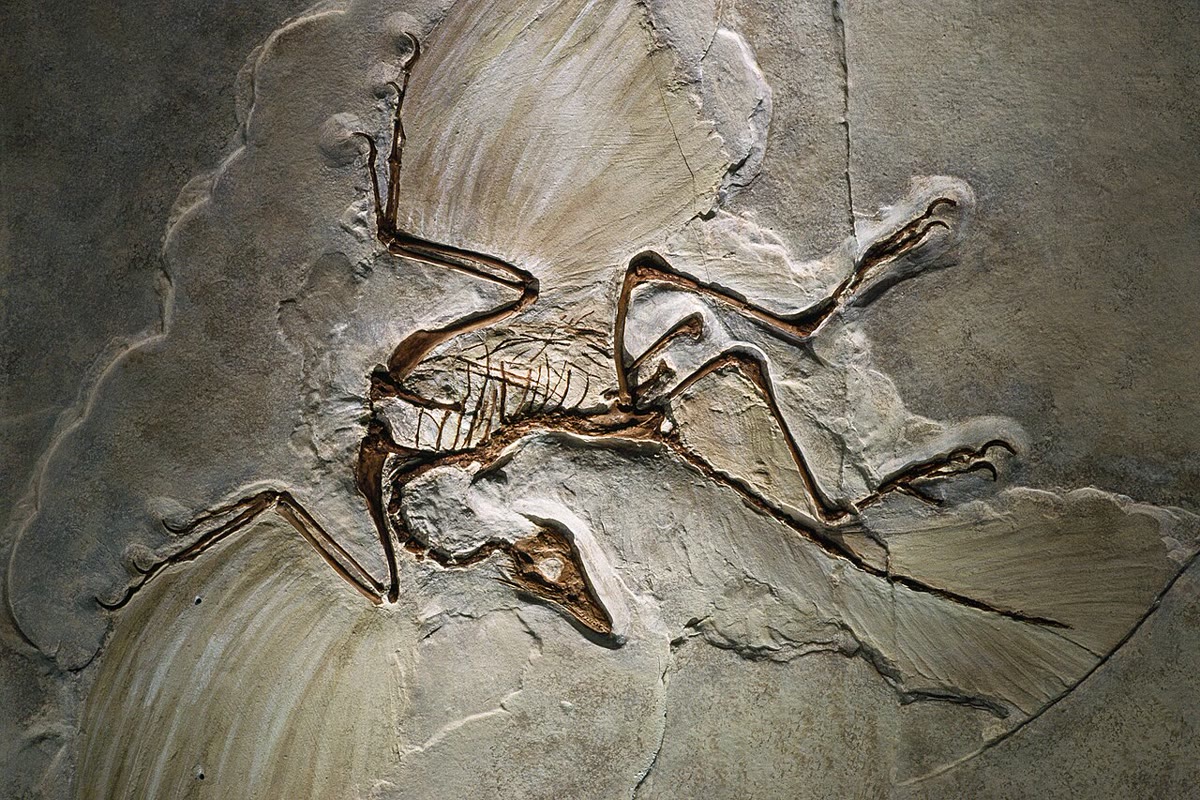
- intermediates exist: the famous slab of Archaeopteryx — feathers and wings on a toothed, long-boned-tailed reptile frame — stands where bird and reptile branches part; fossil whales with working hind legs stand where Example 44.5’s land-mammal ancestry demanded them.
Proof. Admitted at this level. ∎
Example 67.3 (The whale series)
The whale’s dossier, filled by rocks: successive fossils, in time order, run from a wolf-sized fourlegged shore mammal, through forms with shrinking legs and strengthening tails, to legless full swimmers — while today’s whale still builds tiny hidden hip-and-leg bones (Example 44.3 noted the vestiges) and still nurses, breathes air and grows fetal hair. Prediction, fossils, vestiges: three keys, one lock.
67.2 The witness of living bodies
Proposition 67.4 (Anatomy remembers)
Living bodies carry their history:
- the shared plan: bat wing, whale flipper, horse leg and your arm are one bone arrangement (Problem 44.1’s four-limb fork) stretched, shortened and re-jobbed — inheritance explains what fresh engineering would never repeat;
- vestiges: the whale’s hips, the flightless beetle’s sealed wings, your own tailbone and the appendix’s shrunken state — parts kept because ancestry builds on, not from scratch;
- embryos agree: vertebrate embryos of fish, chick and human run strikingly alike through their early weeks (Proposition 58.4’s plan-laying) — shared build instructions, diverging late.
Proof. Admitted at this level. ∎
Proposition 67.5 (The molecules vote)
The newest witness is Remark 65.7’s code. Compare one well-kept gene’s spelling across species: human and chimp differ in few letters, human and mouse in more, human and fish in more still, human and yeast most — and the distances, tallied gene after gene, redraw the same tree the anatomists drew from bones and the paleontologists from layers. Three independent witnesses, one family tree: that agreement is why biologists stopped arguing about whether and turned to how.
Proof. Admitted at this level. ∎
Example 67.6 (Watching it move)
Change is even watchable where generations turn fast. The peppered moth’s dark form spread through soot-stained industrial woods and receded when the air cleared; insecticide-proof insects and antibiotic-defying microbes (Chapter 69 will meet the medical case) arise within years; island finches’ beak-size distributions shift with drought and plenty, measured live by ring-and-caliper studies. Small moves, short times — the mechanism caught running, whatever its long-run reach.
Method 67.7 (Weighing historical evidence)
Evolution is history, and historical claims are tested like the cold case of Problem 66.1 — by convergence of independent witnesses:
- ask what the claim predicts: which intermediates, which vestiges, which molecular distances;
- check each witness separately: rocks, bodies, molecules, live watches;
- weigh their independence: witnesses that could not have colluded, agreeing, multiply credibility;
- hold the verdict open to the next find — and note when finds keep landing where the claim said to dig (the whale legs were sought, and found).
67.3 Exercises
Exercise 67.1 ★
What is a fossil, and why do rock layers read as a timeline?
Solution
Solution of Exercise 67.1.
A preserved trace of past life sealed in sedimentary rock. Layers stack in deposition order, oldest lowest — so upward through the stack is forward through time.
Exercise 67.2 ★
State the layered record’s three testimonies.
Exercise 67.3 ★
What mix of features makes Archaeopteryx an intermediate?
Exercise 67.4 ★
Give three vestiges and what each testifies.
Solution
Solution of Exercise 67.4.
The whale’s hidden hip-and-leg bones: a walking ancestry. The flightless beetle’s sealed wings: flying ancestors. The human tailbone (or shrunken appendix): a tailed, differently-fed line. Each is a kept part testifying to a former build.
Exercise 67.5 ★
How do molecular comparisons redraw the tree?
Exercise 67.6 ★
Name two live watches of change from Example 67.6.
Solution
Solution of Exercise 67.6.
The peppered moth’s dark form tracking soot and clean air; insecticide- and antibiotic-proof pests arising in years; the finches’ beak measurements shifting with drought and plenty.
Exercise 67.7 ★★
Why does the shared limb plan argue inheritance rather than good design reused? (What would fresh engineering be free to do?)
Solution
Solution of Exercise 67.7.
Fresh engineering could give each limb its best mechanism — struts for wings, hydrofoils for flippers — and would repeat no arbitrary bone count. The one arrangement, awkwardly stretched to every trade, is what building-on- inheritance produces and free design would not.
Exercise 67.8 ★★
Assemble the whale’s full dossier: class features, vestiges, fossil series, molecular kin — one line each.
Solution
Solution of Exercise 67.8.
Class: milk, air-breathing, fetal hair — mammal heirlooms (Example 44.5). Vestiges: hidden hips and leg bones. Fossils: the time-ordered series from four-legged shore mammal to legless swimmer. Molecules: its gene-distances place it among the mammals, hoofed kin nearest. Four witnesses, one dossier.
Exercise 67.9 ★★
Why does the agreement of rocks, bodies and molecules count for more than any one witness? Use Method 67.7’s independence step.
Solution
Solution of Exercise 67.9.
Because the witnesses could not collude: rocks were laid, bodies built and molecules spelled by processes with no access to each other’s testimony. Independent witnesses agreeing multiply credibility — one tree from three sources is the convergence the method prizes.
Exercise 67.10 ★★
“No rabbits among the trilobites.” Why is that absence — sustained across every dig ever made — itself strong evidence?
Solution
Solution of Exercise 67.10.
Because the claim forbids it: mammals must not appear below the layers of their ancestors. Every dig is a fresh chance to falsify — and the absence, sustained across every excavation ever made, is the claim passing its test daily.
Exercise 67.11 ★★
The embryo witness: what agrees, when does it diverge, and which chapter’s machinery says why shared early instructions matter most?
Solution
Solution of Exercise 67.11.
Vertebrate embryos agree strikingly through the early plan-laying weeks and diverge late. The development chapter’s machinery says why: early instructions lay the shared body plan — the deepest, oldest chapters of the text — while later reading writes the species’ particulars. Shared early text, shared deep ancestry.
Exercise 67.12 ★★★
Write the chapter’s argument as Method 67.7 applied in full: claim, predictions, four witnesses, verdict — and the question the verdict hands to Chapter 68.
Solution
Solution of Exercise 67.12.
Claim: species change and share descent. Predictions: time-ordered faunas in the tree’s nesting; intermediates at forks; vestiges of former builds; molecular distances grading with kinship. Witnesses: the rocks deliver the order and the intermediates; bodies deliver plan and vestiges; molecules deliver the matching tree; live watches deliver change in motion. Verdict: descent with change stands on convergent independent testimony — and hands the next chapter its question: what drives the change?
67.4 Problem: The Museum’s New Wing
Problem 67.1
Weekend problem — curating the evidence hall
The natural history museum builds an evolution wing, and the class curates four rooms: Rocks, Bodies, Molecules, Live Watches.
Part I — Room by room.
- Rocks: order the wall — trilobite slab, first fish, amphibian-kin tracks, reptile skeletons, Archaeopteryx cast, early mammal jaw — and write the room’s one-sentence caption from Proposition 67.2.
- Bodies: the centerpiece spreads bat wing, whale flipper, horse leg and human arm from one skeleton stand. Caption the shared plan — and add the vestige cabinet’s three exhibits.
- Molecules: the wall chart tallies one gene’s letter-differences: chimp 1, mouse 8, fish 24, yeast 41 (illustrative counts). What must the chart’s tree match, for the room to work?
- Live Watches: choose two exhibits from Example 67.6 and say what each shows moving.
Part II — The visitors’ questions.
- “Why are there still monkeys, if we descend from ancestors shared with them?” Answer with the tree’s branching — cousins, not ladders (Definition 44.6).
- “Where are the missing links?” Point to the found ones — two from this chapter — and state what each stood between.
- “Is evolution not just a theory?” Answer with the historical-evidence method: what “theory” means here, and what the four rooms’ agreement establishes.
- “Could tomorrow’s dig overturn it?” State what kind of find would — rabbits among trilobites — and what its absence, dig after dig, has meant.
Part III — The wing’s closing panel.
- Draft the panel linking the wing to the classification hall next door: why the old nested boxes were the tree all along.
- Add the molecule paragraph: what the shared code says about the trunk.
- Add the honest paragraph: what the wing shows (change, kinship, intermediates) and what it does not yet explain — naming the mechanism question the next hall will take up.
- Close with one sentence a twelve-year-old will remember, containing family and time.
Solution
Solution of Problem 67.1.
1. Order: trilobites lowest, then first fish, amphibian-kin tracks, reptiles, Archaeopteryx, early mammal jaw. Caption: “Read upward, the rocks change cast in exactly the order the family tree predicts — with the in-betweens standing at the branchings.”
2. Caption: “One bone plan — stretched to fly, paddle, gallop and write: inheritance re-jobbed, never redesigned.” Cabinet: the whale’s hips, the sealed beetle wings, the human tailbone.
3. The tree implied by the letter-counts — chimp nearest, yeast farthest — must match the anatomists’ and paleontologists’ tree next door: same branching, independently derived.
4. The moths: a population’s colors tracking its environment within decades. The finches: beak distributions moving with the seed supply, caliper-measured — inheritance-fed change, watched live.
5. Because descent branches: we and today’s monkeys are cousins on separate branches of a shared fork — no one alive is anyone’s ancestor, and a cousin’s existence no more denies kinship than your cousins deny yours.
6. Archaeopteryx, standing between reptile frame and bird kit; the legged fossil whales, standing between shore mammal and swimmer. Both were predictions before they were finds.
7. In science “theory” names an explanation tested until it organizes a field — not a guess. What the rooms establish is the historical fact of change and descent, by convergent independent witnesses; the theory proper is the mechanism the next hall explains.
8. A true anachronism — mammal bones below trilobite layers, verified — would break the order the claim demands. That no dig in two centuries has produced one is the claim surviving its hardest test, every day, everywhere digging continues.
9. “The boxes-in-boxes you met next door were never filing convenience: attributes nest because descent branches — the classification was the family tree, drawn before anyone knew what it drew.”
10. “Every exhibit in this wing, and every visitor before it, writes its build in the same four letters read by the same code: the branches differ, the trunk’s language never has.”
11. “This wing shows that species change, that they share descent, and that the record keeps the in-betweens. What it has not yet said is what drives the change — the mechanism hall is next, and its answer runs on variety, inheritance and the environment’s checks.”
12. “All life is one family album, and the rocks kept the early pages — given time, cousins grow as different as whales and bats, and stay family.”