Primary & Middle School Biology · Grades 1–9
17Bones and Muscles
Jump, and land: something inside you just worked like a perfect machine. Rigid rods held your shape, hinges let your legs fold and spring, and hundreds of little motors pulled exactly when needed. The rods are your bones, the hinges your joints, the motors your muscles — the body’s equipment for every movement it will ever make.
17.1 The skeleton
Definition 17.1 (Skeleton and bones)
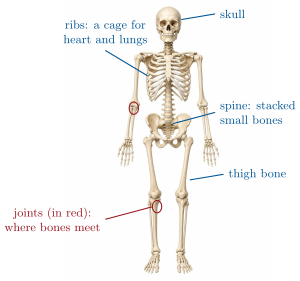
The skeleton is the frame of about bones inside the body. Its main regions:
- the skull, a solid helmet of bone around the brain;
- the spine (backbone), a bendable column of small bones stacked from neck to hips, holding the trunk upright;
- the ribs, curved bones forming a cage around heart and lungs;
- the limb bones: long bones in arms and legs — the thigh bone is the longest of the body.
Example 17.2 (Feel your frame)
No X-ray needed: press gently and the skeleton reports. Knuckles; the ridge of the shin; the chain of small bumps down the middle of your back — the spine, one small bone after another; the ribs you can count under your fingers. The frame is right under the skin.
Remark 17.3 (Hard outside, alive inside)
A bone is not dead material like a chalk stick: it is living, fed by blood, growing while you grow — and able to repair itself. A broken arm in a cast mends because the bone itself slowly rebuilds the break. Chalk sticks never do that.

17.2 Joints, where the frame bends
Proposition 17.4 (Rigid rods, bending places)
Bones themselves never bend — a bent bone is a broken bone. All the body’s bending happens at the joints, where two bones meet: shoulder, elbow, wrist, hip, knee, ankle, and the many small joints of the spine, whose little bends add up to a supple back.
Proof. Admitted at this level. ∎
Example 17.5 (The spine’s trick)
No single bone in your back can curl — yet you can roll forward almost into a ball. The spine is a column of more than small bones, each turning a few degrees on its neighbors: many small bends making one big one. That is also why you should bend knees, not back, to lift something heavy — knees are built for big folds, the spine for gentle ones.
17.3 Muscles, the movers
Definition 17.6 (Muscle)
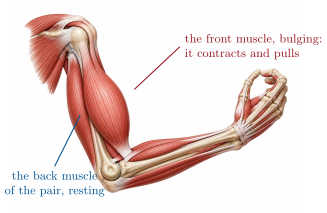
A muscle is a fleshy motor attached to the bones. A muscle can contract — shorten and thicken — and in contracting it pulls the bone it is attached to. Muscles only pull; no muscle can push.
Proposition 17.7 (Working in pairs)
Since muscles only pull, moving a joint both ways takes a pair: one muscle in front of the arm bends the elbow, its partner behind straightens it; each relaxes while the other pulls. Nearly every joint of the body is moved by such pairs.
Proof. Admitted at this level. ∎
Example 17.8 (Feel the pair at work)
Grip your upper arm with the other hand and slowly bend the elbow: the muscle in front swells and hardens — it is contracting. Now straighten the arm: the front softens, and behind the arm its partner tightens instead. You have just felt Proposition 17.7 happen.
Method 17.9 (Looking after bones and muscles)
- Move every day — bones grow stronger, muscles too, with use;
- eat the builders’ foods: dairy for bones, and varied meals (Chapter 12);
- warm up before hard exercise, so muscles stretch instead of tearing;
- lift heavy things with bent knees and a straight back;
- helmets and pads where falls are likely: bones repair, but slowly.
17.4 Exercises
Exercise 17.1 ★
Name the four regions of the skeleton in Definition 17.1, and what each protects or holds up.
Exercise 17.2 ★
About how many bones has the skeleton? Which is the longest?
Exercise 17.3 ★
Can a bone bend? Where does all the body’s bending happen?
Exercise 17.4 ★
The spine can curl although none of its bones can. Explain its trick.
Solution
Solution of Exercise 17.4.
It is a column of more than small bones, each able to turn a few degrees on its neighbors; the many small bends add up to one big supple curl.
Exercise 17.5 ★
What does a muscle do when it contracts? What can no muscle ever do?
Exercise 17.6 ★
Why does bending and straightening the elbow need two muscles? Tell what each does at each moment.
Exercise 17.7 ★
How does a broken arm in a cast mend? What does this show about bone, by Remark 17.3?
Exercise 17.8 ★
Try it: do the grip test of Example 17.8 on your own arm. Describe what the front of the arm does when you bend, and when you straighten.
Exercise 17.9 ★★
Why do grown-ups say “lift with your knees, not with your back”? Answer with Example 17.5.
Exercise 17.10 ★★
A puppet on strings can be made to wave: each string can only pull its arm one way. How is this exactly the muscles’ situation, and what is the puppet-maker’s answer to it? Compare with Proposition 17.7.