Primary & Middle School Biology · Grades 1–9
38Life Through the Seasons
Photograph the same chestnut tree on the first of every month and pin the twelve pictures in a row: bare branches, buds, leaves, candles of flowers, conkers, gold, bare branches again. Nothing moved — the tree stood still all year — and yet everything changed. Chapter 20 followed the animals through the year; now, with a surveyor’s eyes, we follow the whole environment, plants first.
38.1 The environment changes with the seasons
Proposition 38.1 (Seasonal change of conditions)
Through the year, an environment’s conditions (Definition 37.4) swing widely: days shorten and lengthen, temperatures fall and rise, soil dampness follows rain and drought. A site surveyed in January and in June gives two different rows in the table — so, by Proposition 37.6, expect two different casts of inhabitants.
Proof. Admitted at this level. ∎
Example 38.2 (One hedge, two surveys)
The lane’s hedge, surveyed twice. June: leaves dense, ten plant species flowering at its foot, bees loud, blackbirds nesting, snails after rain. January: bare twigs, green reduced to ivy and moss, no insect flying, blackbirds foraging in the leaf litter, snails sealed in their shells deep in the bank. Same place, same components list — living, mineral, traces — but the living column has transformed.
38.2 How plants pass the bad season
Definition 38.3 (Deciduous and evergreen)
Trees divide by their winter answer:
- deciduous trees — oak, chestnut, beech — drop all their leaves in autumn and stand bare;
- evergreen trees — pine, holly, ivy on the wall — keep working leaves all winter, usually tough, waxy or needle-shaped ones (Proposition 14.7 met the needles already).
Definition 38.4 (Buds)
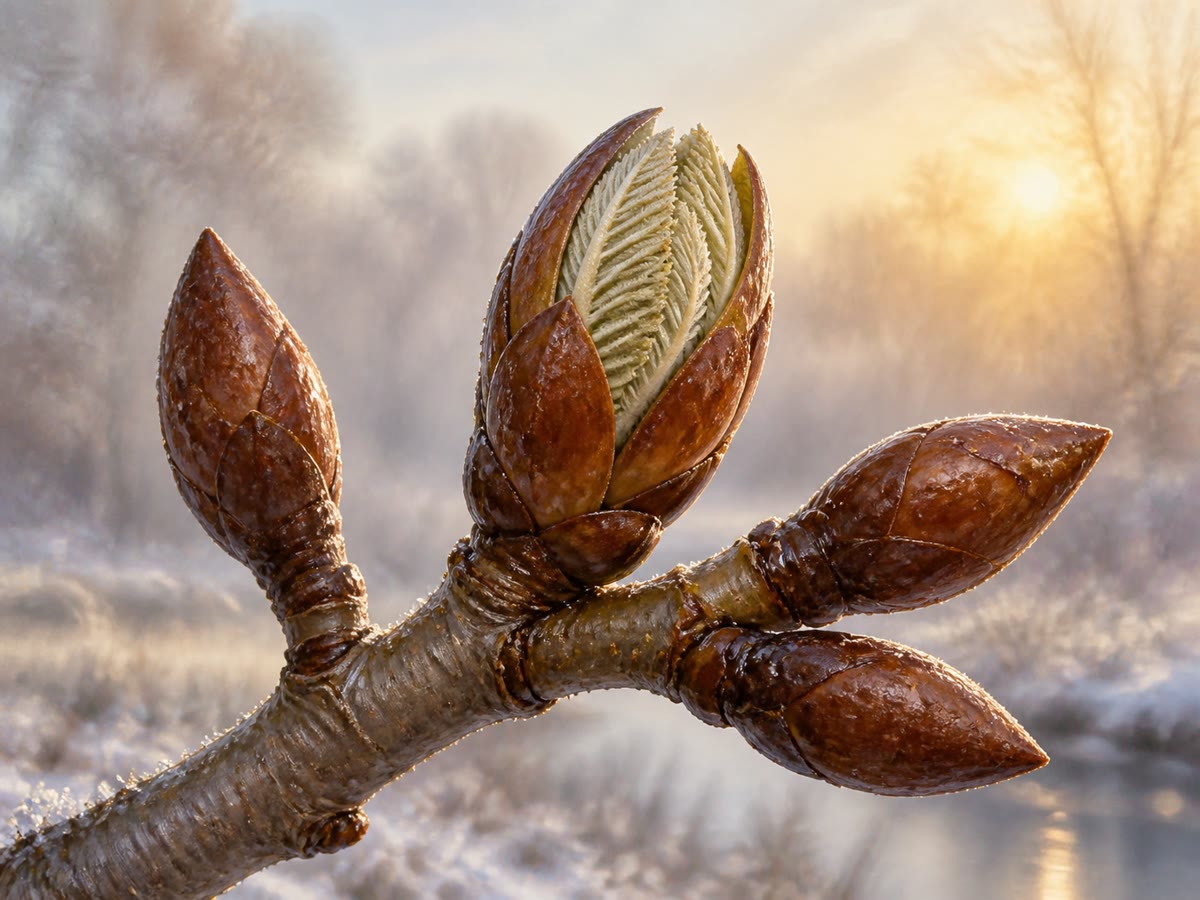
A deciduous tree in winter is not dead: next spring is already packed on its twigs as buds — tiny complete shoots, leaves folded small, wrapped in weatherproof scales. Spring’s “new” leaves were built the summer before; the bud is winter storage for them.
Example 38.5 (Opening a horse-chestnut bud)
The horse chestnut’s big sticky buds open well under a blade (a grown-up’s work): under the varnished scales, packed in cottony down, lie miniature folded leaves — perfect, pale, waiting. A twig cut in February and stood in water indoors “leafs out” weeks early: the shoots were finished; only warmth was missing.
Proposition 38.6 (The herb layer’s winter answers)
Smaller plants have their own strategies:
- annuals — the poppy, the bean — die entirely in autumn and pass winter as seeds (Proposition 9.5: a seed waits out cold safely);
- perennials — the daffodil, the dandelion — let their tops die back and wait underground as bulbs, tubers or tough rootstocks (Example 24.7’s storerooms, doing winter duty);
- evergreens of the ground — moss, ivy — simply endure.
Proof. Admitted at this level. ∎
Example 38.7 (Where did the daffodils go?)
The daffodil patch flowers in March, yellows in May, and by July has vanished without trace — yet next March it returns, denser. All summer, autumn and winter it existed as bulbs below the lawn: the plant never left; it withdrew to storage.
38.3 The animals’ calendar, revisited
Proposition 38.8 (Animal answers, in survey terms)
Chapter 20’s three strategies — migrate, hibernate, stay active — now read as answers to the surveyed changes: each species tracks its own needed conditions and food.
- the swallow follows its food supply to where conditions keep insects flying;
- the hedgehog and the sealed snail wait out the months their bodies cannot work through;
- insects add a fourth answer: most pass winter as eggs, larvae or chrysalises (Example 8.8) tucked in soil, bark or leaf litter — the adult dies, the species winters as its young stages.
Proof. Admitted at this level. ∎
Example 38.9 (Where the June insects are in January)
January’s hedge shows no insect — yet June’s are all present: the butterflies as chrysalises under the coping stones, the grasshoppers as eggs in the soil, the ladybugs as huddled sleeping adults deep in the leaf litter, the bees as a tight warm cluster in the hive. The June survey walks about; the January survey must dig, lift and peer — the inhabitants have changed form, not address.
Method 38.10 (Surveying through the year)
To study a site’s seasonal life:
- survey the same marked site (Method 37.8) once each season — same square, same instruments, same search time;
- record conditions and inhabitants each time; photograph the site from the same spot;
- search winter’s hidden forms deliberately: buds, bulbs, eggs, chrysalises, sealed snails — and put every cover back;
- lay the four surveys side by side: pair each change of inhabitants with a change of conditions, and name each absentee’s winter form or destination.
Remark 38.11 (Nothing simply vanishes)
The year-round table teaches one deep rule: no species of the June survey has simply ceased. Each one is elsewhere (migrated), asleep (hibernating), in storage (bulb, seed), or in another life stage (egg, chrysalis). “Gone” is never a full answer in biology — the follow-up question is always gone where, as what?
38.4 Exercises
Exercise 38.1 ★
Which conditions of a site swing with the seasons? Name three.
Solution
Solution of Exercise 38.1.
Day length (light), temperature, and soil or air dampness following rain and drought.
Exercise 38.2 ★
Deciduous or evergreen: oak, pine, beech, holly, horse chestnut? What does each word mean?
Exercise 38.3 ★
What is inside a winter bud, and when was it built?
Solution
Solution of Exercise 38.3.
A tiny complete shoot — miniature folded leaves wrapped in weatherproof scales. It was built the summer before.
Exercise 38.4 ★
How does an annual plant pass the winter? And a perennial like the daffodil?
Exercise 38.5 ★
Explain Example 38.5’s February twig: why can it leaf out weeks early indoors?
Solution
Solution of Exercise 38.5.
Because the shoots inside its buds were already finished last summer; the twig lacked only warmth, which the indoor water supplies weeks before the garden does.
Exercise 38.6 ★
Give the four winter answers of animals, each with one species.
Exercise 38.7 ★★
For each June hedge inhabitant, name its January form and address: butterfly, grasshopper, ladybug, snail, swallow.
Exercise 38.8 ★★
Why must the four seasonal surveys use the same site, instruments and search time? Which rule of Chapter 37 is at work?
Solution
Solution of Exercise 38.8.
So that any difference between the four tables comes from the seasons and not from the surveying — the fair-test rule of Method 37.8, applied across time instead of across sites.
Exercise 38.9 ★★
The January hedge survey lists far fewer living things than June’s. Give two reasons the difference overstates the true loss, using Example 38.9.
Solution
Solution of Exercise 38.9.
First, many “absentees” are present in hidden forms — eggs, chrysalises, sleeping adults, bulbs — that a walking-about survey misses without digging and lifting. Second, some are not lost but elsewhere: the migrators will return. The January list understates residents and counts travelers as vanished.
Exercise 38.10 ★★
A gardener digs up “dead” daffodil ground in August and finds firm bulbs. Translate the find with Proposition 38.6: what state is the plant in, and what will the bulbs do in March?
Exercise 38.11 ★★
Apply Remark 38.11: a pond’s frogs are nowhere to be found in January. Give the two questions to ask, and the toad-and-frog answer to them.
Solution
Solution of Exercise 38.11.
Gone where, as what? Frogs winter dormant — buried in the pond’s mud bottom or in damp shelters on land — passing the cold months torpid until spring calls them back to the water to breed.
Exercise 38.12 ★★★
Evergreen leaves are tough, waxy or needle-shaped; deciduous leaves are broad and thin. Propose what problem of winter the evergreen leaf’s build answers (think of the woodlouse’s water troubles in reverse), and why the deciduous tree prefers to drop its thin leaves instead.
Solution
Solution of Exercise 38.12.
Winter’s problem for a working leaf is holding water: frozen ground gives roots almost none, while wind and sun keep drawing it out — the woodlouse’s drying problem, all winter long. The evergreen leaf’s wax and needle build cuts those losses to what the tree can afford. A broad thin leaf cannot be sealed so well; the deciduous tree’s cheaper answer is to write its thin leaves off each autumn and store spring in buds instead.
38.5 Problem: The Twelve Photographs
Problem 38.1
Weekend problem — a year of the chestnut tree, read frame by frame
Lena photographs the chestnut tree by the gate on the first of every month for a year, and pins the twelve prints in a row. Under each print she notes day length and the morning’s temperature.
Part I — Reading the row.
- January and December show bare branches. What, on the twigs, proves the tree is alive and spring-ready in both frames?
- Between which two frames do the buds burst open? Lena’s notes there read: days – hours, mornings –. Which changing conditions is the tree answering?
- The May frame shows upright “candles” of white flowers. Using Chapter 16 (or Chapter 31), what must visit between the May and September frames for October’s conkers to exist — and what is a conker, exactly?
- The October frame shows gold leaves; November’s, bare branches and a brown carpet below. Name the tree’s type from Definition 38.3, and where its next spring is stored through the frames that follow.
Part II — The tree’s neighbors.
- Under the tree, the March frame catches a patch of daffodils absent from the July frame. Where is the patch in July, and in what form?
- Poppies edge the path in June; in the January frame their spot is bare earth. In what form is the poppy present in January, and by which strategy of Proposition 38.6?
- The June frame catches a swallow above the tree and bees on the flowers below; neither appears from November to February. For each, say where it is then, and as what.
- A magpie appears in every single frame. Which animal strategy is that, and what must the magpie manage all winter that the swallow escapes by leaving?
Part III — The rule of the row.
- Lena summarizes: “the tree’s year follows the conditions’ year.” Support her with two pairings of a frame-to-frame change in the tree against a change in her day-length and temperature notes.
- Her little brother says the July daffodil patch “died”. Correct him with Remark 38.11 — and state the follow-up question his word “gone” always deserves.
- Predict frame 13 — next January’s photograph — in detail: branches, twigs, ground below. Which parts of your prediction are certain enough to bet on, and why?
- A chestnut twig, cut in February and stood in warm water indoors, leafs out in three weeks. What does this show about which condition the buds were waiting for — and design the twin-twig fair test (Method 22.1) that would nail it down.
Solution
Solution of Problem 38.1.
1. The buds on every twig — winter storage holding next spring’s shoots, built the previous summer.
2. Between the March and April frames (with the notes’ lengthening days and milder mornings). The tree answers the rising temperature and lengthening light.
3. Pollinating insects — bees above all — must visit the flowers, so that pollen reaches pistils and fertilization follows. A conker is the seed formed from a fertilized ovule, in its spiky fruit case.
4. Deciduous. Its next spring rides the winter frames as buds on the bare twigs.
5. Below the lawn, as bulbs — the perennial’s underground storage.
6. As seeds in the soil: the annual’s strategy — the plants themselves died in autumn.
7. The swallow: in Africa, as its migrated self, following flying insects. The bees: in the hive, as the winter cluster, warm around their queen.
8. Staying active. The magpie must find food through the leanest months — the very problem the swallow escapes by leaving.
9. For example: buds burst (March–April) as days pass – hours and mornings warm past ; leaves gild and drop (October–November) as days shorten and mornings chill. Tree events pair with condition changes frame after frame.
10. The patch did not die: it withdrew to storage — alive as bulbs below the same spot. “Gone” always deserves: gone where, as what?
11. Bare branches carrying buds; a magpie likely somewhere; below, leaf litter and bare daffodil ground hiding bulbs; poppy seeds in the path’s earth. The certain bets are the buds and the bareness — they follow from the tree’s deciduous machinery and one year’s proof; the magpie is probable, not promised.
12. It shows warmth was the missing condition — light indoors in February is no longer than outdoors, but the water and room are warm, and that sufficed. Fair test: two twigs from the same tree, both in water at the same window, one in a warm room, one in a cold porch — one difference, warmth; if only the warm twig leafs out, the verdict is nailed.