Primary & Middle School Biology · Grades 1–9
49Organs at Work
Sprint up three flights of stairs and take stock: legs burning, heart hammering, breath racing — and, oddly, skin flushing and warm. Nobody ordered these changes; they ordered themselves, and in perfect proportion. This chapter measures what a working organ actually consumes, and how the body reorganizes its deliveries the moment work begins.
49.1 What a working muscle consumes
Proposition 49.1 (The muscle’s bill)
A working muscle spends, and its spending can be measured. Compared with the same muscle at rest, a hard-working muscle:
- takes far more oxygen from the blood crossing it — several times its resting draw;
- takes far more glucose — the blood’s ready sugar-nutrient, its everyday fuel;
- releases correspondingly more carbon dioxide — and heat.
This is Proposition 46.5’s cellular burning, read from an organ’s meters: fuel and oxygen in, work, waste gas and warmth out.
Proof. Admitted at this level. ∎
Example 49.2 (Measuring across a muscle)
Physiologists compare blood entering a muscle with blood leaving it. At rest, the leaving blood has given up a modest share of its oxygen and glucose. In hard work the same comparison shows the leaving blood stripped — most of its deliverable oxygen taken — while carbon dioxide has jumped. Same organ, same meters: only the work changed, and the bill followed it.
Remark 49.3 (The warmth is the receipt)
The working body’s heat is not an accident: burning fuel always yields warmth, and muscle is the body’s furnace room. Shivering is the trick run deliberately — muscles set to work at nothing but warmth (Example 18.2’s standing charge, briefly doubled). The sprint’s flushed skin is the cooling system carrying furnace heat away — next section’s business.
49.2 Deliveries on demand
Proposition 49.4 (The body reorganizes its supply)
The moment work begins, the supply lines reorganize to pay the bill (Example 27.7 announced it; here is the full dispatch):
- breathing deepens and quickens — reloading the blood faster at the lungs (Example 26.6);
- the heart beats faster and harder — more rounds per minute (Proposition 27.6);
- the blood is redirected: the vessels serving the working muscles (and the cooling skin) widen, while those of the resting digestive tract narrow — the same blood, rerouted to the floor that is spending.
All three follow the work automatically, steered by the brain’s unasked services (Remark 33.4).
Proof. Admitted at this level. ∎
Example 49.5 (The dispatch, felt from inside)
The stair sprint’s stock-taking, explained line by line: racing breath — reloading; hammering heart — faster rounds; burning legs — the muscles’ bill being paid at the limit; flushed warm skin — furnace heat carried out to the cooling surface. Even the classic stitch and the sluggishness after a big meal fit: digestion and sprint compete for the rerouted blood, which is why Method 25.7 advised against racing on a full stomach.
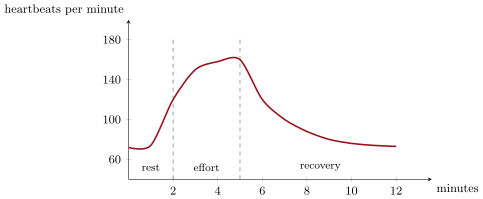
Definition 49.6 (Recovery)
When the effort stops, pulse and breathing do not: they fall back only gradually — the recovery phase. The body is settling debts: reloading its oxygen stores, clearing the effort’s wastes, shedding the accumulated heat. The fitter the body, the faster its recovery — which is why recovery time is itself a fitness measurement.
49.3 Training, and the limits of the machine
Proposition 49.7 (Training raises the ceiling)
Exercised regularly, the whole supply chain strengthens (Remark 27.9, Method 26.8): the heart moves more blood per beat, the breathing muscles deepen, the muscles themselves grow and store more fuel, and their fine vessels multiply. Result: the same effort costs a trained body a lower pulse, and its ceiling — the hardest effort it can pay for — rises. The machine is rebuilt by its own use.
Proof. Admitted at this level. ∎
Example 49.8 (Two runners, one hill)
Untrained and trained run the same hill. Untrained: pulse at halfway, gasping, forced to walk — the supply lines cannot pay the bill, and the debt calls a halt. Trained: pulse at the top, speech possible, recovery in three minutes. Same hill, same bill — different ceilings, built by months of exactly such hills taken gently.
Method 49.9 (Reading your own machine)
A self-experiment with a watch (Method 27.8 supplies the pulse technique):
- record the resting pulse, seated and calm;
- do three minutes of steady effort — step-ups, skipping;
- record the pulse at once, then each minute until it returns to rest: the recovery time;
- repeat weekly through a term of regular exercise: watch resting pulse, effort pulse and recovery time all drift down — the rebuild of Proposition 49.7, in your own data.
49.4 Exercises
Exercise 49.1 ★
List what a working muscle takes more of, and what it releases more of.
Solution
Solution of Exercise 49.1.
More oxygen and more glucose taken from the blood; more carbon dioxide and more heat released.
Exercise 49.2 ★
Exercise 49.3 ★
Describe the entering-versus-leaving blood comparison, and what it shows in rest against effort.
Solution
Solution of Exercise 49.3.
Blood entering the muscle is compared with blood leaving it. At rest the leaving blood has given up only a modest share of oxygen and glucose; in hard work it leaves stripped of most deliverable oxygen, and much richer in carbon dioxide. The difference is the muscle’s bill.
Exercise 49.4 ★
Name the three supply reorganizations of Proposition 49.4.
Exercise 49.5 ★
Why does hard work warm you — and what is shivering, in this chapter’s terms?
Exercise 49.6 ★
What is recovery, and what debts is the body settling during it?
Exercise 49.7 ★★
Read the pulse graph: resting value, plateau value, and roughly how long recovery takes. What would training change in each?
Exercise 49.8 ★★
Explain the after-lunch sluggishness and the sprinter’s stitch with the rerouting rule.
Solution
Solution of Exercise 49.8.
Both are rerouting effects. After lunch the digestive tract holds a large share of the blood, so the rest of the body runs sluggish; sprinting then forces the two floors to compete for deliveries — the stitch and the old rule against racing on a full stomach.
Exercise 49.9 ★★
Why is the flushed skin of effort a delivery change, not a malfunction? Whose problem is it solving?
Exercise 49.10 ★★
List three rebuilds by which training raises the ceiling, and the everyday sign of each.
Solution
Solution of Exercise 49.10.
The heart moves more blood per beat — everyday sign, a lower resting pulse. The muscles grow and store more fuel — the same hill feels easier. The supply network’s fine vessels multiply and breathing deepens — speech stays possible during effort, and recovery shortens.
Exercise 49.11 ★★
Two students run Method 49.9: resting pulses and ; recoveries three and eight minutes. Which machine is the trained one, and what exactly do the two numbers each certify?
Solution
Solution of Exercise 49.11.
The -rest, three-minute machine is the trained one. The resting pulse certifies a heart that moves more per beat; the recovery time certifies supply lines that settle the effort’s debts fast. Together they are the two ends of Proposition 49.7’s rebuild.
Exercise 49.12 ★★★
Connect three chapters in one paragraph: the muscle’s bill (Proposition 49.1), respiration’s purpose (Proposition 46.5), and the blood’s delivery service (Proposition 27.1) — as one account of a single sprint.
Solution
Solution of Exercise 49.12.
In a sprint, the leg muscles’ cells burn glucose with oxygen to power contraction — respiration’s purpose — and their bill (more fuel, more oxygen in; more carbon dioxide, heat out) must be paid at once. The blood is the paying service: loaded at lungs and intestine, pumped faster by the racing heart, rerouted to the legs, it delivers the fuel and oxygen and carts off the carbon dioxide — one sprint, three chapters, a single account.
49.5 Problem: The School Fitness Study
Problem 49.1
Weekend problem — a term of pulse data, read like a physiologist
The class runs Method 49.9 every Monday for a term: resting pulse, pulse after three minutes of step-ups, and recovery time. Two anonymized records: student A — week 1: rest , effort , recovery minutes; week 12: rest , effort , recovery minutes. Student B — week 1: rest , effort , recovery minutes; week 12: rest , effort , recovery minutes.
Part I — Inside one session.
- During the step-ups, list what is happening to a thigh muscle’s oxygen and glucose draw, and to its carbon dioxide and heat output.
- Explain why breathing and pulse climb together during the minutes of effort.
- A student feels warm and flushed by minute three. Give the furnace-and-cooling account.
- Why does the pulse not drop to resting the moment the step-ups stop?
Part II — Reading the term.
- Describe A’s changes across the term, and name the rebuilds of Proposition 49.7 behind each number.
- B’s numbers barely moved. Give the two honest readings — and which extra fact about B’s life outside class would decide between them.
- Week 5, a student measures right after a hurried lunch and gets odd numbers. Which rule of Proposition 49.4 interfered, and what should the protocol say about measuring times?
- Why must each student always measure the same way — same effort, same timing? (An old friend among methods; name it.)
Part III — The physiologist’s letter.
- Write the two-sentence summary of A’s term for the class notice board, using ceiling and recovery.
- A parent asks whether a low resting pulse is worrying. Answer with Exercise 27.11’s cyclist.
- The class wants one number to track next term. Argue for recovery time over effort pulse, using Definition 49.6.
- Close with the study’s moral in one sentence: what rebuilt A’s machine?
Solution
Solution of Problem 49.1.
1. Its oxygen and glucose draw from the passing blood multiplies; its carbon dioxide output and heat output rise in step — the bill of hard work.
2. Because they are two stages of one supply line: breathing reloads the blood at the lungs, the heart moves the reloaded blood to the muscles. Demand raised at one end raises the pace of both.
3. Working muscles are furnaces; their heat must leave. The blood carries it to the skin, whose widened vessels flush and radiate — furnace inside, radiator at the surface.
4. Because debts remain: oxygen stores to reload, wastes to clear, heat to shed. The pulse falls only as the accounts settle — that falling is recovery.
5. Rest : a heart rebuilt to move more per beat. Effort : the same step-ups now cost less — stronger muscles, richer fine-vessel supply. Recovery minutes: the whole chain settles its debts faster. The term’s exercise did the rebuilding.
6. Either B began the term already trained — numbers near their trained floor move little — or B skipped the term’s exercise and merely kept a stable untrained machine. Deciding fact: B’s activity outside class (sport elsewhere would confirm the first reading; none, the second — and B’s good week-1 numbers lean that way already).
7. The rerouting rule: after a meal the digestive tract claims the blood, so resting pulse reads high and effort tolerance low. Protocol: measure before lunch, or a good two hours after — always the same slot.
8. The fair test: only measurements taken the same way can be compared, week against week and student against student.
9. “Twelve weeks raised A’s ceiling: the same effort now costs beats instead of , from a resting pulse eight beats lower. And A’s machine settles its debts in five minutes where September needed nine — recovery is the clearest gain of all.”
10. Usually the opposite of worrying: a trained heart moves more blood per beat and so idles low — the cyclist’s calm doing an untrained ’s work. (Any concern belongs to a doctor, but low-and-fit is the common story.)
11. Recovery time measures the whole chain — heart, lungs, vessels, muscles — settling real debts, and it improves steadily and visibly with training; effort pulse depends more on the day’s exact effort and mood. As a single tracked number, recovery is the honester summary.
12. Its own use: effort, repeated gently and regularly, is what rebuilt the machine that performs it.