Primary & Middle School Biology · Grades 1–9
46What Is Respiration?
Put a woodlouse in a closed jar and, hours later, the air in the jar has changed: some of its oxygen is gone, replaced by carbon dioxide. Repeat with a germinating seed, a mushroom, a goldfish, a spoonful of living soil — same result, every time. Proposition 26.5 showed the swap in your own chest; this year opens the idea to its full width: the swap is not a human habit but a property of life itself.
46.1 Respiration, defined and measured
Definition 46.1 (Respiration)
Respiration is the gas exchange by which a living thing takes oxygen from its surroundings and releases carbon dioxide. It must not be confused with breathing — the visible chest movements of Definition 26.1: breathing is one way of serving respiration; respiration itself is the gas swap, and it goes on in every living cell, movements or none.
Proposition 46.2 (How the swap is shown)
Two standard bench tests reveal respiration:
- an oxygen probe in a closed container shows the oxygen level falling while a living thing sits inside;
- limewater, a clear liquid that turns milky in carbon dioxide, clouds when the container’s air is passed through it.
Falling oxygen plus clouding limewater, with a lifeless control container staying unchanged (Method 22.1 — the fair test follows us everywhere): that is respiration, measured.
Proof. Admitted at this level. ∎
Example 46.3 (The gallery of respirers)
Run the two tests on a menagerie: a mouse — fast fall, quick clouding; a woodlouse — the same, smaller; a germinating pea — unmistakable (a jar of sprouting peas can exhaust its oxygen in a day); a mushroom — yes; pond snails — yes; a spoonful of living soil — yes, its billions of decomposers respiring together (Example 42.2). Only the control jar — pebbles, dry sand — changes nothing.
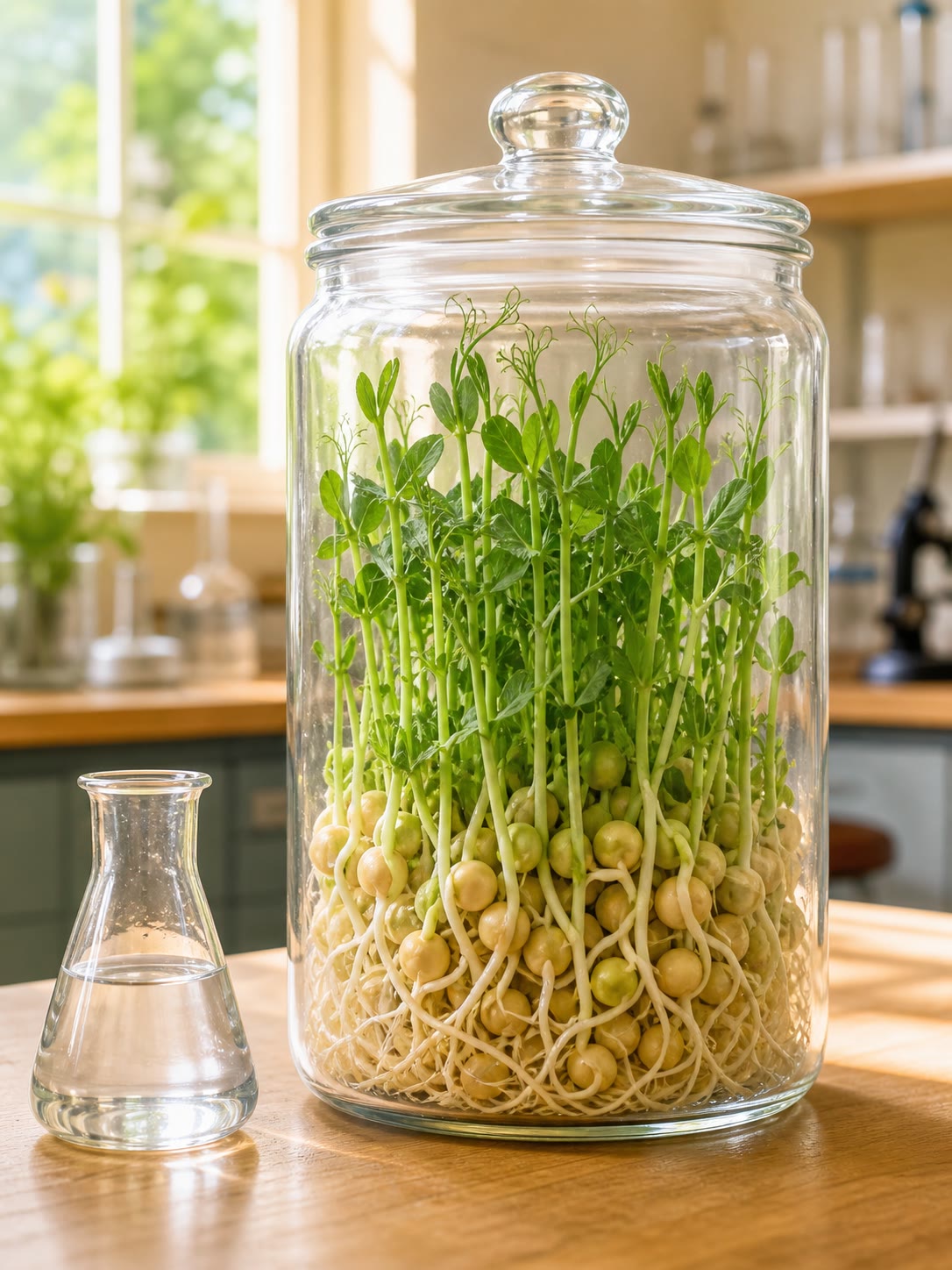
Remark 46.4 (Plants respire too)
Remark 40.5 said it in passing; the jar proves it: a potted plant in the dark lowers its jar’s oxygen and clouds limewater like any animal. In daylight the producers’ manufacture masks the effect — taking in far more carbon dioxide than respiration releases — but the respiration never stops. Green does not excuse a cell from breathing-in-the-wide-sense; nothing living is excused.
46.2 Why living things respire
Proposition 46.5 (Respiration powers the cells)
The point of the swap is energy. In every living cell, nutrients (Definition 25.3) are slowly burned with the oxygen respiration brings: their energy is released for the cell’s work — contraction, building, commanding — and carbon dioxide is the burnt-out remainder, carted away. Proposition 41.6’s “burned share” was exactly this, seen from the ledger; here it is seen from the cell.
Proof. Admitted at this level. ∎
Example 46.6 (The fire comparison, used honestly)
A candle flame also consumes oxygen and releases carbon dioxide — burning and respiration are genuinely the same kind of chemistry. The differences matter as much: the cell’s burning is slow, flameless, spread over thousands of tiny steps, and its energy is captured for work rather than lost as light and scorch. Respiration is combustion domesticated — fire on a leash, in every cell you own.
Example 46.7 (Reading demand)
Because the burning powers the work, demand tracks effort: the sprinting child of Example 26.6 respires far faster than the reader in the armchair; the germinating pea — building a plant at full speed (Definition 9.4) — respires far faster than the dry, waiting seed beside it, whose respiration idles near zero for years. Respiration is the engine note of life: loud in effort and growth, a whisper in dormancy, silent only in death.
46.3 Respiration in every habitat
Proposition 46.8 (One need, many surroundings)
Every living thing must get its oxygen from its surroundings — and surroundings differ. Air is oxygen-rich; water holds far less, dissolved (Exercise 26.11 met the consequence); soil and mud hold less still. Where and how a living thing lives is therefore shaped by how it solves its oxygen problem — the subject of the next two chapters, for animals’ equipment (Chapter 47) and for water’s economy (Chapter 48).
Proof. Admitted at this level. ∎
Method 46.9 (Testing a respiration question)
To test any claim about respiration (“seeds respire faster warm”, “the pond mud respires”):
- close the subject in a container, with an oxygen probe or a limewater trap;
- build the twin control — same container, subject absent or lifeless;
- vary one condition at a time, if the claim names one (warmth, dampness, dark);
- read the verdict in the difference: oxygen fallen, limewater clouded — against the control’s stillness.
Example 46.10 (The method on a cold seed)
Claim: germinating peas respire more slowly in the cold. Two jars of sprouting peas, one at room warmth, one in the fridge; limewater traps on both; a lifeless third as control. Next day: the warm jar’s limewater is milky, the cold jar’s barely misted, the control’s clear. Verdict: respiration runs with the peas’ working pace — Proposition 42.8’s conditions-rule, measured in gas.
46.4 Exercises
Exercise 46.1 ★
Define respiration, and distinguish it from breathing.
Solution
Solution of Exercise 46.1.
Respiration is the gas exchange by which a living thing takes oxygen from its surroundings and releases carbon dioxide. Breathing is only the chest’s visible pumping movements — one way of serving the exchange; the exchange itself runs in every living cell.
Exercise 46.2 ★
Name the two bench tests that reveal respiration, and what each shows.
Solution
Solution of Exercise 46.2.
An oxygen probe in a closed container — shows the oxygen level falling; and limewater — a clear liquid that turns milky when carbon dioxide passes through it.
Exercise 46.3 ★
Why does every respiration experiment need a lifeless control container?
Solution
Solution of Exercise 46.3.
To prove the change comes from the living subject and not from the container, the day’s warmth or the limewater itself: the fair test’s twin, with life the one difference.
Exercise 46.4 ★
What is the point of respiration, by Proposition 46.5? What is carbon dioxide, in that account?
Exercise 46.5 ★
List five very different living things shown respiring in Example 46.3.
Solution
Solution of Exercise 46.5.
A mouse, a woodlouse, germinating peas, a mushroom, pond snails — and a spoonful of living soil.
Exercise 46.6 ★
How can a plant be shown to respire, given that daylight masks the effect?
Solution
Solution of Exercise 46.6.
Test it in the dark: with the light-driven manufacture stopped, the jar’s oxygen falls and limewater clouds — respiration unmasked.
Exercise 46.7 ★★
Give two honest likenesses and two honest differences between a candle’s burning and a cell’s respiration.
Exercise 46.8 ★★
Rank by respiration rate, with reasons: a dry pea, a germinating pea, a sprinting child, a reading child.
Solution
Solution of Exercise 46.8.
Sprinting child (hard muscular work) reading child (the body’s quiet standing charge) germinating pea (building fast, but small) dry pea (dormant — respiration idling near zero). Rate follows work.
Exercise 46.9 ★★
A sealed jar of sprouting peas goes overnight; a candle lowered in next morning goes straight out. Explain with this chapter — and say what the limewater trap would have shown meanwhile.
Solution
Solution of Exercise 46.9.
All night the sprouting peas’ respiration consumed the jar’s oxygen and released carbon dioxide; by morning too little oxygen remains to keep a flame alight. The limewater would have clouded steadily through the night.
Exercise 46.10 ★★
Design, by Method 46.9, the experiment for: “living soil respires; baked lifeless soil does not.”
Exercise 46.11 ★★
Why does a grain store’s manager fear damp grain heaps warming by themselves? Connect Example 46.7 and the compost heap’s warmth (Example 42.7).
Solution
Solution of Exercise 46.11.
Damp grain wakes: germination begins, and respiration rises from a whisper toward the sprouting pea’s pace — billions of grains burning their stores at once, heating the heap like the compost’s working crews. Warmth speeds the work further: a damp heap can heat itself toward spoilage. Dry grain sleeps cold; damp grain is a slow furnace.
Exercise 46.12 ★★★
“Breathing is behavior; respiration is chemistry; the first serves the second.” Defend each clause with one observation from this chapter or Chapter 26.
Solution
Solution of Exercise 46.12.
Behavior: breathing can be watched — the chest’s movements, fifteen times a minute (Example 26.2). Chemistry: respiration runs in things with no chest at all — peas, mushrooms, soil — detected only by gas tests. Service: breathing exists to renew the lungs’ air so the gas swap can continue — racing exactly when the cells’ burning races (Example 26.6).
46.5 Problem: The Sealed Jars
Problem 46.1
Weekend problem — six jars, two mysteries, one gas swap
For the science fair, the class prepares six sealed jars, each with an oxygen probe and a limewater trap: A — pebbles; B — dry peas; C — germinating peas; D — a mouse (with food, water, and for a few hours only, under the teacher’s watch); E — a green plant in the light; F — the same kind of plant in a dark box.
Part I — Predictions.
- Predict A’s readings, and state A’s job in the experiment.
- Predict B and C, and explain the difference although both jars hold “the same” peas.
- Predict D, and say why the teacher limits the hours.
- E and F hold identical plants. Predict each jar’s oxygen trend, and reconcile the difference using Remark 46.4.
Part II — Results and readings.
- The morning’s data match the predictions — except a classmate is amazed that F’s plant “breathes like an animal”. Set out what F actually shows, and what E hides.
- C’s oxygen fell three times faster than B’s per gram of peas. Translate the factor of three into Example 46.7’s terms.
- D’s limewater clouded fastest of all. Give the chain — from the mouse’s warm, moving body to the milky liquid — in four steps.
- Name the single conclusion all of B, C, D and F support, in one sentence beginning “Every living thing…”.
Part III — Pressing further.
- A seventh jar is proposed: mushroom slices. Predict its readings, and say which kingdom-level point of Example 46.3 it would add.
- The fair’s visitors ask why jar C matters to farmers. Answer with the granary of Exercise 46.11.
- An eighth jar: pond water with its mud. The oxygen falls overnight. Who in the jar is respiring, and why does the finding matter for Chapter 48’s question?
- Close the fair’s poster with the chapter’s distinction: which jars showed breathing, and which showed respiration? (Careful — one word covers them all.)
Solution
Solution of Problem 46.1.
1. No change: oxygen steady, limewater clear. A is the lifeless control — the stillness every other jar is read against.
2. B: barely measurable change — dry peas are dormant, respiration idling. C: clear oxygen fall and clouding — germination is full-speed building, and the work is paid in respiration.
3. D: the fastest fall and clouding of all — a warm, moving mammal burns hard. The hours are limited because the mouse is consuming its jar’s oxygen; the experiment must end long before the air runs short.
4. E: oxygen steady or rising — the lit plant’s manufacture takes in carbon dioxide and releases more oxygen than its respiration uses. F: oxygen falling, limewater clouding — in the dark the manufacture stops and respiration, never stopped, shows plain.
5. F shows that the plant respires always — oxygen in, carbon dioxide out, like the mouse. E hides the same respiration under the bigger daytime trade: the manufacture’s intake and output swamp it. Together the twins separate the two exchanges.
6. The germinating pea is working three times as hard per gram — building roots and shoot at full pace — and respiration is the engine note of that work.
7. The mouse’s muscles and warm body burn nutrients with oxygen; the burning releases carbon dioxide into the jar’s air; the trapped air passes through the limewater; the carbon dioxide turns it milky.
8. “Every living thing respires — animal, plant, seed awake or barely asleep — taking oxygen and releasing carbon dioxide.”
9. Oxygen falling, limewater clouding — the mushroom respires. It adds that the rule covers fungi too: neither plant nor animal, and no exception.
10. Because a granary is jar C at warehouse scale: grain kept damp begins germinating and respiring hard, heating and spoiling the store — the manager’s dryness rules are respiration control.
11. Everything in it: the pond snails and small animals, the mud’s decomposers, the plants and green single cells in their dark hours. It matters because the pond’s inhabitants all draw on one small dissolved oxygen stock — the economy the next chapters open.
12. Only D — the mouse — showed breathing: visible chest movements serving its gas swap. Every jar with life in it showed respiration: B faintly, C, D, F plainly, E masked by daylight manufacture but respiring all the same.