Primary & Middle School Biology · Grades 1–9
21Classifying Animals
A natural history museum keeps millions of animals — drawers of beetles, halls of skeletons, jars of fish. Yet a curator can walk to any one of them in minutes. The secret is not memory but order: every animal has its place in a great system of groups within groups, built from the sorting rules of Chapter 14 — and this year we learn how the system works.
21.1 Groups inside groups
Definition 21.1 (Classification)
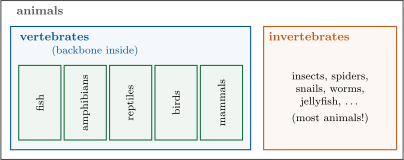
To classify living things is to sort them by shared body features into groups, and to sort those groups into bigger groups — groups nested inside groups, like boxes in boxes. The whole arrangement is a classification.
Example 21.2 (The cat’s addresses)
One cat, several nested addresses: the cat is a mammal (fur, milk for the young); every mammal is a vertebrate (a skeleton with a backbone inside); every vertebrate is an animal. Cat inside mammals, mammals inside vertebrates, vertebrates inside animals: each box sits inside a bigger one.
Definition 21.3 (Vertebrates and invertebrates)
A vertebrate is an animal with an inner skeleton built around a backbone — like the spine you felt in Example 17.2. An animal without a backbone is an invertebrate: insects, spiders, snails, worms, jellyfish — the vast majority of all animals.
21.2 The five classes of vertebrates
Proposition 21.4 (The five vertebrate classes)
Vertebrates are classified into five great groups, called classes:
- fish: scales, fins, breathe in water — trout, shark, sardine;
- amphibians: moist bare skin, eggs in water, tadpole childhood — frog, toad, newt;
- reptiles: dry scaly skin, most lay shelled eggs on land — lizard, snake, tortoise, crocodile;
- birds: feathers, beak, shelled eggs — blackbird, ostrich, penguin;
- mammals: fur or hair, young fed on milk — cat, whale, bat, human.
Proof. Admitted at this level. ∎
Example 21.5 (Sorting a zoo delivery)
Six crates arrive: a python (dry scaly skin, shelled eggs — reptile), a toad (moist bare skin — amphibian), a penguin (feathers — bird), a shark (fins and gills — fish), a dolphin (milk for its calf — mammal), and a crate of giant snails (no backbone at all — invertebrates, in no vertebrate class whatever).
Remark 21.6 (Reptile or amphibian?)
Lizards and newts look alike at a glance — four legs, long tail. The skin decides: the lizard’s is dry and scaly, the newt’s moist and bare; the lizard’s eggs have shells and are laid on land, the newt’s are laid bare in water. Same silhouette, different classes.
21.3 Using a classification
Method 21.7 (Placing a vertebrate in its class)
Ask the questions in order, stopping at the first yes:
- Feathers? — a bird.
- Fur or hair (or milk for the young)? — a mammal.
- Dry scaly skin? — a reptile.
- Moist bare skin and a tadpole childhood? — an amphibian.
- Fins and gills, life in water? — a fish.
No backbone at all? Then it was an invertebrate, and the questions do not apply.
Proposition 21.8 (What a class tells you for free)
Knowing an animal’s class is knowing a bundle of facts before looking: told only “it is a mammal”, you already expect fur, milk for the young, and — like nearly all mammals — young born alive. That saving is the whole point of classification: learn the group once, and every member arrives half-known.
Proof. Admitted at this level. ∎
Example 21.9 (A new species arrives)
Naturalists still discover animals never seen before. When a new bat-like animal is found with fur and milk, it goes straight into the mammals — and at once biologists expect a backbone, a four-chambered heart and warm blood, before any of it is checked. The classification pays out predictions.
Remark 21.10 (Toward the family tree)
Why do fur, milk and backbones travel together so faithfully? The full answer — that members of a group inherit their shared features from common ancestors — belongs to the story of kinship and evolution, taken up in later years. For now, the nested boxes simply work, and work marvellously.
21.4 Exercises
Exercise 21.1 ★
What is a vertebrate? What is an invertebrate? Give two examples of each.
Solution
Solution of Exercise 21.1.
A vertebrate has an inner skeleton built around a backbone (the trout, the cat); an invertebrate has no backbone (the snail, the bee, the earthworm, the jellyfish).
Exercise 21.2 ★
Name the five classes of vertebrates with their defining features.
Exercise 21.3 ★
Place each animal: the sardine, the crocodile, the newt, the ostrich, the whale, the earthworm.
Solution
Solution of Exercise 21.3.
Sardine: fish. Crocodile: reptile. Newt: amphibian. Ostrich: bird. Whale: mammal. Earthworm: invertebrate — no backbone, so no vertebrate class at all.
Exercise 21.4 ★
Write the cat’s nested addresses, smallest box to biggest, as in Example 21.2.
Solution
Solution of Exercise 21.4.
The cat, inside the mammals, inside the vertebrates, inside the animals.
Exercise 21.5 ★
A lizard and a newt look alike. Which two features separate their classes?
Exercise 21.6 ★
Which group holds the vast majority of all animals? Name four of its members.
Solution
Solution of Exercise 21.6.
The invertebrates. For example: insects, spiders, snails, worms (and jellyfish).
Exercise 21.7 ★
Run Method 21.7 aloud on the penguin and on the dolphin, question by question.
Exercise 21.8 ★
You are told only: “this animal is a bird.” List three things you now expect without looking, by Proposition 21.8.
Solution
Solution of Exercise 21.8.
For example: feathers, a beak, wings, shelled eggs — and a backbone, since birds are vertebrates.
Exercise 21.9 ★★
The whale has almost no hair and lives like a fish. Using Method 21.7 and Example 14.5, explain why it is nonetheless a mammal — and why “lives in the sea” never was a classification feature.
Solution
Solution of Exercise 21.9.
The questions stop at “milk for the young”: the whale nurses its calf, so it is a mammal, near-hairless or not. “Lives in the sea” is a habitat, not a body feature — and classification was built on what an animal has precisely because habits and homes can be shared by strangers: the shark and the dolphin share an address, not a class.
Exercise 21.10 ★★
The snake has no legs, and neither has the earthworm. Why is one a vertebrate reptile and the other an invertebrate? Which single feature outranks the missing legs?
Solution
Solution of Exercise 21.10.
The backbone. The snake has a spine of hundreds of small bones — a vertebrate, with the dry scaly skin of a reptile; the earthworm has no backbone at all — an invertebrate. Missing legs are just a missing feature; the backbone question is asked first.
Exercise 21.11 ★★★
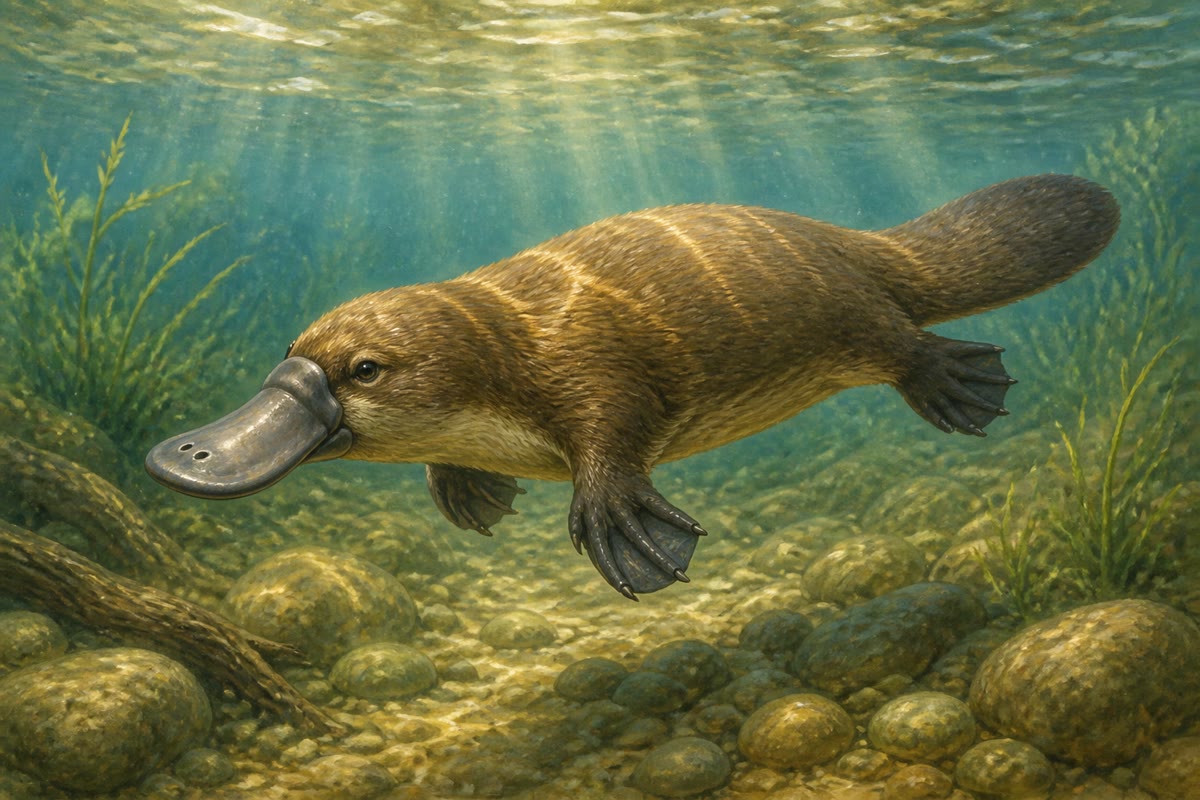
The platypus puzzled naturalists: fur and milk, yet it lays shelled eggs. Which class won, and why? What does the puzzle show about classifying by bundles of features rather than by a single one?
Solution
Solution of Exercise 21.11.
The mammals won: fur and milk for the young are the mammal bundle, and the platypus has both — the egg is one feature out of step. Classification weighs the whole bundle rather than letting a single feature decide; an animal odd in one respect still sits where most of its features point. (The platypus is odd enough that mammals with eggs form their own small sub-group.)