Primary & Middle School Biology · Grades 1–9
27The Heart and the Blood
Press two fingers — not the thumb — on the inside of your wrist, below the thumb’s base, and wait. There: a small, steady knock, again and again, about once a second. That knock is your heart at work, felt from a distance. It has been beating since before you were born, and it is the engine of the body’s delivery service.
27.1 The blood, the body’s delivery service
Proposition 27.1 (What the blood carries)
The blood is a liquid that reaches every corner of the body, and it is the body’s carrier:
- from the small intestine, it collects the nutrients (Proposition 25.5);
- from the lungs, it collects oxygen (Proposition 26.5);
- it delivers both to every part of the body — muscles, brain, bones, skin;
- on the way back it carries off the wastes, delivering the carbon dioxide to the lungs to be breathed out.
Proof. Admitted at this level. ∎
Example 27.2 (One delivery round)
Follow a drop of blood: through the lungs it turns bright red, loaded with oxygen; the heart sends it out; in a running leg muscle it hands over oxygen and nutrients, takes on carbon dioxide, and darkens; back at the heart, it is sent to the lungs to unload and reload — and out again. A full round takes well under a minute.
Definition 27.3 (Blood vessels)
Blood travels in tubes called blood vessels: wide ones leaving and entering the heart, branching finer and finer — down to hair-thin vessels that thread between the body’s parts, where the deliveries are handed over. Laid end to end, one body’s vessels would stretch for tens of thousands of kilometres.
Remark 27.4 (Seeing the vessels)
Look at the underside of your wrist: bluish lines under the skin — blood vessels on their way back to the heart. A scraped knee shows the other end of the network: even the thinnest cut finds blood, because the finest vessels are everywhere.
27.2 The heart, the pump
Definition 27.5 (The heart)
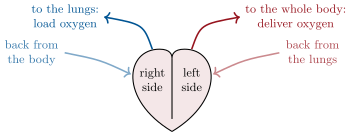
The heart is a hollow muscle, about the size of its owner’s fist, in the middle of the chest behind the rib cage. By squeezing — a beat — it drives the blood through the vessels. It has two sides: the right side pumps blood to the lungs to load oxygen; the left side pumps the oxygen-rich blood to the whole body.
Proposition 27.6 (The pulse)
Each beat drives a little wave of blood along the vessels; felt at the wrist or the neck, that wave is the pulse. Counting the pulse counts the heartbeats: about to a minute for a child at rest, to for an adult — and much more during effort.
Proof. Admitted at this level. ∎
Example 27.7 (The heart keeps up with the legs)
Running, your leg muscles burn nutrients and oxygen fast; the deliveries must speed up. So the heart beats faster and harder — a child’s pulse can pass in a sprint — while breathing quickens to reload the blood (Example 26.6). Heart and lungs are two halves of one supply chain.
Method 27.8 (Taking a pulse)
- Turn a hand palm up; place two fingers of the other hand on the wrist, just below the thumb’s base — never the thumb, which has a little pulse of its own;
- press gently until you feel the knocking;
- count the knocks for one minute (a clock with seconds helps);
- write the number down, with what the body was doing: resting, walking, after a sprint.

Remark 27.9 (A muscle that never rests — almost)
Between two beats the heart relaxes for a fraction of a second — that sliver is all the rest it ever takes. Day and night, about beats a day, for a whole life. Like every muscle (Method 17.9), it grows stronger with exercise: a trained heart moves more blood per beat, and so can beat more calmly.
27.3 Exercises
Exercise 27.1 ★
Name two things the blood delivers, and where it collects each.
Solution
Solution of Exercise 27.1.
Nutrients, collected at the small intestine; and oxygen, collected at the lungs.
Exercise 27.2 ★
What waste gas does the blood carry away, and where does it drop it off?
Solution
Solution of Exercise 27.2.
Carbon dioxide — dropped off at the lungs, where it is breathed out.
Exercise 27.3 ★
What is the heart made of, how big is it, and where does it sit?
Exercise 27.4 ★
What does each side of the heart do?
Exercise 27.5 ★
What is the pulse, and what does counting it tell you?
Solution
Solution of Exercise 27.5.
The little wave each heartbeat drives along the vessels, felt at wrist or neck. Counting it counts the heartbeats per minute.
Exercise 27.6 ★
Why must the pulse be taken with fingers and not the thumb?
Exercise 27.7 ★
Why does the pulse race during a sprint? Tell the story from the leg muscles’ point of view.
Exercise 27.8 ★
Try it: take your resting pulse with Method 27.8, do thirty seconds of star jumps, and take it again. Report both numbers.
Solution
Solution of Exercise 27.8.
Open answer. Typically about – resting, – after the star jumps — the supply chain at work.
Exercise 27.9 ★★
In Example 27.2, the drop of blood is bright red leaving the lungs and darker leaving the leg muscle. What changed in it, each time?
Exercise 27.10 ★★
The blood connects three organs of your grade: small intestine, lungs, heart. Draw or describe the network: what does each contribute to the delivery service?
Exercise 27.11 ★★★
A trained cyclist’s resting pulse can be ; an untrained adult’s, . Using Remark 27.9, explain how slower can mean stronger — what must each of the cyclist’s beats be doing?