Primary & Middle School Biology · Grades 1–9
57The Reproductive Systems
Chapter 54 needed gametes; Chapter 56 switched their factories on. This chapter maps the factories themselves: the male and female reproductive systems — the organs, the gametes each produces, and the female system’s remarkable monthly rhythm. Plain anatomy, plainly named: these are organs like heart and lungs, and this is their chapter.
57.1 The male system
Definition 57.1 (The male reproductive system)
The male system’s organs:
- the two testes, held outside the body’s warmth in the scrotum — the gamete factories: from puberty on they produce sperm cells continuously, by the hundreds of millions;
- ducts that store and carry the sperm, joined on the way by glands whose fluids feed and carry them — together making semen;
- the penis, through which semen leaves the body — the same organ, on its other duty, carrying urine (Definition 53.3); a valve arrangement keeps the two duties strictly apart.
Example 57.2 (The sperm cell, up close)
Under the microscope (Definition 29.4), a sperm cell is a cell stripped for travel: a head that is almost all nucleus — the father’s contribution, packed (Remark 29.6) — and a lashing tail. Smallest cell in the body, built to swim, provisioned for days. Production runs from puberty into old age: the male factory is continuous.
57.2 The female system
Definition 57.3 (The female reproductive system)
The female system’s organs, all within the lower belly:
- the two ovaries — the gamete stores and factories: unlike the testes, they hold their stock of future egg cells from birth, and from puberty release them one at a time;
- the two oviducts, fringed tubes that catch the released egg cell — the usual meeting place of Proposition 54.2’s step 2;
- the uterus (the womb of Proposition 32.1), whose thick muscular wall and renewable lining are the zygote’s lodging;
- the vagina, connecting the uterus to the outside — where semen is received, and the birth canal of Example 32.6.
Example 57.4 (The egg cell, up close)
The egg cell is the sperm’s opposite in everything but role: the body’s largest cell — a tenth of a millimetre, at the eye’s edge — round, unmoving, stocked with provisions for the journey’s first days (the yolk principle of Remark 8.3, at cell scale). One factory runs continuous millions; the other releases a single provisioned cell a month: Proposition 23.7’s numbers-against-care, written into the gametes themselves.
57.3 The cycle
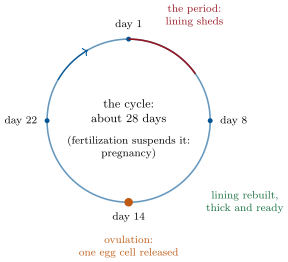
Proposition 57.5 (The menstrual cycle)
From puberty to about fifty, the female system runs a repeating program of roughly 28 days — the menstrual cycle, ordered by the hormone chain of Definition 56.4:
- the uterus lining rebuilds itself, thick and blood-rich — the lodging prepared;
- mid-cycle, around day 14, an ovary releases one egg cell — ovulation; the oviduct catches it, and for about a day it can be fertilized;
- no fertilization: the lining is not needed; it breaks down and leaves through the vagina over a few days — the menstrual period — and the program restarts;
- fertilization: the zygote settles into the prepared lining (Definition 32.3), the cycle suspends, and pregnancy begins.
Proof. Admitted at this level. ∎
Remark 57.6 (Living with the cycle)
Practicalities, said plainly: cycles are irregular for the first years — the machinery is tuning; length varies from person to person and month to month; periods can bring cramps (the uterus is a muscle, Definition 17.6, and it works during shedding) — warmth, movement and, when needed, the school nurse’s advice all help; and pads, tampons and cups are simply the period’s practical equipment, a normal aisle of every pharmacy. None of this is illness: the cycle is the system running exactly as built.
Method 57.7 (Reading the two systems side by side)
To keep the map straight, compare by function:
- gamete factory: testes — ovaries;
- gamete: continuous swimming millions — one provisioned egg cell a month;
- meeting place: the oviduct, reached by the sperm’s swim from the vagina through the uterus;
- lodging: none in the male map — the uterus, monthly prepared, in the female;
- timetable: continuous from puberty — cyclic, puberty to about fifty.
57.4 Exercises
Exercise 57.1 ★
Map the male system: name each organ and its function.
Exercise 57.2 ★
Map the female system likewise.
Exercise 57.3 ★
Contrast sperm cell and egg cell: size, build, numbers, provisioning.
Solution
Solution of Exercise 57.3.
Sperm cell: the body’s smallest — a nucleus-packed head and a swimming tail, provisioned lightly, made continuously by the hundreds of millions. Egg cell: the body’s largest, round and unmoving, richly provisioned, released one a month.
Exercise 57.4 ★
What happens at ovulation, on which rough day, and how long is the egg cell fertilizable?
Exercise 57.5 ★
What is the menstrual period, in the lining’s terms — and what does its arrival say about that cycle?
Solution
Solution of Exercise 57.5.
The breakdown and shedding of the uterus’s prepared lining, leaving over a few days. Its arrival says that cycle ended without fertilization.
Exercise 57.6 ★
Which event suspends the cycle, and what follows in the uterus?
Solution
Solution of Exercise 57.6.
Fertilization. The zygote settles into the prepared lining, the cycle suspends, and pregnancy begins.
Exercise 57.7 ★★
Where do Proposition 54.2’s three steps happen on this chapter’s map — organ by organ?
Exercise 57.8 ★★
Read the gametes as Proposition 23.7’s two strategies in miniature. Which side carries which logic?
Exercise 57.9 ★★
Why are the first years of cycles often irregular, and why is a varying length normal? (Two facts from Remark 57.6.)
Solution
Solution of Exercise 57.9.
The machinery is tuning in its first years — the hormone chain settling into rhythm — so irregularity is expected; and cycle length genuinely varies, person to person and month to month. Both are the system running normally.
Exercise 57.10 ★★
Explain period cramps with Definition 17.6 — and name two things that help.
Solution
Solution of Exercise 57.10.
The uterus is a muscle, and shedding is muscular work — its contractions are felt as cramps. Warmth and movement help (and the school nurse has advice when they are not enough).
Exercise 57.11 ★★
The two factories run opposite timetables — continuous against cyclic-with-stock-from-birth. Connect each to its gamete’s build and role.
Solution
Solution of Exercise 57.11.
The sperm’s job is the journey: cheap, swimming, and needed in millions because almost none arrive — so the factory runs continuously. The egg’s job is to become the zygote’s first provisions: costly, stocked from birth, and released with a month’s preparation behind it — so the factory is a treasury, spending one at a time.
Exercise 57.12 ★★★
“The cycle is the uterus asking, every month, the question only fertilization can answer.” Unfold the image into the four numbered events of Proposition 57.5.
Solution
Solution of Exercise 57.12.
Event 1 is the question being prepared: the lining rebuilt, the lodging readied. Event 2 poses it: one egg cell released — will fertilization come? Event 3 is the answer “no”: the unneeded lining sheds, and the wheel asks again next month. Event 4 is the answer “yes”: the zygote settles, the asking stops, and the lodging serves its purpose for nine months.
57.5 Problem: The Clinic’s Teaching Models
Problem 57.1
Weekend problem — explaining the systems with two models and a calendar
A health center’s open day uses three teaching props: a male-system model, a female-system model, and a large 28-day cycle calendar. You are the volunteer explainer.
Part I — The two models.
- A visitor traces the male model from testes to exit. Narrate the route, naming what is added on the way and the double-duty organ’s arrangement.
- On the female model, point out where the gamete stock waits, where fertilization usually happens, and where a pregnancy lodges.
- A visitor asks why the models’ gamete factories differ so sharply — millions daily against one a month. Answer with Example 57.4’s closing sentence.
- Another asks what the systems were doing before puberty. Answer with Chapter 56’s machinery in one line.
Part II — The calendar.
- Walk the calendar: place the period, the rebuild, ovulation and the fertile day, with their rough dates.
- A visitor assumes day 28 is the same for everyone. Correct the assumption with Remark 57.6 — two variabilities.
- Show on the calendar what changes if fertilization happens near day 14 — which events are cancelled, which begin (Definition 32.3 continues the story).
- A teenager asks, quietly, whether cramps mean something is wrong. Give the muscle answer and the two helps — and the address for anything beyond them.
Part III — The explainer’s craft.
- Visitors giggle at the models. Your opening sentence treats the systems as Chapter 57’s first paragraph does. Write it.
- Summarize the two systems in Method 57.7’s five-line comparison, from memory.
- A visitor asks where babies’ beginnings fit on the props. Chain the three props into Proposition 54.2’s three steps.
- Close the open day with one sentence on why health centers teach this anatomy at all — knowledge against legend, as Example 56.8 argued.
Solution
Solution of Problem 57.1.
1. From the testes — the factories, kept in the scrotum — sperm pass into the ducts for storage and transport, are joined by the glands’ fluids to make semen, and leave through the penis; the same organ carries urine at other times, a valve arrangement keeping the two duties strictly apart.
2. The stock waits in the ovaries, from birth; fertilization usually happens in the oviducts; a pregnancy lodges in the uterus’s prepared lining.
3. The gametes are built to opposite strategies: millions of cheap swimmers against one provisioned egg a month — numbers-against-care, written into the cells themselves.
4. Waiting for their orders: the systems stood built but idle until the brain-base control center’s hormones switched them on at puberty.
5. Days 1–5 or so: the period. Through mid-cycle: the lining rebuilds. Around day 14: ovulation, with the fertile day around it. Then the prepared wait — to day 28 and the wheel’s next turn.
6. Cycle length varies from person to person, and month to month in one person — and the first years run irregular while the machinery tunes. The calendar teaches the pattern, not anyone’s exact dates.
7. Cancelled: the lining’s breakdown and the next period — the wheel stops. Beginning: the zygote’s settling into the lining, and pregnancy’s nine months.
8. Cramps are the muscular uterus working as it sheds — normal, not damage; warmth and movement help, and anything stronger has its address at the nurse’s or doctor’s door.
9. For example: “These are organs like heart and lungs — everyone in this room owns one set or the other, and this is simply their chapter.”
10. Factories: testes — ovaries. Gametes: continuous swimming millions — one provisioned egg a month. Meeting: the oviduct. Lodging: none — the monthly-prepared uterus. Timetable: continuous from puberty — cyclic, puberty to about fifty.
11. Step 1 on the two models: the factories make the gametes. Step 2 on the female model: their joining in the oviduct. Step 3 across model and calendar: the zygote lodging in the calendar’s prepared lining, the wheel stopped, development begun.
12. “Because bodies run better on knowledge than on legend — and everything taught today has a trained, confidential address for its follow-up questions.”