Primary & Middle School Biology · Grades 1–9
13Caring for Nature
After the picnic, one family leaves the meadow exactly as it found it; another leaves bags, bottle caps and a trampled anthill. The meadow’s rabbits, ants and daisies cannot ask us to be careful — but they are living things sharing our places, and how we behave in nature matters to them. Caring for nature is something anyone can learn, at any age.
13.1 Nature is where living things live
Definition 13.1 (Nature and the environment)
Nature is the world of living things and their surroundings: meadows, forests, ponds, seas — and the air, water and soil they depend on. The surroundings a living thing depends on are called its environment.
Example 13.2 (Everything is somebody’s home)
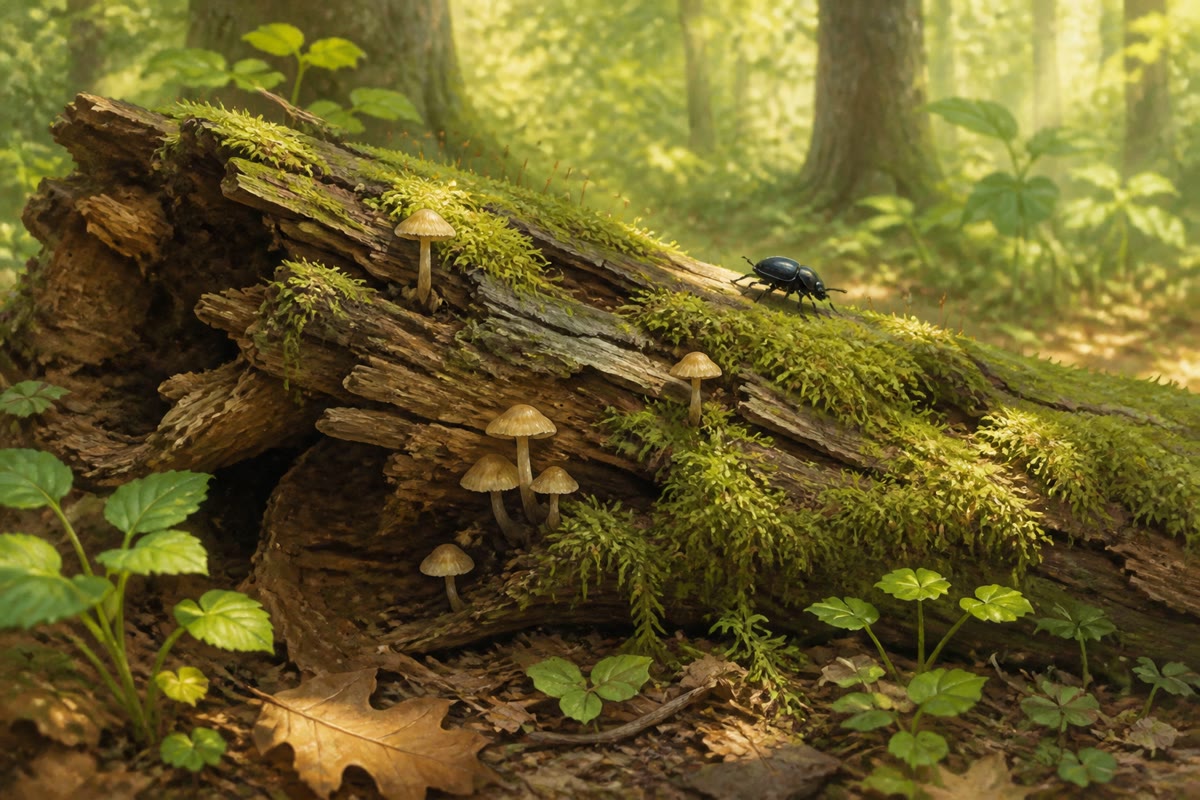
A rotting log in the forest looks like rubbish — it is a palace: beetles under the bark, woodlice beneath, moss on top, a hedgehog wintering in the hollow. Kick it apart for fun and four households lose their home. In nature, almost everything is somebody’s home, food, or shelter.
Remark 13.3 (We are part of it)
People are living things too: the air we breathe, the water we drink and the food we eat all come from nature. Caring for it is not only kindness to rabbits — it is looking after the world we ourselves live from, as Chapter 11 said of every habitat.
13.2 What harms, what helps
Proposition 13.4 (Small actions, real harm)
In nature, harm rarely comes from wanting to be bad — it comes from not thinking:
Proof. Admitted at this level. ∎
Example 13.5 (The bottle cap)
A dropped plastic cap is nothing to us and stays in the meadow for many, many years — long enough for grown-ups to have children who find the same cap. Nature has no dustbin lorry: whatever we leave, stays.
Method 13.6 (The visitor’s rules)
Out in nature:
- carry all your litter home — all of it;
- look at flowers, insects and nests instead of collecting them; pick at most a few common flowers, never all of a clump;
- put back every stone and log you turn over — someone lives under it;
- stay on paths near fragile spots like stream banks;
- watch animals from a distance, quietly, and leave their young alone.
Leave the place so that nobody can tell you were there.
Example 13.7 (Helping on purpose)
Caring can go beyond not harming. A saucer of water in a heat wave, a small wild corner of the garden left unmowed, seeds for the birds in the cold, a school pond like the one of Example 11.8: each one gives some living things food, water or a home they had lost.
13.3 Sorting and saving
Proposition 13.8 (Waste can be given back)
Much of what we throw away can be used again. Sorting waste — glass with glass, paper with paper, peelings to the compost — lets bottles become new bottles and peelings become soil, instead of everything piling up. And what is saved — water, paper, electricity — never becomes waste at all.
Proof. Admitted at this level. ∎
Example 13.9 (The compost bin)
Apple cores and carrot peelings, in a compost bin, turn slowly into dark crumbly soil — with the help of worms, woodlice and living things too small to see. Next spring, that soil feeds the tomatoes. Nothing was wasted; the peelings went back into the cycle of life.
Remark 13.10 (Small hands count)
Turning off the tap while brushing teeth, both sides of the paper, the compost bin, the litter carried home: each is small, and millions of people do them — or don’t. Nature is cared for, or harmed, mostly in small everyday choices like yours.
13.4 Exercises
Exercise 13.1 ★
What is a living thing’s environment? Name three things in yours that come from nature.
Solution
Solution of Exercise 13.1.
The surroundings a living thing depends on. For example: the air we breathe, the water we drink, the food we eat — all from nature.
Exercise 13.2 ★
Who can lose their home when a rotting log is kicked apart? Name three inhabitants from Example 13.2.
Solution
Solution of Exercise 13.2.
For example: the beetles under the bark, the woodlice beneath the log, the moss on top, the hedgehog wintering in the hollow.
Exercise 13.3 ★
Give four visitor’s rules of Method 13.6.
Solution
Solution of Exercise 13.3.
For example: carry all litter home; look instead of collecting, and never pick all of a clump; put back every turned stone or log; stay on paths near fragile spots; watch animals quietly from a distance and leave their young alone.
Exercise 13.4 ★
Why must litter go home with us? Answer with the bottle cap of Example 13.5.
Exercise 13.5 ★
Why should we not pick all the flowers of a clump? Give the two reasons of Proposition 13.4.
Exercise 13.6 ★
What happens to apple cores in a compost bin? Who does the work, and what do we get at the end?
Solution
Solution of Exercise 13.6.
They rot down slowly into dark, crumbly soil. Worms, woodlice and living things too small to see do the work; at the end we get compost — good soil that feeds next year’s plants.
Exercise 13.7 ★
Give two ways of helping nature on purpose, from Example 13.7.
Solution
Solution of Exercise 13.7.
For example: a saucer of water in a heat wave, a wild unmowed corner in the garden, seeds for birds in the cold, digging a small pond.
Exercise 13.8 ★
Try it: on your next walk, count the pieces of litter you see (without touching dangerous ones). Which kind is most common? Where should each kind have gone?
Solution
Solution of Exercise 13.8.
Open answer. Plastic wrappers and bottles usually win. Each kind should have gone home with its owner — and then into the right sorting bin.
Exercise 13.9 ★★
At the pond, Emma wants to take three tadpoles home in a jar “to help them grow safely”. Using this chapter and Exercise 11.10, what would you advise instead?
Solution
Solution of Exercise 13.9.
Leave the tadpoles in the pond: it holds everything they need — pond water, food, room to grow legs — and a jar does not. If Emma wants to help, she can watch them there through the spring, keep the bank untrampled, and perhaps help make a new pond habitat like the school one.
Exercise 13.10 ★★
“One bottle cap is nothing.” Use Remark 13.10 to answer: what happens when a million visitors each think the same sentence — in the bad direction, and in the good one?
Solution
Solution of Exercise 13.10.
A million “nothings” in the bad direction is a meadow buried in caps — small harms multiply. In the good direction, a million small cares — litter carried home, taps turned off, waste sorted — add up just as surely: nature is mostly cared for in choices exactly that small.