Primary & Middle School Biology · Grades 1–9
5The Five Senses
Close your eyes and the world does not disappear: you still hear the classroom, smell lunch cooking, feel the chair under you. The body has five doors to the world — the senses — and each door is an organ of the body, working for you all day long.
5.1 Five senses, five organs
Definition 5.1 (Sense and sense organ)
A sense is a way the body finds out about the world. Each sense works through a sense organ, a part of the body built for that job:
- sight — the eyes see light, colors and shapes;
- hearing — the ears hear sounds;
- smell — the nose smells odors;
- taste — the tongue tastes food;
- touch — the skin, all over the body, feels rough and smooth, warm and cold.
Example 5.2 (Breakfast, sense by sense)
One bowl of hot chocolate uses all five: the eyes see the steam, the nose smells the cocoa, the skin of the hands feels the warm bowl, the ears hear the spoon clink, and the tongue — the best part — tastes it.

Remark 5.3 (Touch is everywhere)
Four sense organs live on the head, but the organ of touch is the skin, and the skin covers you from head to toe. That is why you can feel a breeze on your neck, a pebble in your shoe and a ladybug landing on your arm — all without looking.
5.2 The senses report to the brain
Proposition 5.4 (Messages to the brain)
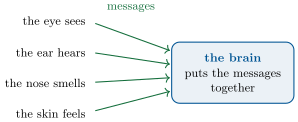
A sense organ does not understand what it senses — it sends a message. All the messages travel inside the body to the brain, in the head, which puts them together: “that is Grandma’s voice”, “that smell is toast”. Without the brain, the eyes and ears would report to no one.
Proof. Admitted at this level. ∎
Example 5.5 (Naming things in the dark)
A friend puts a familiar object in your hands while your eyes are closed: a key, a sponge, a spoon. You name it almost at once. The skin sent its message — cold, hard, jagged — and the brain answered: “a key”. Senses collect; the brain understands.
Remark 5.6 (Helping each other)
The senses work as a team. Food “tastes” dull when a cold blocks your nose, because smell was doing half the work of flavor. And when one sense cannot do its job at all, the others learn to do more: people who cannot see read with their fingertips, using touch, and cross the street with their ears.
5.3 Taking care of the sense organs
Proposition 5.7 (Fragile doors)
Sense organs are precious and easy to hurt. Too-loud sound hurts the ears; looking at the Sun hurts the eyes; a too-hot spoonful burns the tongue. A hurt sense organ may stay hurt — so we protect them.
Proof. Admitted at this level. ∎
Method 5.8 (Protecting my senses)
Example 5.9 (The concert next door)
After very loud music, ears sometimes whistle for a while. That whistling is the ear saying “too much!”. People who work with loud machines wear ear covers for exactly this reason — their ears must last them a lifetime.
5.4 Exercises
Exercise 5.1 ★
Name the five senses and, for each, its sense organ.
Exercise 5.2 ★
Which sense organ reports: (a) the color of a balloon? (b) the softness of a blanket? (c) the smell of rain? (d) the sound of a bell?
Exercise 5.3 ★
Which sense organ is not on the head? How far does it reach?
Solution
Solution of Exercise 5.3.
The skin, the organ of touch. It covers the whole body, from head to toe.
Exercise 5.4 ★
In Example 5.5, the eyes were closed. Which organ sent the message, and which part of the body understood it?
Solution
Solution of Exercise 5.4.
The skin of the hands sent the message (cold, hard, jagged); the brain understood it and named the object.
Exercise 5.5 ★
With a cold and a blocked nose, food seems to lose its flavor. Which two senses usually team up when you eat?
Solution
Solution of Exercise 5.5.
Taste and smell. The nose does half the work of flavor, which is why food seems dull when it is blocked.
Exercise 5.6 ★
Give three rules of Method 5.8, and say which sense organ each one protects.
Exercise 5.7 ★
Why do people who work with loud machines wear ear covers? Use Proposition 5.7.
Exercise 5.8 ★
Try it: with eyes closed, let a helper hold three foods under your nose — perhaps banana, cheese, orange. How many did your nose name correctly, without the eyes’ help?
Solution
Solution of Exercise 5.8.
Open answer — most people name two or three out of three. The nose recognizes familiar foods well, even with no help from the eyes.
Exercise 5.9 ★★
A friend claims: “The eye understands what it sees.” Correct the sentence using Proposition 5.4: what does the eye really do, and who does the understanding?
Solution
Solution of Exercise 5.9.
The eye only sees — it collects light and sends a message. The brain does the understanding: it receives the message and says “that is Grandma”, “that is my school”. Senses collect; the brain understands.
Exercise 5.10 ★★
How can a person who cannot see “read” a book, and cross a street safely? Say which senses take over which jobs.
Solution
Solution of Exercise 5.10.
Reading: with the fingertips — touch takes over from sight, feeling raised dots on the page. Crossing the street: with the ears — listening for cars coming and going — often with a cane whose tip lets touch check the ground ahead.