Primary & Middle School Biology · Grades 1–9
28Adapted to Their World
Put a polar bear in the Sahara and a camel on the pack ice, and neither would last a season. Yet each, at home, is a champion: the bear swims iced seas in comfort, the camel crosses deserts that would finish a horse in days. Living things fit their worlds with an exactness that repays close study — feature by feature.
28.1 What adaptation means
Definition 28.1 (Adaptation)
An adaptation is a feature of a living thing’s body or behavior that fits it to the conditions of its environment — to the cold or the drought, to its food, to its hunters. Proposition 11.4 showed animals fitting their habitats; adaptation is that fit, examined piece by piece.
Example 28.2 (The camel, piece by piece)
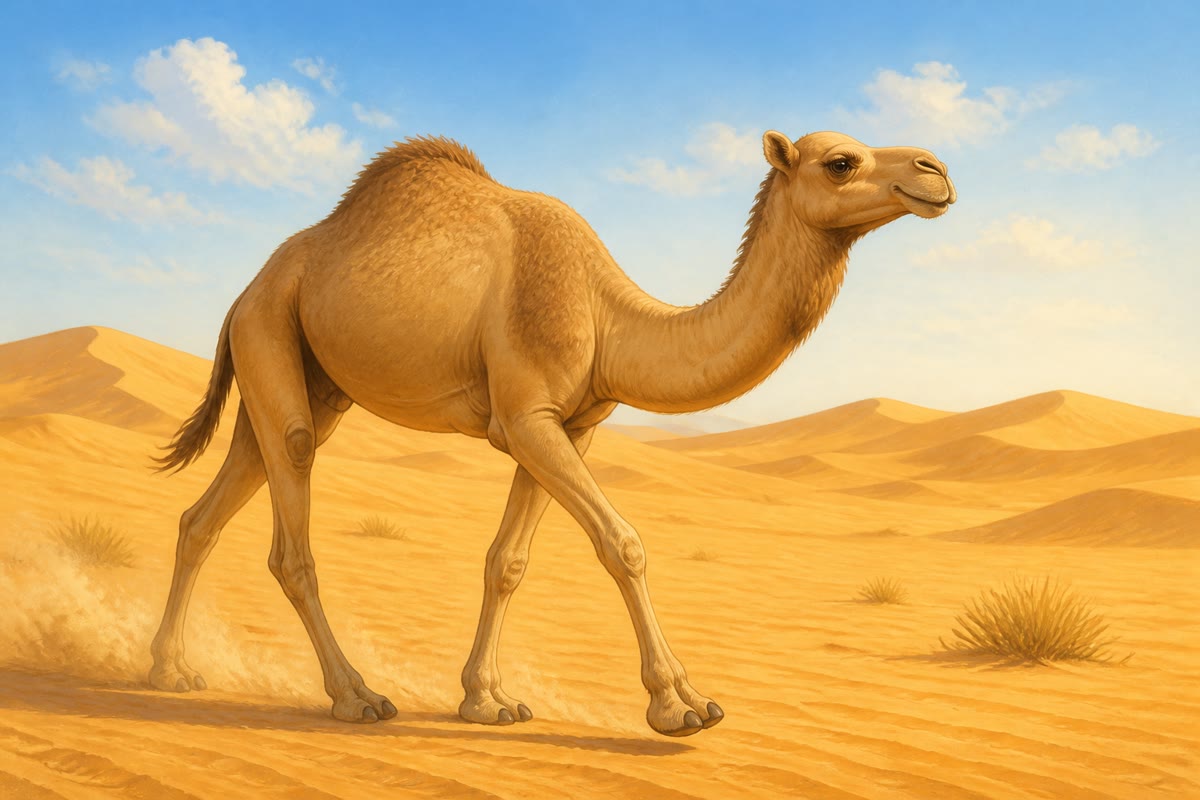
The desert’s problems: heat, no water, soft sand. The camel’s answers: humps of fat — a food store for lean crossings; the ability to drink a hundred litres in minutes and then go days without; wide two-toed feet that do not sink in sand; nostrils that close against blowing dust and long double eyelashes to match. Every desert problem, met by a feature.
Example 28.3 (The polar bear, piece by piece)
The pack ice’s problems: cold, icy water, prey that is hard to approach on white ice. The bear’s answers: thick fur over a deep layer of fat — double insulation; broad, slightly webbed paws — snowshoes and paddles in one; white coat — invisible against the snow it hunts on. The same exactness, tuned to the opposite world.
Proposition 28.4 (Adaptations answer problems)
Wherever the environment sets a hard problem, the living things at home there carry features answering it:
- cold: thick fur, fat layers, small ears that lose little warmth;
- drought: water storage, waxy skins, deep roots;
- life in water: streamlined bodies, fins and webbed feet, water-shedding coats;
- hunters all around: camouflage colors, armor, spines, speed, and eyes set wide to watch all round;
- hunting for a living: sharp senses, forward eyes, claws and speed (Proposition 10.4).
Proof. Admitted at this level. ∎
28.2 Plants are adapted too
Example 28.5 (The cactus)
The desert tests plants hardest — they cannot walk to water. The cactus answers: a thick, barrel-shaped stem that stores water and does the leaves’ light-catching work; leaves shrunk to spines, losing almost no water — and defending the barrel against thirsty animals; roots spread wide and shallow to catch a whole rare shower at once.
Example 28.6 (Alpine cushions)
High mountain plants face freezing wind. Many grow as tight, ground-hugging cushions: inside the cushion, the wind is broken and the air stays milder — a shape that is shelter. Lowland cousins of the same plants grow tall and loose; the mountain forms hug the rock.
Method 28.7 (Reading an organism’s world from its body)
Given an unfamiliar animal or plant:
- list its striking features — coat, feet, eyes, body shape, leaves, roots;
- for each, ask: what problem would this solve?
- assemble the answers into a picture of its home — cold or hot, wet or dry, hunter or hunted;
- check the guess against where the organism really lives.
This is Method 11.6 grown up: from matching a habitat to reconstructing a world.
Example 28.8 (The method on a mystery skin)
A museum drawer holds an unlabelled skin: dense soft fur, tiny eyes, huge shovel-shaped front claws. Fur says mammal; the shovels say digging; the useless eyes say life in the dark. Verdict: an underground digger — and indeed it is a mole (Example 11.5), read correctly from three features alone.
Remark 28.9 (How does the fit come about?)
A camel never decides to grow wide feet, and no polar bear chooses its white coat. How, then, do living things come to fit their worlds so well? It is one of biology’s deepest questions, and its full answer — how the fit builds up, generation after generation — is a story this book keeps for a later year. For now, learn to see the fit: the seeing is what made the question askable.
28.3 Exercises
Exercise 28.1 ★
What is an adaptation? Give one animal example and one plant example.
Solution
Solution of Exercise 28.1.
A feature of body or behavior that fits a living thing to its environment’s conditions. Animal: the polar bear’s double insulation of fur and fat. Plant: the cactus’s water-storing stem.
Exercise 28.2 ★
Name three desert problems and the camel’s answer to each.
Solution
Solution of Exercise 28.2.
No water: drinking a hundred litres at once and lasting days without, plus the humps’ fat store. Soft sand: wide two-toed feet. Blowing dust: closable nostrils and long double eyelashes. (Heat and hunger: the humps again — fat for lean crossings.)
Exercise 28.3 ★
Name three pack-ice problems and the polar bear’s answer to each.
Solution
Solution of Exercise 28.3.
Cold: thick fur over a deep fat layer. Icy water and snow: broad, slightly webbed paws — snowshoes and paddles. Wary prey on white ice: the camouflage of a white coat.
Exercise 28.4 ★
What jobs do the cactus’s spines do? What does its barrel stem store, and what work has the stem taken over?
Exercise 28.5 ★
Why do many high-mountain plants grow as tight cushions?
Solution
Solution of Exercise 28.5.
The cushion shape breaks the freezing wind: inside it the air stays milder. The shape itself is the shelter.
Exercise 28.6 ★
Give two adaptations of hunted animals and two of hunters, from Proposition 28.4.
Exercise 28.7 ★
Retell Example 28.8: which three features gave the mole away, and what did each one say?
Exercise 28.8 ★
Try it: pick any animal you can watch — a duck, a cat, a spider — and run Method 28.7 on it: three features, three problems solved.
Solution
Solution of Exercise 28.8.
Open answer. Example for the duck: webbed feet (paddling), water-shedding feathers (staying dry and warm afloat), flat sifting beak (feeding from water).
Exercise 28.9 ★★
The desert fox has enormous ears; the arctic fox, tiny ones. Using the cold line of Proposition 28.4, explain both — what must big ears do with warmth?
Exercise 28.10 ★★
A mystery animal: streamlined body, webbed hind feet, dense water-shedding fur, whiskers, and it holds its breath well. Reconstruct its world with Method 28.7. (It builds dams.)
Solution
Solution of Exercise 28.10.
Streamlining, webbed feet and breath-holding say: a swimmer and diver; dense water-shedding fur says: a mammal living half in cold water; whiskers say: feeling its way in dark or murky water. A water-dwelling, dam-building mammal of rivers and lakes — the beaver.
Exercise 28.11 ★★★
The whale (Example 14.5) is a mammal shaped like a fish: streamlined, finned, smooth. The trout is a fish shaped the same way. What does this resemblance between two unrelated swimmers show about adaptations — who set the shape, the family or the water?
Solution
Solution of Exercise 28.11.
The water set it. Whale and trout inherited nothing swimming-shaped from a shared family — one is a mammal, the other a fish — yet the same problem, moving fast through water, favors the same streamlined answer in both. Adaptations answer the environment’s problems; similar problems can draw similar shapes from very different families.