Primary & Middle School Biology · Grades 1–9
31From Flower to Fruit
Chapter 16 watched the cherry blossom become a cherry and left one question open: what actually happens when a grain of pollen lands on the pistil? This year, armed with Chapter 23’s idea of fertilization and Chapter 29’s cells, we can open the flower’s machinery properly.
31.1 Flowers have male and female parts
Proposition 31.1 (The flower’s two roles in one)
Reproduction in flowering plants is sexual reproduction, exactly in Definition 23.1’s sense — and most flowers carry both roles at once:
- the stamens are the male part: each grain of pollen carries the plant’s male reproductive cells;
- the pistil is the female part: deep inside it lie the ovules, each holding an egg cell.
The “future seeds” of Definition 16.1 now have their real name: ovules, waiting to be fertilized.
Proof. Admitted at this level. ∎
Remark 31.2 (Same plan as the animals)
Male cells, egg cells, fertilization: the vocabulary of Chapter 23 translates word for word. The unity of life again (Proposition 29.2) — daisies and dolphins reproduce on one underlying plan, however different the machinery looks.
31.2 Pollination, then fertilization
Definition 31.3 (The two steps)
Making a seed takes two distinct steps:
- pollination: a pollen grain travels from a stamen to the top of a pistil — carried by an insect (Proposition 16.3) or by the wind;
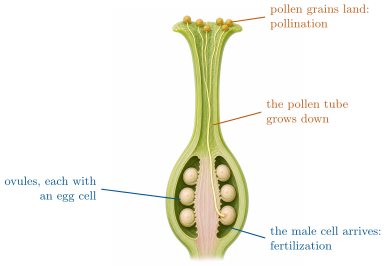
- fertilization: the landed grain grows a fine tube down through the pistil; through it, the male cell reaches an ovule and joins its egg cell.
Pollination is the journey; fertilization is the meeting.
Example 31.4 (Why unvisited flowers fall)
Remark 16.5’s orchard rule now has its mechanism: no visit, no pollen on the pistil; no pollen, no tube, no fertilization; and an unfertilized flower withers whole — no swelling pistil, no cherry. The missing step was invisible, a cell’s journey down a tube — but the empty branch in July is visible enough.
31.3 After the meeting: seed and fruit
Proposition 31.5 (What each part becomes)
After fertilization, the transformation of Proposition 16.3 runs with new precision:
- each fertilized ovule becomes a seed — the tiny plant inside it (Definition 9.1) grows from the fertilized egg cell, exactly as an animal grows from its own (Example 29.8);
- the pistil around them swells into the fruit;
- petals and stamens, their work done, wither and fall.
Proof. Admitted at this level. ∎
Example 31.6 (Counting pips)
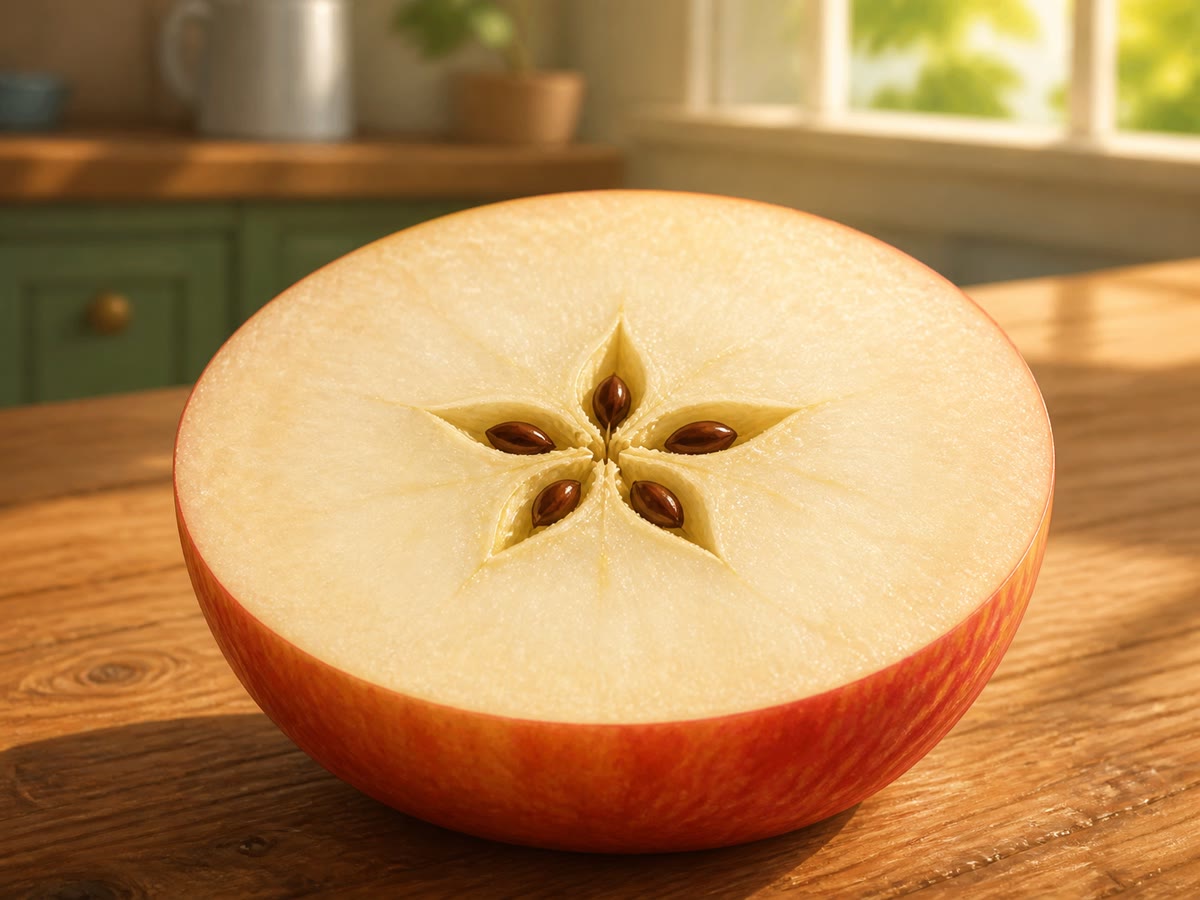
Cut an apple across: five little chambers, a few pips in each. Every pip is one ovule that was reached by one pollen tube. A lopsided apple with empty chambers on one side tells of a poorly pollinated flower — too few grains landed to fertilize all the ovules, and the fruit swelled unevenly.
Example 31.7 (Wind-borne pollen)
Grasses, wheat and hazel trees have no petals, no scent, no nectar — nothing to offer visitors. Their pollen rides the wind: made in enormous quantities, dust-fine, thrown into the air to land where luck takes it. The strategy trades precision for quantity — the spore-cloud logic of Remark 24.4, played with pollen. (It is that airborne pollen, in passing, that tickles hay-fever noses in June.)
Method 31.8 (Diagnosing a fruitless plant)
A plant flowered well but bears no fruit. Ask in order:
- Did pollinators reach it? (Indoors, netted, no insects about, cold rainy flowering weeks?)
- If not, pollinate by hand: touch a soft brush to the stamens of one flower, then to the pistil of another;
- did frost or damage kill the flowers before the ovules could be fertilized (Exercise 16.9)?
- If fruit now sets, the plant’s machinery was sound — only the journey of step 1 had failed.
31.4 Exercises
Exercise 31.1 ★
Which part of the flower is male, and what does it make? Which is female, and what lies inside it?
Exercise 31.2 ★
Define pollination and fertilization, and say which comes first.
Solution
Solution of Exercise 31.2.
Pollination: a pollen grain travels from a stamen to the top of a pistil. Fertilization: the grain’s tube carries the male cell down to an ovule, where it joins the egg cell. Pollination comes first — the journey before the meeting.
Exercise 31.3 ★
Tell the journey of one pollen grain, from stamen to egg cell, in four steps.
Solution
Solution of Exercise 31.3.
Made in a stamen; carried (by insect or wind) to the top of a pistil — pollination; grows a fine tube down through the pistil; its male cell reaches an ovule and joins the egg cell — fertilization.
Exercise 31.4 ★
After fertilization: what does each fertilized ovule become? What does the pistil become? What happens to the petals?
Exercise 31.5 ★
What is each apple pip, in this chapter’s vocabulary? What does a lopsided apple with empty chambers tell?
Exercise 31.6 ★
How do grasses and hazels pollinate without petals, scent or nectar? What is the cost of their method?
Solution
Solution of Exercise 31.6.
Their pollen rides the wind: dust-fine, made in enormous quantities, thrown into the air. The cost is waste — almost every grain lands nowhere useful, so quantity must replace precision.
Exercise 31.7 ★
Why does a flower that no insect visited usually make no fruit? Name the missing step.
Solution
Solution of Exercise 31.7.
No visit, no pollen on the pistil — pollination, the first step, never happened, so no tube grew and no ovule was fertilized; the flower withers whole.
Exercise 31.8 ★
Try it (with a flowering balcony or windowsill plant): pollinate two flowers by hand with a soft brush, as in Method 31.8, and mark them with thread. Do the marked flowers set fruit more often than the others?
Exercise 31.9 ★★
List the parallels between plant and animal reproduction: male cells, egg cells, fertilization, the new individual’s first cell. Where does each item live, in the flower’s case?
Solution
Solution of Exercise 31.9.
Male cells: in the pollen grains of the stamens. Egg cells: in the ovules inside the pistil. Fertilization: at the bottom of the pollen tube, in the ovule. First cell of the new individual: the fertilized egg cell in the ovule — which grows into the tiny plant of the seed, as an animal grows from its own first cell.
Exercise 31.10 ★★
A cherry grower’s spring was cold and rainy: bees barely flew for two weeks, though no frost came and the trees blossomed magnificently. Predict July’s harvest and explain it with Definition 31.3.
Solution
Solution of Exercise 31.10.
A poor harvest — most blossoms fell fruitless. The machinery was sound and the flowers unhurt; what failed was step 1, pollination: for two crucial weeks the couriers stayed home, so most pistils never received pollen and most ovules were never fertilized.
Exercise 31.11 ★★★
A greenhouse tomato grower installs a hive of bumblebees indoors, though no flower outside can be reached from the sealed greenhouse. Using this chapter, explain exactly what service the bumblebees sell — and why fans blowing air across the plants can partly replace them for tomatoes (whose pollen shakes loose), while for cherry trees they could not.
Solution
Solution of Exercise 31.11.
The bumblebees sell pollination — the transport step: carrying pollen from stamens to pistils inside a building no outdoor pollinator can enter. Tomato pollen shakes loose easily, so a fan’s vibration and moving air can do crude transport within each flower — a mechanical courier. Cherry pollen must travel from tree to tree, flower to flower, with a precision only a body that visits blossoms in turn provides; wind in a hall cannot aim, so for cherries the living courier has no cheap substitute.