Primary & Middle School Biology · Grades 1–9
55Reproduction and the Environment
Why does the frog chorus start in May and not November? Why does a good beech year fill the woods with seedlings, and a cold wet June empty next spring’s pond of froglets? The last chapter built the mechanism of the next generation; this one plugs it into the world: reproduction is timed, provisioned — and limited — by the environment.
55.1 Timed by the seasons
Proposition 55.1 (Breeding follows the calendar of plenty)
Species time their reproduction so the young arrive when conditions and food will serve them (Proposition 38.1):
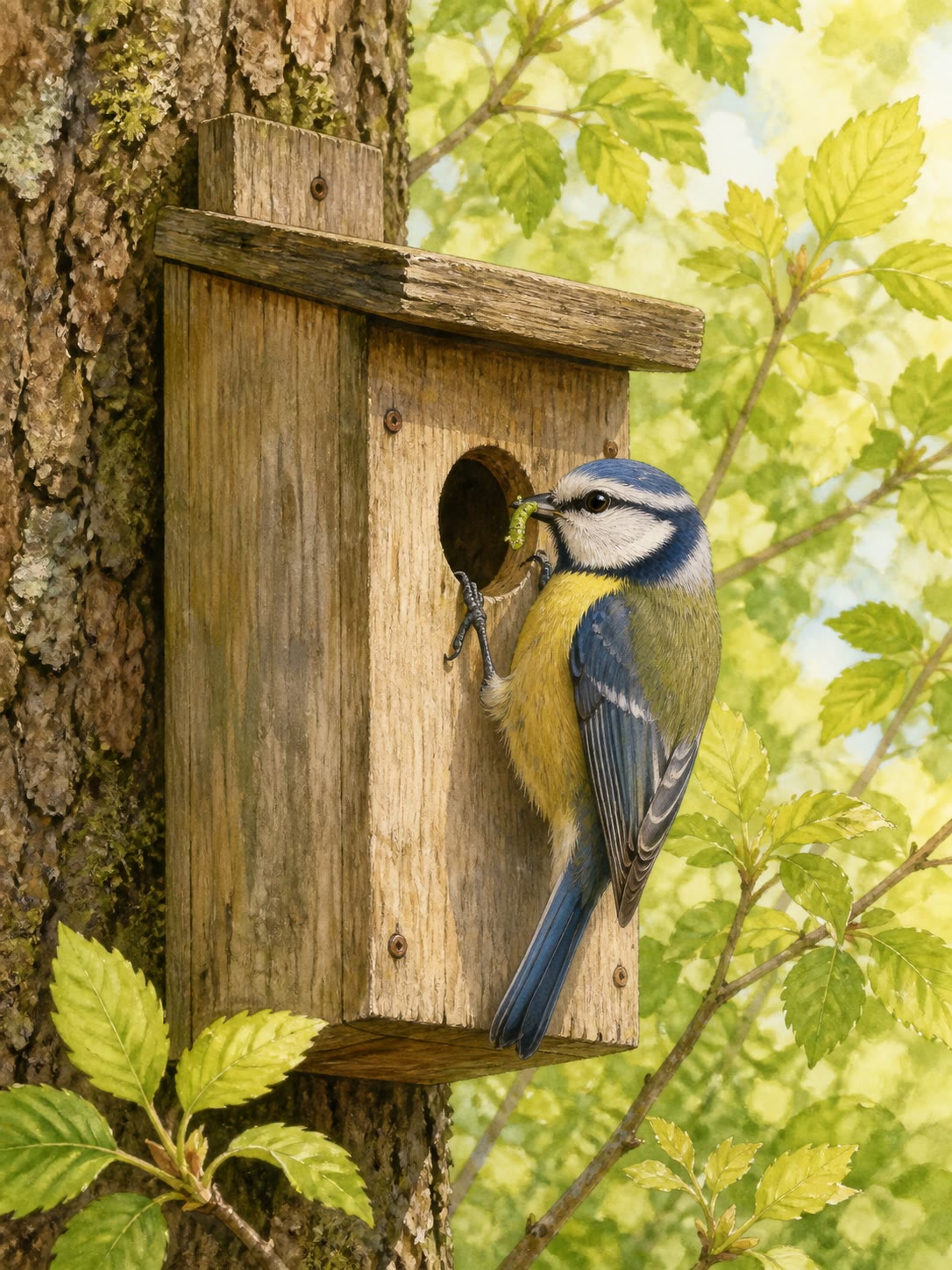
- the blue tit lays so its chicks hatch at the spring caterpillar peak (Example 19.4’s oak chain, timed to the day);
- the frog spawns in the warming pond, giving tadpoles a summer of growth before winter;
- plants flower to their pollinators’ season and ripen seed to the dispersal calendar (Problem 38.1);
- the stag’s autumn bellow sets births for the next spring — the gestation counted in.
The cues that start the machinery are the environment’s own signals: lengthening days above all, warmth, rain.
Proof. Admitted at this level. ∎

Example 55.2 (The indoor lambs)
Sheep breeders exploit the cue directly: ewes come into breeding condition as days shorten; kept under artificial long-then-shortened light, a flock can be brought to lamb for the profitable early market. The machinery reads light, not calendars — change the light and the calendar follows. A cue known is a lever.
55.2 Provisioned by the habitat
Proposition 55.3 (Reproduction is paid for in matter)
Eggs, milk, nectar, seeds and antlers are all production in Definition 41.4’s sense — organic matter the parents must first acquire. So the habitat’s richness sets the budget:
- a well-fed hen lays daily; a starved one stops — the ledger of Problem 41.1 balancing on the egg line;
- the beech fruits massively only in “mast years” following good growing seasons — seed crops are banked summers (Example 40.7);
- hard years thin the clutch: many birds lay fewer eggs, or none, when prey is short.
Proof. Admitted at this level. ∎
Example 55.4 (Counting the tits’ clutch)
Nest-box studies show blue tit clutches tracking the caterpillar supply: rich oak woods, ten or more eggs; poor gardens, six or seven. The bird does not decide this with a ledger — her body’s condition, built from the habitat’s food, sets what she can provision. Clutch size is habitat quality, written in eggs.
55.3 Limited by the world: populations
Definition 55.5 (Population)
A population is all the individuals of one species living in one place — the pond’s frogs, the wood’s beeches. Reproduction adds to it; deaths and departures subtract; the environment sets the ceiling.
Proposition 55.6 (Why populations do not explode)
Every species over-produces — thousands of eggs per frog pair, thousands of seeds per beech (Proposition 23.7) — yet ponds are not solid with frogs. The surplus is spent against the environment’s checks:
- predation — the herons and dragonfly larvae of Example 23.8;
- food and space — only so many caterpillars, nest holes, patches of light on the forest floor;
- conditions — late frost on the blossom (Exercise 16.9), drought on the tadpoles’ shrinking pond.
On average, in a steady habitat, each pair replaces itself — the balance of Proposition 34.6, seen from the parents’ side.
Proof. Admitted at this level. ∎
Example 55.7 (Two springs at the pond)
Spring 1, mild and wet: high water, early insects — thousands of eggs, hundreds of froglets, the population climbs. Spring 2, a drought: the pond shrinks to a puddle, tadpoles crowd, oxygen falls (Proposition 48.3), herons feast on the concentrated shoal — a handful of froglets. Same frogs, same mechanism, two verdicts: the environment countersigns every generation.
Remark 55.8 (Humans move the checks)
Most human effects on wildlife run through these checks, not through the core mechanism: drained ponds and grubbed hedges remove breeding habitat (Proposition 11.7); pesticides empty the caterpillar peak the tits timed for; garden nest boxes and the restored wet meadows of Example 30.10 add ceiling back. Protecting a species in practice means protecting the environment its reproduction is plugged into — cue, budget and checks together.
Method 55.9 (Auditing a population change)
When a population rises or falls, audit in order:
- timing: did the cue and the resource peak still coincide? (a too-early spring can strand the chicks after the caterpillars);
- budget: what did the season’s habitat let parents provision?
- checks: which changed — predators, food, space, conditions?
- habitat: was breeding ground itself gained or lost?
55.4 Exercises
Exercise 55.1 ★
Why does the blue tit lay when it does? Name the rule and the cue.
Solution
Solution of Exercise 55.1.
The rule: young must arrive when food and conditions serve them — for tit chicks, the spring caterpillar peak on the oaks. The cue that starts her machinery: the lengthening days.
Exercise 55.2 ★
What does the stag’s autumn timing achieve, and what must be counted in?
Exercise 55.3 ★
Why is reproduction “paid in matter”? Give three payments from Proposition 55.3.
Solution
Solution of Exercise 55.3.
Because every egg, seed and drop of milk is organic matter the parents must first acquire and rebuild (Definition 41.4). Payments: the hen’s daily egg, the beech’s mast-year seed crop, the doe’s milk (or the stag’s regrown antlers).
Exercise 55.4 ★
What is a population? What adds, what subtracts, what sets the ceiling?
Solution
Solution of Exercise 55.4.
All the individuals of one species in one place. Reproduction (and arrivals) add; deaths and departures subtract; the environment’s food, space, predators and conditions set the ceiling.
Exercise 55.5 ★
Name the three checks that spend the frogs’ surplus.
Solution
Solution of Exercise 55.5.
Predation (herons, dragonfly larvae); food and space (only so much to eat, so many places); conditions (frost, drought, the shrinking pond).
Exercise 55.6 ★
What does a ten-egg against a six-egg tit clutch report, and about what?
Solution
Solution of Exercise 55.6.
Habitat quality, written in eggs: a rich caterpillar habitat builds a hen that can provision ten; a poor one, six or seven.
Exercise 55.7 ★★
Explain the sheep breeders’ light trick, and what it proves about cues.
Solution
Solution of Exercise 55.7.
Ewes’ breeding machinery is started by shortening days; artificial lighting replays that signal on the breeder’s schedule, and the flock lambs early. It proves the timing is read from the cue itself — change the light, and the “calendar” obeys.
Exercise 55.8 ★★
Retell Example 55.7 as Method 55.9’s four questions, answered for spring 2.
Solution
Solution of Exercise 55.8.
Timing: cue and spawning were normal — no mismatch. Budget: parents provisioned normally — thousands of eggs. Checks: all three tightened — the drought shrank space and oxygen, crowding starved, herons concentrated their hunting. Habitat: the breeding pond itself nearly vanished — the decisive line.
Exercise 55.9 ★★
A warming climate brings oak caterpillars two weeks earlier, but the tits’ day-length cue is unchanged. Predict the mismatch and its audit line.
Solution
Solution of Exercise 55.9.
The chicks hatch to a feast already over: caterpillars peaked while the day-length cue still said “wait”. Fledging falls though weather, budget and predators are kind — the audit’s timing line fails: cue and resource peak no longer coincide.
Exercise 55.10 ★★
“The codfish’s millions are not wasted — they are spent.” Defend the sentence with Proposition 55.6.
Solution
Solution of Exercise 55.10.
The millions are the strategy: each egg is a stake played against predation, hunger and conditions, and the checks collect almost all of them — that is the plan, not its failure. On average the survivors replace the parents; the spending is how an uncaring strategy buys its few winners (Exercise 23.7 said it first).
Exercise 55.11 ★★
Which check does each human action move: draining a marsh; hanging nest boxes; spraying the orchard against caterpillars in May; restoring a wet meadow?
Solution
Solution of Exercise 55.11.
Draining a marsh: removes breeding habitat — the habitat line. Nest boxes: add space — easing that check. May spraying: empties the food peak — the food check, at the worst moment. Restoring a wet meadow: returns habitat and food together (Example 30.10).
Exercise 55.12 ★★★
Connect three chapters in one paragraph: the strategy line (Proposition 23.7), the pyramid’s losses (Example 41.7), and this chapter’s checks — as one account of why the pond is not solid with frogs.
Solution
Solution of Exercise 55.12.
The frog sits at the many-and-uncared end of the strategy line: thousands of cheap eggs, no guarding. The pyramid’s arithmetic guarantees most tadpole-matter must feed the pond’s consumers rather than become frog — each floor passes on only a fraction. And the checks are where that arithmetic is enforced: predation, food, space and conditions collect the surplus each season, leaving on average a pair to replace a pair. The pond is not solid with frogs because the strategy plans for losses, the pyramid prices them, and the checks collect them.
55.5 Problem: The Nest-Box Ledger
Problem 55.1
Weekend problem — ten years of blue tits, audited box by box
A school monitors twenty nest boxes for ten years: laying dates, clutch sizes, fledglings per box — beside the weather log and the groundskeeper’s diary.
Part I — Reading the normal years.
- Years 1–4: laying in late April, clutches of eight to ten, most eggs fledging. Name the cue that sets late April, and the peak the timing aims at.
- Year 3’s clutches ran a egg or two larger after a warm caterpillar-rich May in year 2 — the parents wintered well. Which proposition does the correlation illustrate?
- Even in good years, about a fifth of eggs never fledge. List the checks likely responsible, from Proposition 55.6.
- Why does the school log weather and grounds work beside the eggs? (Answer with the audit’s four questions.)
Part II — The anomalies.
- Year 5: a freak warm March brought caterpillars out two weeks early; laying dates barely moved. Predict year 5’s fledging, and name the failure line of the audit.
- Year 6: the groundskeeper’s diary records the old oaks’ dead limbs removed and the meadow strip mowed monthly. Fledging drops although the weather was kind. Which audit lines does the diary implicate?
- Year 7: a sparrowhawk pair settles. Clutches are unchanged, but fledgling counts dip. Which check moved, and why did the clutch line not move with it?
- Year 8: boxes doubled to forty; total fledglings rise, but per-box success holds steady. What ceiling did the new boxes raise, and which did they leave untouched?
Part III — The report.
- Write the ten-year summary sentence linking clutch size to habitat quality, citing Example 55.4.
- The town proposes felling the oak row for a car park, “compensating” with fifty more nest boxes. Audit the offer: which of cue, budget, checks and habitat do boxes replace, and which only the oaks provide?
- Recommend two grounds measures for year 11, each tied to its audit line.
- Close with the chapter’s moral in one sentence: what, besides two parents, does every fledgling need?
Solution
Solution of Problem 55.1.
1. The lengthening days of spring cue the laying; the timing aims the hungry chicks at the oaks’ caterpillar peak.
2. Proposition 55.3: reproduction is provisioned from the habitat — parents built by a rich season provision larger clutches after it.
3. Predation on eggs and chicks; food shortfalls in cold snaps; conditions — a wet chilling week in the nest; (space is what the boxes themselves supply).
4. Because eggs alone explain nothing: the audit needs the cue-and-peak timing (weather log), the budget (what the season offered), the checks and the habitat (the grounds work). The ledger is only readable beside its context columns.
5. Fledging falls: chicks hatch after the early peak has passed — the timing line: cue unchanged, resource moved, coincidence broken.
6. Budget and checks through habitat: dead limbs held the insects and natural holes, the monthly-mown strip fed no caterpillars or spiders — food check tightened and habitat impoverished, kind weather notwithstanding.
7. Predation. The clutch was provisioned before the hawk’s toll falls — the hen’s budget set it; the hawk collects later, on fledglings. Different lines of the ledger, different collectors.
8. The nest-space check — more breeding places, so more total pairs. Untouched: the food ceiling per territory, which is why each box’s own success held rather than rose.
9. “Ten years of clutches tracked the grounds: rich caterpillar years and untidy oaks filled the boxes with eight to ten eggs, poor and tidied years with six — clutch size is habitat quality, written in eggs.”
10. Boxes replace only nest space. The oaks are cue-target and budget at once — the caterpillar peak the timing aims at and the food that provisions clutch and chicks — and a check-easer besides (their limbs’ natural larder). Fifty boxes on a car park are shelves in an emptied pantry.
11. Leave the meadow strip unmown through spring — restocking the food budget; keep (or replace) dead limbs and old oaks — preserving the habitat and the peak the whole calendar aims at.
12. A habitat: the cue at the right time, the food to pay for it, and checks mild enough to leave, on average, a pair to replace a pair.