Primary & Middle School Biology · Grades 1–9
18A Balanced Diet
A builder’s site needs bricks, cement, planks — and fuel for the machines. Your body is a building site that never closes: it grows, repairs itself and runs about all day. Its deliveries arrive three or four times a day, on a plate. What must the deliveries contain? That is the question of diet.
18.1 Why the body needs food
Proposition 18.1 (Food’s two jobs)
Food does two different jobs:
- it provides energy — the power to move, to keep warm, to keep heart and brain running, even during sleep;
- it provides building material — what the body uses to grow taller, build muscle and bone, repair scrapes and replace worn parts.
A diet must deliver both, every day.
Proof. Admitted at this level. ∎
Example 18.2 (Fuel even at rest)
Even lying perfectly still you spend energy: the heart beats, the chest rises and falls, the body stays warm at about whatever the weather. That standing charge is why missing meals makes you weak and cold, not just hungry.
18.2 The food families
Definition 18.3 (The food families)
Foods are sorted into food families by what they bring:
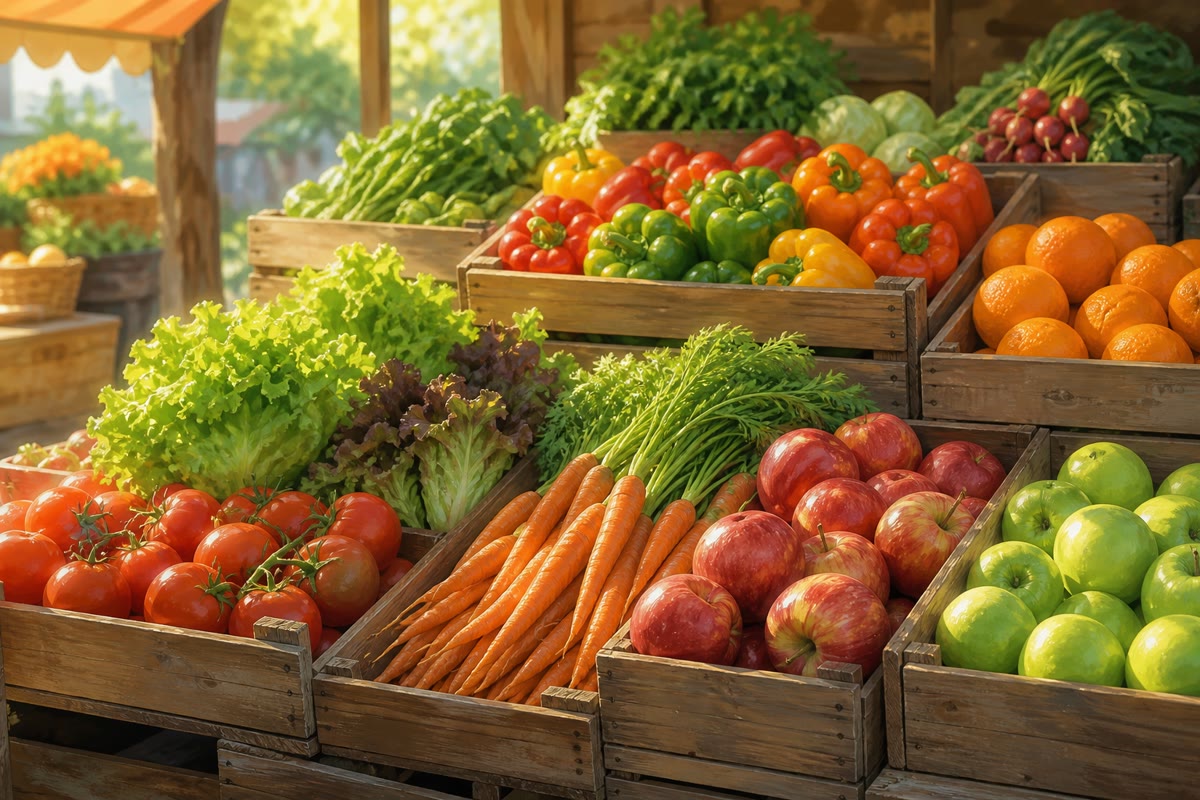
- fruit and vegetables — vitamins, fibre and water; the freshness family;
- cereals and starchy foods (bread, pasta, rice, potatoes) — the steady energy family;
- dairy (milk, yogurt, cheese) — the bone-building family;
- meat, fish and eggs — the body-building family;
- fats (butter, oil) — concentrated energy, needed in small amounts;
- sugary foods — quick pleasure, needed not at all: the treat family;
- and water — the only drink the body requires, all day long.
Example 18.4 (Balancing a lunch)
Pasta with tomato sauce, a piece of fish, green beans, a yogurt, an apple, water: every family present, treats absent — a balanced lunch. Chips, a soda and a chocolate bar feed exactly two families (fats and sugar) and skip the ones the building site was waiting for.
Remark 18.5 (No forbidden foods, only forgotten ones)
Balance is measured over days, not single bites. A slice of birthday cake breaks no rule — the trouble is never one treat, it is treats instead of the families, day after day. The practical question at each meal is not “is this food bad?” but “which family have I forgotten today?”
18.3 Matching food to the day
Proposition 18.6 (Needs change with the day and the person)
How much energy a body needs depends on who it is and what it does: a growing child needs proportionally more building material than a grown-up; a day of sport or winter cold burns more energy than an afternoon of reading. Hunger grows with the body’s spending.
Proof. Admitted at this level. ∎
Example 18.7 (Why breakfast matters)
By morning, the body has run all night — heart, breath, warmth — on no deliveries at all. Breakfast restocks it for the morning’s lessons and running about. Skip it, and by mid-morning the site runs short: rumbling stomach, wandering attention, no strength at play.
Method 18.8 (Checking a day’s balance)
At the end of the day, run through the list:
- fruit or vegetables at every meal? (aim: about five helpings in the day)
- starchy food at each meal for steady energy?
- builders present — dairy a few times, and meat, fish or eggs once or twice?
- water as the day’s drink?
- treats: a small amount, not a main part?
Whatever family is missing, invite it tomorrow.
18.4 Exercises
Exercise 18.1 ★
What are food’s two jobs? Give one food family that mainly serves each job.
Exercise 18.2 ★
Name the food families, and the one drink the body requires.
Exercise 18.3 ★
Sort this shopping into families: rice, yogurt, carrots, eggs, butter, apples, bread.
Exercise 18.4 ★
Why does the body spend energy even during sleep? Name two of the night’s expenses.
Solution
Solution of Exercise 18.4.
Because the body never stops: the heart beats all night, the chest keeps breathing, and the body stays warm at about — all paid for in energy.
Exercise 18.5 ★
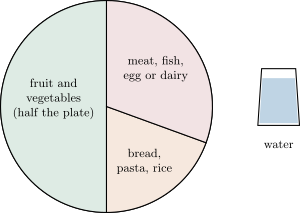
Check the lunch “pasta, fish, green beans, yogurt, apple, water” against the balanced plate of the figure: which part of the plate is each item?
Solution
Solution of Exercise 18.5.
Green beans and the apple: the freshness half. Pasta: the starchy quarter. Fish and the yogurt: the builders’ quarter. Water: the glass. Every part of the plate is served.
Exercise 18.6 ★
Why is breakfast especially important? What happens mid-morning without it?
Solution
Solution of Exercise 18.6.
The body has run all night on no deliveries; breakfast restocks it. Without it, by mid-morning energy runs short: rumbling stomach, wandering attention, weak play.
Exercise 18.7 ★
Who needs proportionally more building material: a child or a grown-up? Why?
Solution
Solution of Exercise 18.7.
The child — a child’s body is still building itself taller and bigger, on top of repairing and running, so building material matters proportionally more.
Exercise 18.8 ★
Try it: run Method 18.8 on your own day, honestly. Which family did you forget — and which appeared more than its share?
Solution
Solution of Exercise 18.8.
Open answer. The commonly forgotten family is fruit and vegetables; the one over its share, sugary foods.
Exercise 18.9 ★★
“Sweets are forbidden!” Is that what this chapter says? Give the more precise rule of Remark 18.5.
Solution
Solution of Exercise 18.9.
No food is forbidden: balance is judged over days, not bites. The rule is that treats must stay small and must not take the place of the families — the question is “which family have I forgotten?”, not “which food is bad?”.
Exercise 18.10 ★★
On a ski holiday, everyone is hungrier than at home. Explain with Proposition 18.6 — name the two extra expenses a cold, sporty day adds.